Plus the Real Story of How One Self-Employed Buyer Bought Their Dream Home on 10 Acres
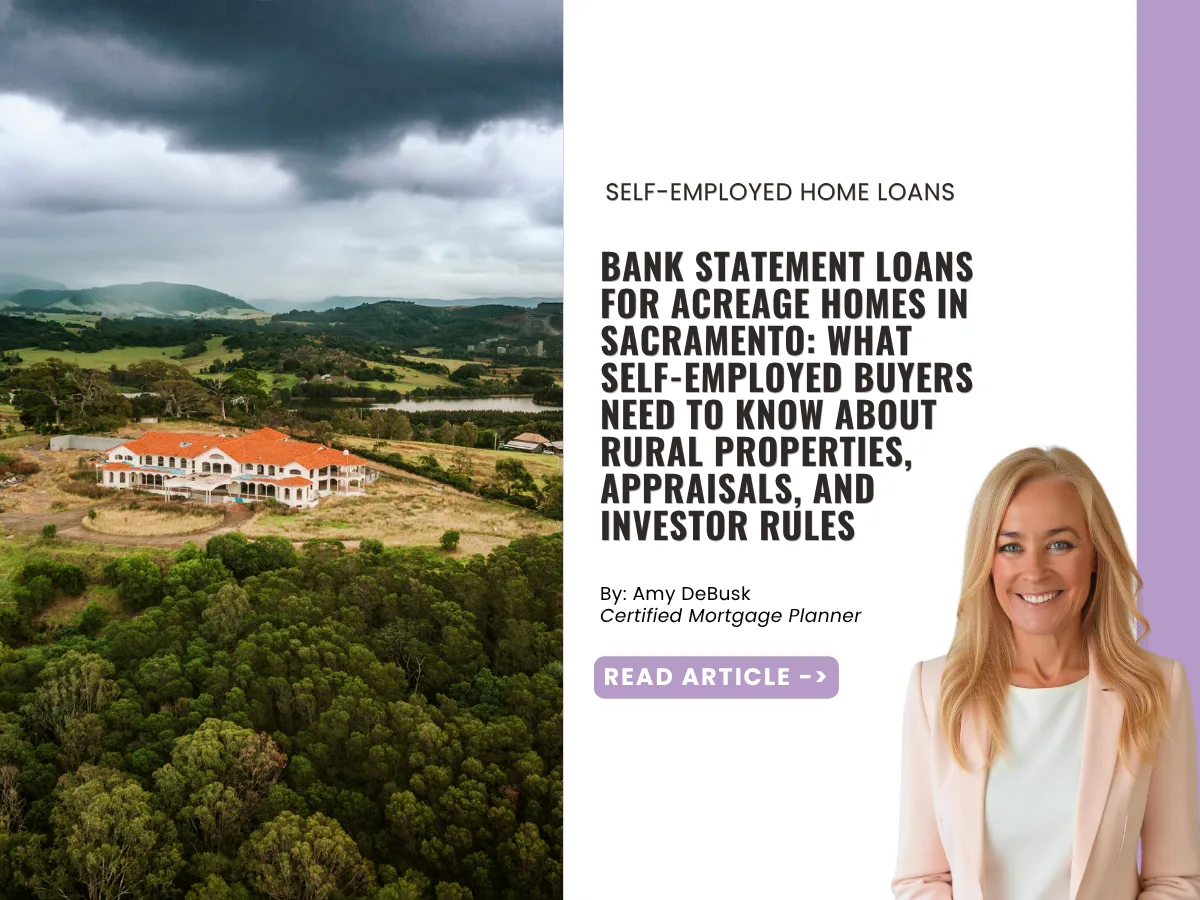
Buying a home with land is a dream that lives deep in the heart of so many self employed buyers. There is something powerful about imagining yourself driving up a long private driveway, listening to the quiet, feeling the trees around you, and finally having the space your life has been expanding toward.
In the Sacramento Valley and Placer County, that dream has become even more popular. Buyers want space. They want peace. They want room for their families, their hobbies, their animals, and their future. And many of these buyers are entrepreneurs, contractors, consultants, creatives, small business owners, and independent professionals. They are the heartbeat of our community. They are the people who do not fit neatly into a W2 box, and they need a mortgage that honors the way they earn income.
That is where bank statement loans come in.
But when you add acreage into the mix, suddenly the rules change.
This blog reveals the nuance behind acreage financing for self employed borrowers, why many lenders decline these properties, and how we help buyers get approved even when the home appears to be rural.
We will also share the real story of our Knoxville, Tennessee client who fell in love with a beautiful home on 10 acres that looked completely rural in photos. They only had 20 percent down, and every lender told them they needed 25 percent because of the acreage. But that wasn't the full truth. When we looked deeper, we discovered a detail that changed everything.
Before we go further, here is space for your video at the top of the blog so readers can watch and then dive in.
Now let's talk about what you really need to know as a self-employed buyer shopping for a home with land in Sacramento.
What Is a Bank Statement Loan and Why Is It a Lifeline for Self-Employed Buyers?
If you are self-employed, you already know the world often misunderstands the way you earn your income. Your tax returns rarely reflect your true cash flow because you are allowed to write off expenses that W2 employees cannot. This means traditional mortgage guidelines often penalize you for being a smart business owner.
A bank statement loan solves that problem.
Instead of reviewing your tax returns, the lender reviews either 12 or 24 months of bank deposits to determine your qualifying income. This allows your approval to be based on the actual inflow of your business or personal accounts, not the net income after deductions.
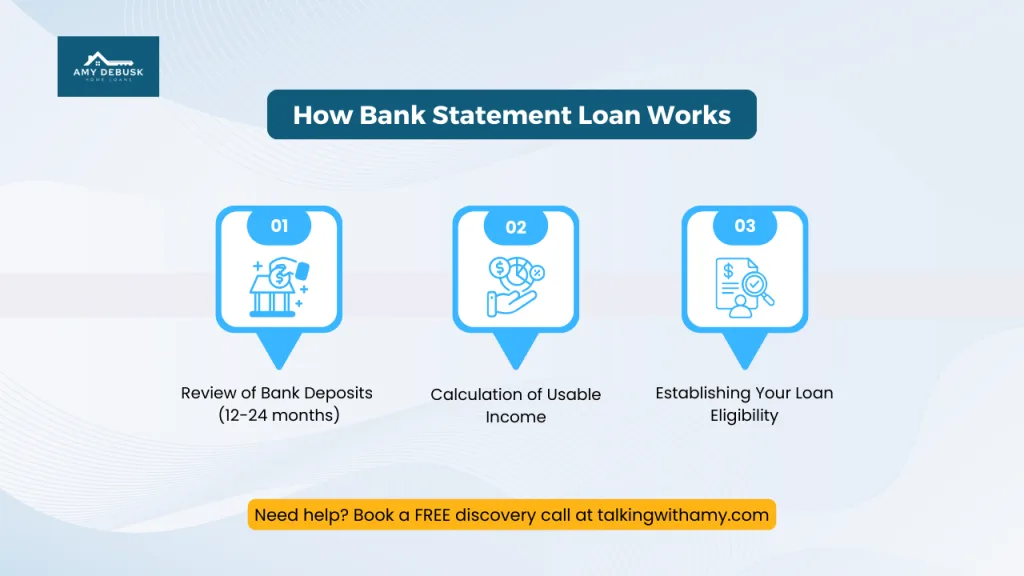
These loans are designed for:
- Entrepreneurs
- Small business owners
- Independent contractors
- 1099 workers
- Ride share drivers
- Real estate agents
- Consultants
- Freelancers
- Beauty, wellness, and service providers
- Anyone with a variable or seasonal income
In California, especially in Sacramento, Roseville, Rocklin, Lincoln, and throughout Placer County, these loans have become an essential tool for self-employed buyers who are ready for homeownership but do not want to pay unnecessary taxes just to qualify for a mortgage.
At Amy DeBusk Home Loans, we have access to multiple investors who specialize in bank statement loans, including one that allows up to 20 acres, which is extremely rare. That access opens doors that many lenders simply cannot.
But acreage comes with its own challenges, and understanding this nuance is the key to getting approved.
The Hidden Challenge With Acreage Homes: Rural Guidelines vs Non-Rural Guidelines
Here is the catch that most self-employed buyers never hear about until it is too late.
Some lenders will not lend on rural properties at all.
Others will lend but tighten their rules dramatically the moment a property is classified as rural. This is because acreage and rural properties carry different risks from the lender's perspective. They behave differently in the market. They often have fewer comparable sales. They are sometimes zoned differently. Utilities may function differently. They may have more outbuildings. There may be land that is not usable. There may be appraiser limitations.
And because of these variables, the guidelines often change.
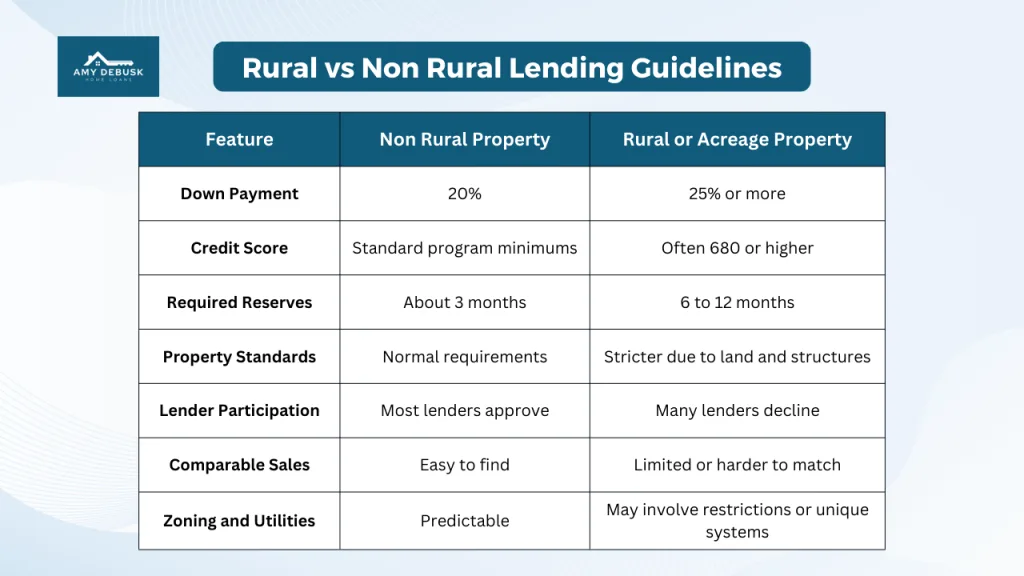
This is usually where the process takes an unexpected turn. A buyer finds a beautiful home on 5, 10 or even 20 acres, and everything seems to be lining up. Their income qualifies, their down payment is read,y and the dream finally feels within reach. Then the property review starts, and the lender's tone suddenly shifts.
A lender may say they do not lend on rural homes or that the down payment must jump to 25% because of the acreage. It feels discouraging and confusing, especially when nothing about the buyer's finances has changed. The frustration comes from thinking the deal is falling apart over something that seems out of your control. But the truth is, it often does not need to end that way.
Many buyers are never told that some properties only appear rural but aren't classified that way. That one detail can completely change the guidelines and open the door back to approval. An experienced lender knows how to look past the surface, understand the zoning and location, and determine whether the home truly requires rural restrictions.
This is why expertise matters so much on acreage loans. You need someone willing to dig deeper instead of giving a quick no. When a lender understands how to position the property correctly, a deal that looked impossible can become fully workable. And that brings us to our Knoxville story.
Our Knoxville Client Story: The Dream Home on 10 Acres That Almost Slipped Away
One of the most meaningful success stories we have ever been a part of involved a self employed buyer shopping for a home near Knoxville, Tennessee. Even though we are headquartered in Roseville, California, we are licensed in multiple states, including Tennessee, and we help self employed buyers across the country.
This client had been searching for months.
They wanted peace.
They wanted land.
They wanted a home where their business, life, and future could grow in a way that felt aligned and expansive.
When they found a beautiful property on 10 acres, it felt like destiny.
But from the very first glance, every lender saw the same thing:
Rural.
Acreage.
Too much land.
And every lender came back with the same answer:
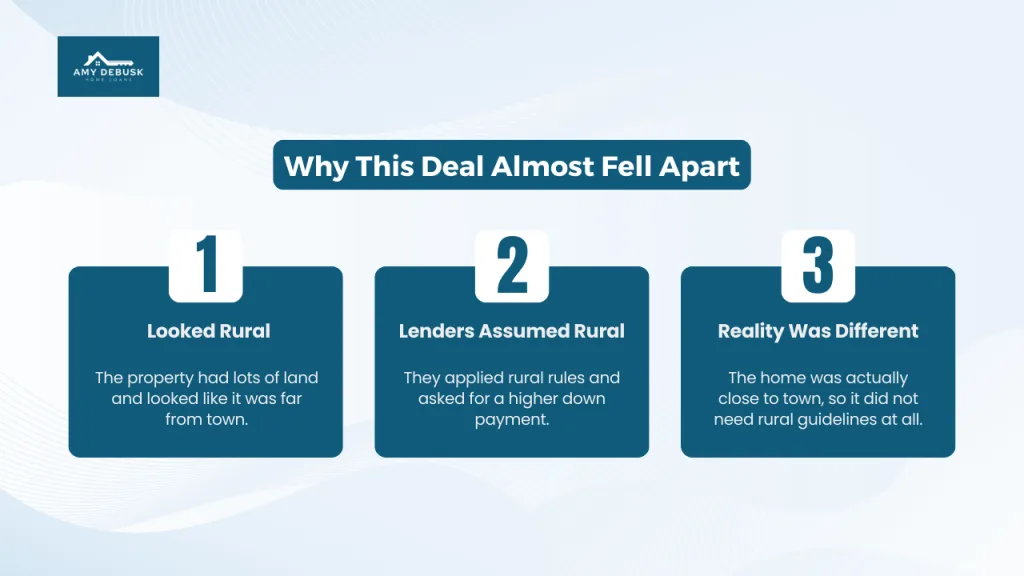
"You need 25 percent down."
This buyer only had 20 percent down, and they were solid, responsible, successful, and ready. Their bank deposits were strong. Their cash flow was consistent. Their credit was good.
They had everything they needed except for this one line on every lender's guidelines chart.
The moment they came to us, something felt off.
Ten acres is a large lot, yes.
But the home itself was well kept.
The neighborhood looked established.
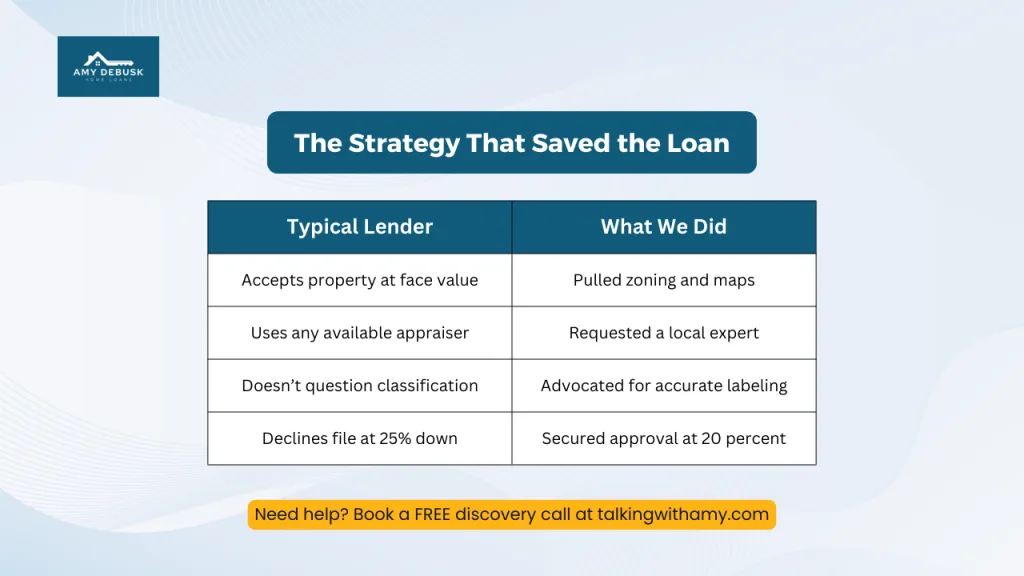
The first thing we did was pull up the map.
What we found changed everything.
Right down the street was a McDonald's.
Not miles away.
Not a long country drive.
Right down the street.
This home looked rural.
But it was actually in the outskirts of town.
That distinction was the entire difference between a decline and an approval.
If the home was classified as rural, they would need 25 percent down.
If it was classified as non rural, they could buy with 20 percent down.
Most lenders simply take the photos at face value and decline the application.
But that is not how we work.
Bank statement loans require thoughtfulness.
Acreage loans require strategy.
Self employed success requires someone who understands nuance.
So here is what we did.
The Strategy That Saved The Loan: Calling the AMC and Securing a Local Appraiser
Appraisals determine everything for acreage properties.
Everything.
The appraiser is the one who decides whether a home is:
- rural
• suburban
• residential
• agricultural
• mixed use
• or something in between
And investors rely on this classification to decide whether a loan is allowed with 20 percent down or requires 25 percent down.
Knowing this, we contacted the Appraisal Management Company directly.
We requested a local appraiser who understood the Knoxville area.
Someone who knew that this property, despite the trees, land, and space, was actually just outside the city.
Someone who drove the neighborhood and would note the restaurants, grocery stores, and roads nearby.
We asked the AMC to assign the order to an appraiser familiar with the community and its zoning patterns.
And we asked something very specific:
Please ensure the appraisal states the correct neighborhood classification.
This is essential for the investor to evaluate the application accurately.
When the report came back, it confirmed exactly what we knew.
The home was not rural.
Which meant the investor allowed the 20 percent down payment.
Which meant the loan was approved.
Which meant our client bought their dream home on 10 acres.
This is what experience solves.
This is the nuance that inexperienced lenders miss.
This is why self employed buyers with acreage dreams need a lender who knows how to navigate these details with confidence.
Acreage Properties Are Approved and Others Are Not
Let's break down the nuance in simple terms, especially for buyers in Sacramento who may be dreaming of homes in Loomis, Newcastle, Auburn, Placerville, or the outskirts of Roseville where acreage properties are more common.
Here is what matters most:
- The appraisal determines everything
Not the listing photos.
Not the buyer's impression.
Not the lender's first glance.
The classification on the appraisal drives the guidelines. - A property can look rural without being rural
Trees, long driveways, and land do not automatically mean rural.
You could have acreage five minutes from town. - Investor rules change at the rural boundary
Non rural homes may allow 20 percent down.
Rural homes may require 25 percent down.
This is not a borrower issue.
It is a property classification issue. - Many lenders decline acreage because they do not have the right investors
At Amy DeBusk Home Loans, we have investors who allow up to 20 acres.
This alone eliminates a huge barrier. - A local appraiser can make or break the entire loan
If the wrong appraiser is assigned, the loan may be misclassified and declined unnecessarily. - Self employed buyers need a lender who calls the AMC
When a lender places the order and walks away, the buyer loses.
When a lender knows which questions to ask the AMC and how to guide the process, the buyer wins.
These are the details that create approvals for self employed homeowners.
Final Thoughts: Your Acreage Dream Is Possible
If you are a self employed buyer in Sacramento, Placer County, or anywhere in California, and you dream of buying a home with land, please know this:
It is absolutely possible.
You just need a lender who understands:
- Bank statement loan guidelines
- Acreage overlays
- Rural classifications
- Appraiser selection
- Investor rule differences
- And how to advocate for you
Your dreams do not need to shrink to fit someone else's guidelines.
You simply need a mortgage advisor who understands how to navigate this path with clarity and confidence.
When you partner with Amy DeBusk Home Loans, you have 25+ years of experience, a deep love for helping self employed buyers, and a team that sees possibilities where others see obstacles.
All loans subject to approval. Equal Housing Lender.
❓Bank Statement Loans for Acreage Homes in Sacramento FAQs
❓ Can I buy a home with acreage using a bank statement loan in Sacramento?
Yes. Bank statement loans are an excellent option for self employed buyers purchasing acreage homes in Sacramento, Placer County, and surrounding areas.
❓ What is the maximum acreage allowed?
We work with investors who allow up to 20 acres, which is extremely rare in today's lending environment.
❓ Do I need 20 percent or 25 percent down?
This depends on how the property is classified. Non rural homes may allow 20 percent down, while rural homes often require 25 percent down.
❓ Do rural homes always require 25 percent down?
Not always, but many investors increase the down payment requirement when a property is classified as rural. The appraisal determines this classification.
❓ How do you determine if a property is rural?
The appraiser, not the photos, makes the final determination. We work closely with the Appraisal Management Company to ensure the correct classification is noted.
❓ Can you help if another lender already denied my acreage property?
Yes. Many denials happen because lenders do not specialize in acreage or bank statement loans. We often approve loans that others turn away.
❓ Do bank statement loans require a higher credit score on acreage homes?
Sometimes. Some investors require a 680 credit score or higher when acreage is involved.
❓ Can I use business or personal bank statements?
Yes. You can use either 12 or 24 months of business or personal statements. We help you choose the option that gives you the strongest income calculation.
How Our Bank Statement Loan AI GPT Helps You Get Clear Answers Fast
One of the biggest challenges self employed buyers face is simply getting straight answers. When you are a business owner, contractor, or 1099 earner, your income pattern does not fit into the traditional boxes that most lenders use. This can leave you feeling confused about what you qualify for, what your numbers mean, and what steps to take next.
To make this process easier, we created our Bank Statement Loan AI GPT, a personalized digital tool designed specifically for self employed homebuyers. This AI tool gives you a simple way to ask detailed questions about bank statement loans, income calculations, guidelines, down payment requirements, and what you may be able to qualify for.
Here is how it helps you:
- You can ask unlimited questions about how bank statement income works
• You get instant guidance on what lenders typically look for
• You can learn how deposits are reviewed and how income is truly calculated
• You can ask about credit scores, reserves, and down payment requirements
• You can explore different loan scenarios before you apply
• You can understand how acreage or rural classifications may affect your loan
The AI tool is designed to educate you, empower you, and give you a deeper understanding of how the loan process works as a self employed buyer. It helps you walk into your consultation with clarity, confidence, and a sense of readiness.
Once you complete your AI questions, you can book a free call with me so we can review your bank statements together and outline your exact path to approval.
This tool is just one of the ways we make mortgages simple for self employed buyers who are dreaming of owning a home with land, space, or acreage. It meets you where you are and helps prepare you for one of the biggest financial decisions of your life.
Download our Bank Statement Loan AI Expert App and get personalized guidance designed for self employed buyers in Sacramento, Roseville, and across California.
All loans subject to approval. Equal Housing Lender.
Want to Learn More About Bank Statement Loans? Explore Our YouTube Playlist for Self Employed Buyers
If you are a self employed buyer and you want to go deeper into how bank statement loans work, I created an entire YouTube playlist dedicated to you. Each video is designed to take a complicated topic and make it simple, clear, and easy to understand so you can feel confident as you move closer to homeownership.
Inside the playlist, you will find videos that explain:
- How bank statement income is calculated
- The difference between 12 and 24 month statements
- Business statements vs personal statement
- How 1099 income is viewed by lenders
- Common mistakes self employed buyers make
- How to strengthen your approval
- How to prepare your finances as an entrepreneur
- How acreage and rural properties are handled
- Real client stories and step-by-step examples
Whether you are just starting to explore your options or you are ready to buy in the next few months, this playlist will give you the clarity and confidence you need to move forward.
You can watch the entire playlist on my YouTube channel at @debuskhomeloans. New videos are added regularly, and each one is created to help you understand your power as a self employed buyer.
If you feel inspired while watching, you can always schedule a call with me so we can review your bank statements together and build your personalized home buying strategy.
All Mortgage Made Easy articles · Book a Complimentary Discovery Call