Pros and Cons Explained (And Why This Matters More Than You Think)
When most first-time buyers begin their home search, they focus on one thing first: price.
That makes sense. Price feels like the biggest hurdle.
But here's what many buyers don't realize until much later in the process:
The type of home you choose can matter just as much as the price you pay.
Different property types come with different loan rules, approval layers, and long-term outcomes. Understanding these differences early helps you avoid failed escrows, last-minute surprises, and unnecessary stress.
This guide walks you through the most common types of homes first-time buyers consider, the real pros and cons of each, and how financing actually works in the real world.
If you are still early in the process, understanding how financing, rates, and strategy all connect is just as important as choosing the home itself. This complete first-time homebuyer guide walks you through everything from preparation to getting your keys.
And if you ever want help walking through this personally, Amy DeBusk Home Loans, a trusted mortgage broker often searched as one of the best mortgage brokers in Roseville CA, can guide you through a pre-approval for many different types of homes so you know exactly what works for you.
What Type of Home Is Best for First-Time Buyers?
The best type of home depends on your budget, lifestyle, and long-term goals.
Some buyers prioritize lower maintenance and affordability, while others want more space and privacy.
Understanding the pros and cons of each option can help you choose a home that fits both your financial situation and your future plans.
Why Property Type Matters Not Just Price
When it comes to mortgage approval, lenders do not just approve people. They also approve properties.
Your loan approval depends on several property-specific factors, including:
- The structure of the home
- How the property is legally classified
- Whether there is shared ownership or a homeowners' association
- The long term risk profile of the property
Because of these factors, two homes with the exact same purchase price can have completely different financing outcomes. One may be easily approved, while the other may face restrictions or be denied based solely on property type.
This is also where interest rate strategy comes into play. Even with the same property, better preparation can lead to significantly better terms. Here's a simple breakdown of how to get the lowest interest rate and improve your overall loan outcome.
Single-Family Residences
The Most Flexible and Lender-Friendly Choice
A single-family residence is a standalone home on its own lot with no shared walls or shared ownership. From a lending perspective, this is the simplest and least risky type of property. This is also why many buyers pair this with more flexible loan options.
Why Buyers Love Single-Family Homes
- Single-family homes are eligible for all major owner-occupied loan programs
- Underwriting is generally easier with fewer restrictions
- Interest rates are typically the most favorable
- No homeowners' association approval is required
- They tend to show strong and consistent long-term appreciation
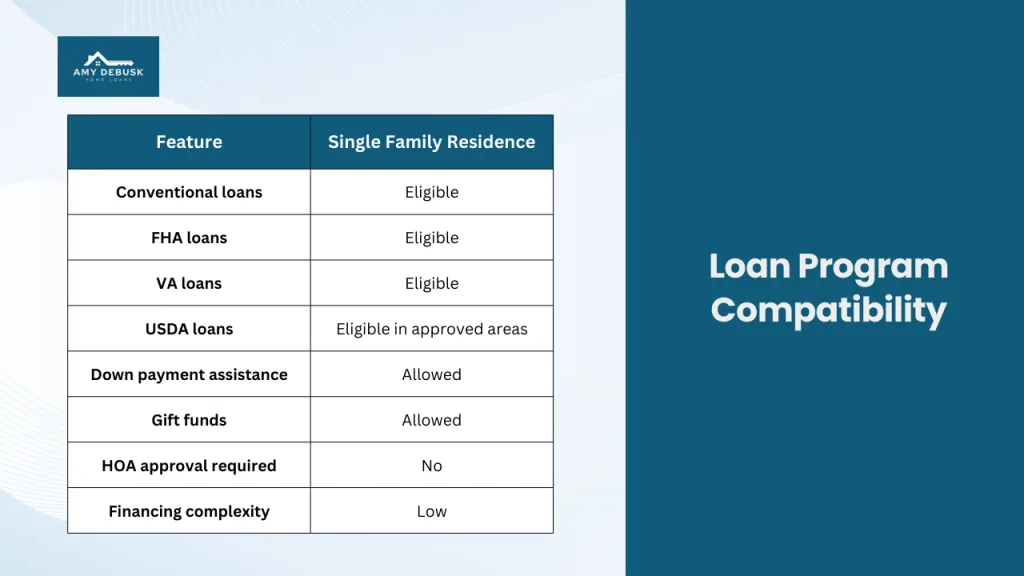
Single-family homes have historically appreciated faster and more consistently than condominiums or manufactured homes. This makes them attractive not only for financing today but also for long-term equity growth.
If your goal is the smoothest approval process, the widest range of loan options, and the strongest long-term flexibility, single-family homes are often the strongest and most lender-friendly choice.
Condos
An Affordable Entry Point With Extra Layers to Understand
Condos can be an excellent entry point into homeownership, especially in higher-cost areas where single-family homes may be out of reach. However, condos come with additional approval layers that buyers need to understand before making an offer. For many buyers, condos are often part of a broader affordability strategy.
Loan Reality for Condos
Financing a condo depends heavily on both the buyer and the condo project itself.
- Conventional loans are typically the most reliable option
- FHA and VA loans require the condo project to be approved
- Many condo projects are not FHA-approved
In some situations, lenders can pursue FHA spot approvals when the project meets specific criteria. Amy DeBusk Home Loans has experience reviewing condo projects and determining when spot approval may be possible.
Interest Rates on Condos
Condos often carry slightly higher interest rates than single-family homes. Lenders price in additional risk related to shared ownership, HOA financial health, and project management.
HOA Fees and Buying Power
Monthly HOA dues usually range from $150 to $600 or more and are included in your debt-to-income ratio.
Because of this, condo buyers often qualify for a lower purchase price than they would with a single-family residence, even when the home price itself looks affordable.
Insurance Requirements
Even though the homeowners' association typically insures the exterior of the building, condo owners are still required to carry walls in homeowner's insurance. This policy covers the interior of the unit, personal belongings, and personal liability.
Appreciation Reality
Condos generally appreciate more slowly than single-family homes due to shared ownership, HOA rules, and restrictions on modifications or rentals.
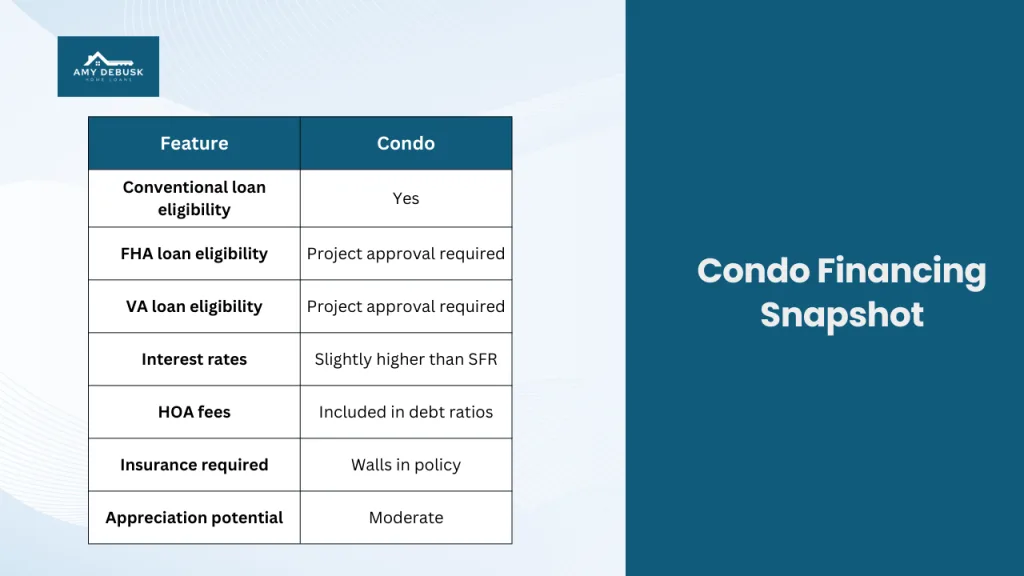
Condos can be a smart and affordable way to enter homeownership, but they require more upfront review and planning. Understanding loan options, HOA fees, and project approval status early helps buyers avoid surprises and choose the right property for their financial goals.
Warrantable vs Non-Warrantable Condos
Why This Distinction Is Critical
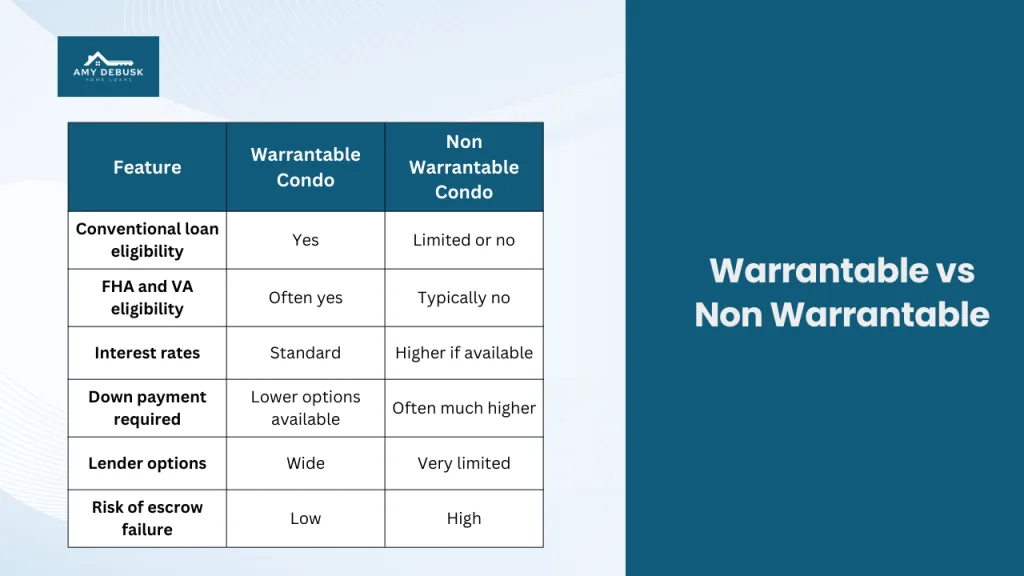
Not all condos are treated the same by lenders. Whether a condo is classified as warrantable or non-warrantable can determine how easy it is to finance or whether it can be financed at all.
- A warrantable condo meets standard lending guidelines and is generally eligible for conventional, FHA, VA, and many down payment assistance programs.
- A non-warrantable condo does not meet those guidelines and may be difficult or impossible to finance with traditional loan programs.
Common Reasons a Condo Becomes Non-Warrantable
- Active or unresolved HOA litigation
- A high percentage of rental or investor-owned units
- HOA financial instability or inadequate reserves
- Insurance coverage gaps or policy issues
If a condo project has active litigation, many lenders will not finance it under any circumstances. This is one of the most common reasons condo escrows fall apart, even when the buyer is fully qualified.
Down Payment Assistance
Down payment assistance can be used on condos, but only when both the condo project and the specific loan program allow it. This approval must be confirmed upfront, as not all condo projects qualify, even if the buyer does.
Gift Funds
Gift funds are generally allowed for condo purchases, subject to standard loan program guidelines and proper documentation.
Before writing an offer on a condo, it is essential to confirm that the project is warrantable and eligible for your loan program. This step is often part of the full pre-approval and property review process. This review should happen early in the process, not after you are already in escrow. Working with a lender who evaluates condo projects upfront can help prevent failed escrows, wasted time, and unnecessary stress.
Half Plex
A Hidden Gem for First-Time Buyers
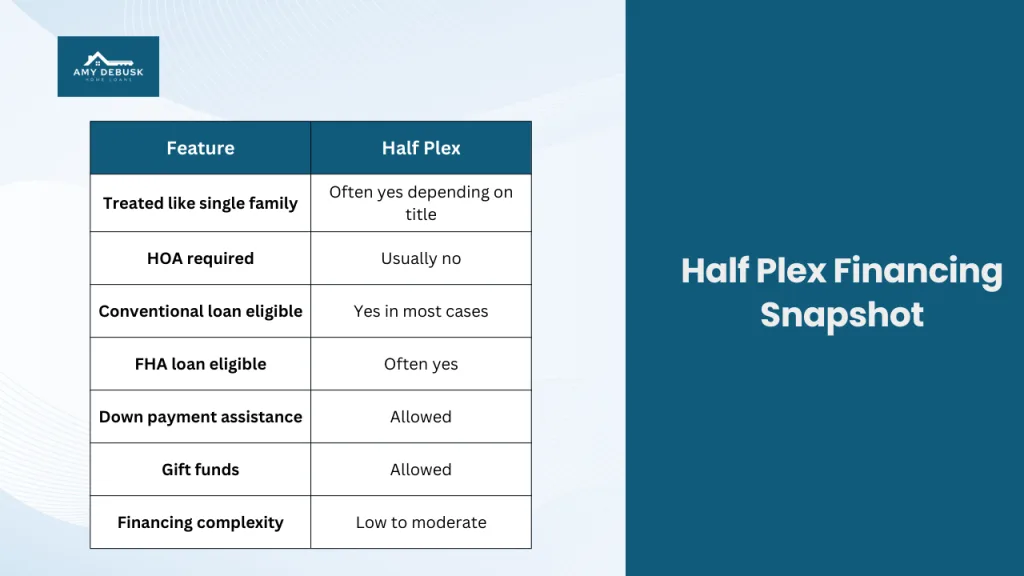
A half plex is one side of a duplex that is typically owned separately and often does not include a homeowners' association. For many first-time buyers, this creates a strong balance between affordability and independence.
Why Half Plex Homes Are Underrated
- They are typically more affordable than single-family homes
- They often come with no HOA fees
- They feel more like a traditional home than a condo
- They provide a strong introduction to owning real estate
Financing Notes
From a lending perspective, half-plex homes are often treated similarly to single-family residences, depending on how the property is titled and legally classified. Confirming this early is important, but when structured correctly, financing is usually straightforward.
Appreciation Outlook
Half plex homes often appreciate better than condos and can be a strong stepping stone into future homeownership or long term investing.
For buyers who want more flexibility than a condo but a lower price point than a single-family home, a half plex can be an excellent and often overlooked option.
Manufactured Homes
Affordable Homes With Their Own Set of Rules
Manufactured homes can be a great option for buyers, especially in rural, foothill, or outlying areas. However, they come with more specific lending rules than single-family homes, which makes early review essential.
In areas like El Dorado County and Sutter County, many homes look like traditional single-family residences but are legally classified as manufactured. That classification directly affects financing.
What Makes a Financeable Manufactured Home
A manufactured home must meet all of the following criteria to qualify for most loan programs:
- HUD certification
- Certification labels on each section, sometimes hidden on older homes
- Permanently placed on an approved permanent foundation
- Legally classified as real property
If any of these elements are missing, financing options can become limited or unavailable.
For buyers exploring alternative paths to homeownership, there are also specialized loan programs that apply to specific property types and borrower situations. For example, this guide on the Section 184 loan explains a unique option available to eligible buyers.
What Lenders Review Closely
In addition to legal classification, lenders also evaluate the overall setup and functionality of the property.
- Proper plumbing and utility connections
- A verified permanent foundation
- An established driveway and access
- Land size is typically under five acres
Credit Score Reality
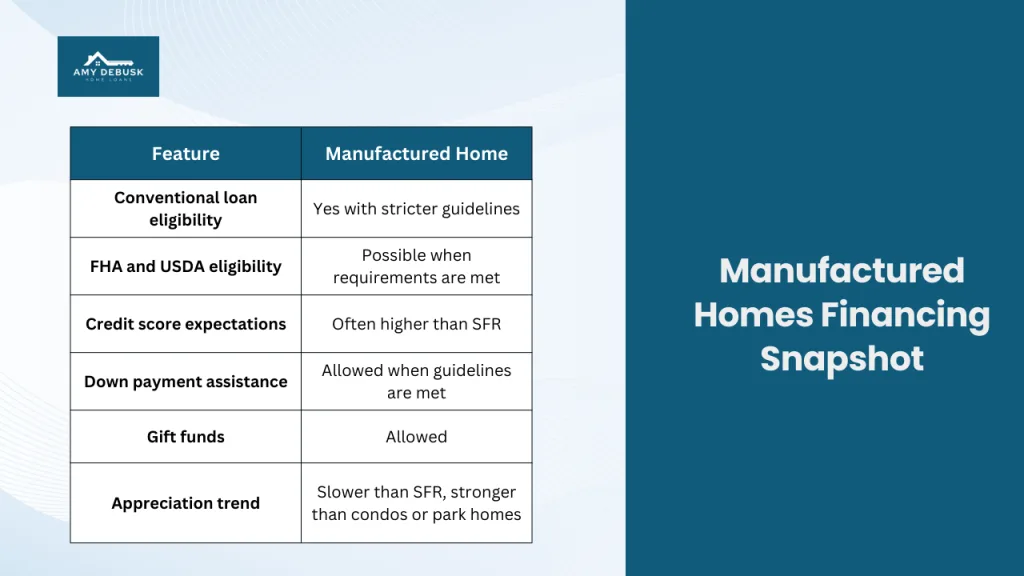
Manufactured homes often require higher credit scores for conventional financing. Many lenders look for scores around 660 FICO or higher, depending on the loan program and overall application strength.
Appreciation Outlook
Manufactured homes generally appreciate more slowly than single-family residences, but they often perform better than condominiums or mobile homes located in parks.
Manufactured homes can be an affordable path to homeownership, but the rules matter. Confirming foundation type, legal classification, and loan eligibility early can make the difference between a smooth purchase and a failed transaction. Working with a lender experienced in manufactured housing helps ensure the home truly qualifies before moving forward.
Mobile Homes / Doublewide Homes in Parks
A Completely Different Financing and Approval Path
Mobile homes or doublewide homes located in parks or on leased land follow an entirely different set of rules than manufactured or single-family homes on owned land. These properties are not financed as traditional real estate.
Because the land is not owned, lenders view these homes as higher risk, which changes how financing works.
Key Differences Buyers Should Know
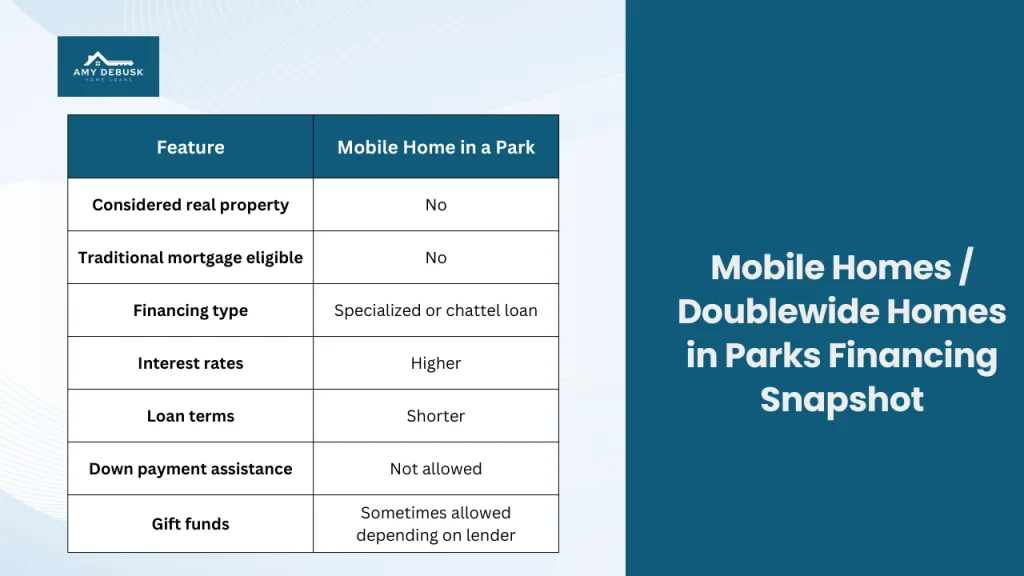
- They are not considered real property
- They require specialized chattel or park loan financing
- Interest rates are typically higher
- Loan terms are often shorter and less flexible
Down Payment Assistance
Not allowed for mobile homes located in parks or on leased land.
Gift Funds
May be allowed in some cases, depending on the lender and loan type.
Mobile homes in parks can be more affordable upfront, but they follow a completely different financing path with higher costs and fewer protections for buyers. Understanding this distinction early helps buyers avoid surprises and ensures the property matches their long-term goals and financing expectations.
Important: Park Approval Is a Separate Step
When buying a mobile home in a park, you must:
- Qualify for the loan
- Separately qualify with the park
Even if you are loan-approved, the park can still deny your application. Some parks have very strict income, credit, and background requirements.
This is a common surprise for first-time buyers and one of the biggest reasons mobile home escrows fall apart.
To go deeper on mobile and manufactured home financing, watch our video How to Buy a Mobile or Manufactured Home with a Mortgage.
Multi-Unit Properties
Living in One and Renting the Others
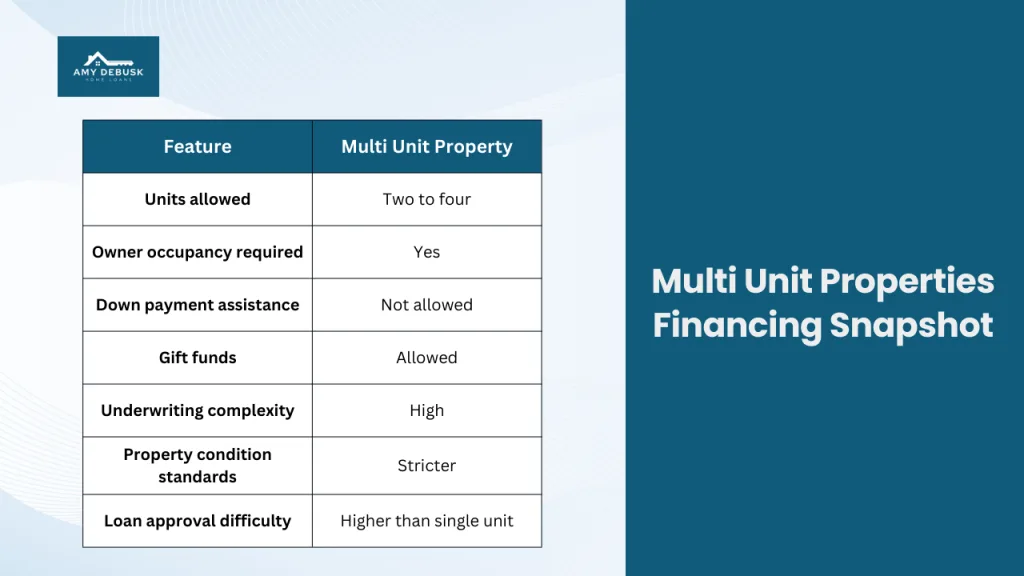
Multi-unit properties with two to four units allow buyers to combine homeownership with rental income. While this can be a powerful strategy, these properties involve more rules and stricter underwriting.
Important Financing Notes
- Down payment assistance is not allowed on multi-unit properties
- Gift funds are typically allowed
- Underwriting is more detailed, and documentation requirements are higher
- Property condition standards are stricter than for single-unit homes
Multi-unit properties are not beginner simple, but they can be a powerful option for financially prepared buyers. Living in one unit while renting the others can help offset housing costs and build long-term wealth when structured correctly with an experienced lender.
For buyers thinking long term, renovation strategy can also play a role in building equity. This guide on renovation loans explains how buyers can purchase and improve a property at the same time.
Quick Reference: Property Types and Down Payment Assistance
Not all property types are treated the same when it comes to financing and down payment assistance. Understanding these differences early can help buyers avoid writing offers on homes that do not align with their loan options.
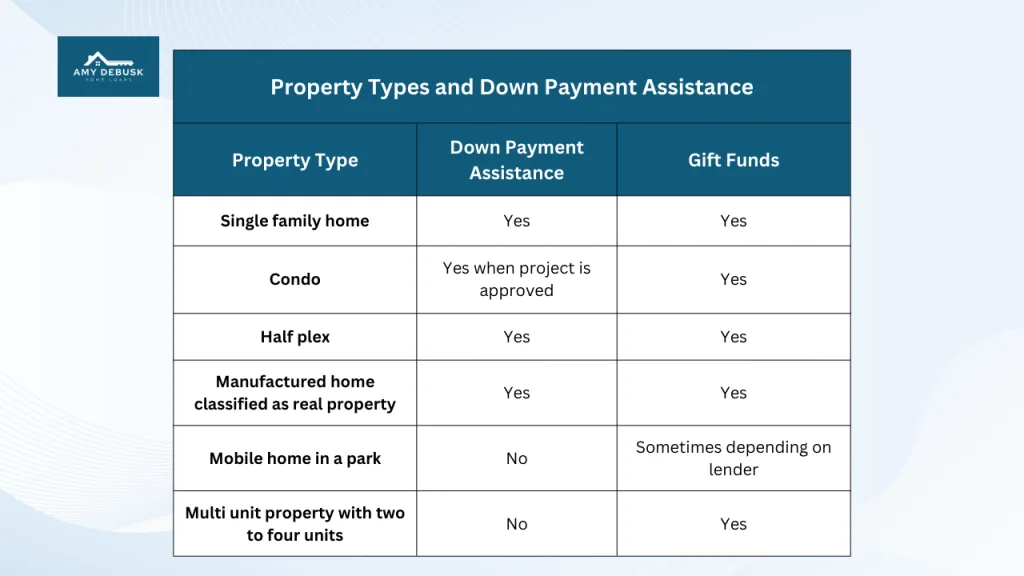
Down payment assistance eligibility depends on both the property type and the specific loan program being used. Confirming these details upfront helps ensure a smoother transaction and prevents costly surprises once you are under contract.
If you want help determining which property types work best with your financing options, schedule a free conversation at talkingwithamy.com.
Why This Matters
Many first-time buyers do not lose escrows because they are unqualified. They lose escrows because the property does not match the loan, HOA, or structural issues surface late, or expectations were never set early in the process.
Understanding how property type, financing rules, and loan requirements work together helps buyers avoid these common pitfalls.
Learning this now does not mean you are late. It means you are early enough to choose wisely, write stronger offers, and move forward with confidence.
What I'm Seeing with First-Time Buyers in Sacramento
In the Sacramento and Placer County markets, many first-time buyers are starting with condos or townhomes due to affordability and lower upfront costs.
As home prices increase, these options can provide a more accessible entry point into homeownership while still allowing buyers to build equity.
I often help buyers compare these options based on their monthly payment, long-term goals, and how quickly they plan to move up to their next home.
What Most First-Time Buyers Get Wrong
One of the biggest mistakes I see is buyers focusing only on the type of home instead of how it fits their overall financial strategy.
The goal isn't just to buy a home, it's to buy the right home that allows you to build equity, stay comfortable with your monthly payment, and position yourself for future opportunities.
This is why I always help buyers look at the bigger picture before making a decision.
Final Thoughts
Buying your first home isn't about finding the "perfect" house.
It's about choosing the right type of home for your loan, your goals, and your future.
If you want guidance through this process, Amy DeBusk Home Loans, a highly trusted mortgage broker in Roseville, CA, can walk you through a personalized pre-approval and help you understand which property types truly work for you.
All loans subject to approval. Equal Housing Lender.
❓Types of Homes for First-Time Buyers FAQs
❓ 1. Why does the type of home I buy affect my loan approval?
Because lenders don't just approve borrowers, they also approve properties. The structure, legal classification, and risk profile of a home directly impact which loan programs are available, how strict underwriting will be, and whether down payment assistance can be used.
❓ 2. Are single-family homes really the easiest to finance?
Yes. Single-family residences qualify for the widest range of loan programs, usually receive the best interest rates, and have the fewest approval hurdles. This is why many lenders and Realtors consider them the "cleanest" transactions.
❓ 3. Why are condos harder to buy than they seem?
Condos require approval not just of you, but of the entire condo project. Issues like HOA finances, litigation, insurance coverage, and the percentage of rental units can all affect financing. This is why some condo escrows fall apart late in the process.
❓ 4. What is the difference between a warrantable and a non-warrantable condo?
A warrantable condo meets standard lending guidelines and is easier to finance. A non-warrantable condo may be difficult or impossible to finance with traditional loans due to factors like HOA litigation, too many rentals, or financial instability within the HOA.
❓ 5. Can I use down payment assistance on a condo?
Yes, down payment assistance can be used on condos, as long as the condo project and loan program allow it. This is why early lender review of the HOA and project status is critical before writing an offer.
❓ 6. What exactly is a half plex, and why is it a good option?
A half plex is one side of a duplex that is often owned separately. It's usually more affordable than a single-family home, often has no HOA, and feels more like traditional homeownership. For many buyers, it's an excellent first step into real estate.
❓ 7. Why do manufactured homes have more rules than single-family homes?
Manufactured homes must meet specific requirements, including HUD certification, permanent foundation, and real property classification. In areas like El Dorado County or Sutter County, many homes that look like SFRs are actually manufactured, which changes loan eligibility.
❓ 8. What's the difference between a manufactured home and a mobile home in a park?
Manufactured homes classified as real property can qualify for traditional mortgages and down payment assistance. Mobile homes in parks are not real property, require specialized financing, have higher rates, and do not allow down payment assistance.
❓ 9. Why do mobile home parks have their own approval process?
When buying in a park, you must be approved by both the lender and the park. Even if you qualify for the loan, the park can deny your application based on its own income, credit, or background standards. Some parks are very strict.
❓ 10. How do I avoid choosing the wrong type of home?
The best way is to get pre-approved early and understand which property types align with your loan options. A lender who reviews both your finances and the property type upfront can help you focus only on homes that truly work.
Because lenders don't just approve borrowers, they also approve properties. The structure, legal classification, and risk profile of a home directly impact which loan programs are available, how strict underwriting will be, and whether down payment assistance can be used.
Yes. Single-family residences qualify for the widest range of loan programs, usually receive the best interest rates, and have the fewest approval hurdles. This is why many lenders and Realtors consider them the "cleanest" transactions.
Condos require approval not just of you, but of the entire condo project. Issues like HOA finances, litigation, insurance coverage, and the percentage of rental units can all affect financing. This is why some condo escrows fall apart late in the process.
A warrantable condo meets standard lending guidelines and is easier to finance. A non-warrantable condo may be difficult or impossible to finance with traditional loans due to factors like HOA litigation, too many rentals, or financial instability within the HOA.
Yes, down payment assistance can be used on condos, as long as the condo project and loan program allow it. This is why early lender review of the HOA and project status is critical before writing an offer.
A half plex is one side of a duplex that is often owned separately. It's usually more affordable than a single-family home, often has no HOA, and feels more like traditional homeownership. For many buyers, it's an excellent first step into real estate.
Manufactured homes must meet specific requirements, including HUD certification, permanent foundation, and real property classification. In areas like El Dorado County or Sutter County, many homes that look like SFRs are actually manufactured, which changes loan eligibility.
Manufactured homes classified as real property can qualify for traditional mortgages and down payment assistance. Mobile homes in parks are not real property, require specialized financing, have higher rates, and do not allow down payment assistance.
When buying in a park, you must be approved by both the lender and the park. Even if you qualify for the loan, the park can deny your application based on its own income, credit, or background standards. Some parks are very strict.
The best way is to get pre-approved early and understand which property types align with your loan options. A lender who reviews both your finances and the property type upfront can help you focus only on homes that truly work.
Want a Fun, Low-Pressure Way to Start Saving for a Home?
Download Our Free SaveBot GPT App
If buying a home feels exciting and overwhelming at the same time, you're not alone. Most first-time buyers don't struggle with motivation - they struggle with knowing where to start.
That's exactly why we created SaveBot GPT, a free interactive tool designed to help first-time buyers turn saving into something simple and doable.
Think of it like a game that helps you:
- See where you are starting from
- Understand how small changes add up
- Learn what actually moves the needle toward homeownership
- Build confidence without pressure or judgment
There's no commitment, no applications, and no stress. It's just a smart, supportive way to explore what's possible and start building momentum.

Download the free SaveBot GPT App
Want More First-Time Buyer Education?
Watch Our Complete YouTube Playlist
There is a lot of misinformation online about buying your first home. Myths around credit, down payments, timing, and loan programs stop great buyers before they ever get started.
To help clear that up, we've created a complete YouTube playlist dedicated to first-time home buyers.
Inside the playlist, you'll find:
- Common first-time buyer myths explained
- Real-world loan scenarios
- Tips on credit, down payment assistance, and affordability
- Honest guidance on what actually matters in today's market
These videos are designed to be easy to understand, practical, and encouraging - whether you're just starting to think about buying or actively preparing.
Watch our full First-Time Home Buyer playlist
All Mortgage Made Easy articles · Book a Complimentary Discovery Call