
If you're trying to get the lowest possible interest rate right now, especially in markets like Sacramento, Roseville, or anywhere in California, the strategy matters more than timing alone.
I'm Amy DeBusk, a Branch Manager and mortgage advisor with over 25 years of experience helping buyers and homeowners structure loans to get the most competitive rates available for their situation.
What most people don't realize is that the lowest rate is not just about the market, it's about how your loan is structured. Understanding the full homebuying process early makes it easier to make better decisions as rates change.
In this guide, I'll walk you through what actually impacts your rate and what I'm seeing right now in the 2026 market.
If you want additional education, videos, and step-by-step tools created specifically for first-time buyer, be sure to visit our First-Time Home Buyer Hub on our website.
Mortgage Rates Are Shifting in 2026
The housing market is picking up speed this year. Mortgage rates have eased from recent highs, buyer demand is returning, and many experts expect more changes ahead as inflation trends and Federal Reserve policy continue to evolve.
If you've been waiting for the "perfect time" to make a move, this could be the opportunity you've been hoping for.
But here's something important to remember:
Mortgage rates often start dropping before the biggest headlines hit, not after.
What I'm Seeing Right Now in Sacramento and Roseville
In the Sacramento and Placer County markets, I'm seeing many buyers focus heavily on trying to "time" the lowest rate.
The reality is, the biggest difference usually comes from preparation, not timing.
Buyers who get fully pre-approved early and structure their loan correctly often secure better pricing than those who wait for headlines about rate drops.
This is something I work through with clients every week.
Why Mortgage Rates Often Change Before the Fed Acts
One of the biggest misconceptions is that mortgage rates only fall after the Federal Reserve cuts interest rates.
In reality, mortgage rates usually respond first.
That's because mortgage rates are influenced more by the bond market than by the Fed's overnight rate.
Here's what happens:
- Mortgage rates track long term Treasury yields, not the Fed's short term rate
- Investors often react early when they expect the economy to slow
- When future Fed cuts seem likely, investors shift money into Treasury bonds
- Increased bond demand pushes yields down
- As yields drop, mortgage rates often decline as well
By the time the Fed officially announces a rate cut, the market has typically already priced it in.
That's why borrowers who wait for the headline announcement often miss the lowest available rates.
Why Housing Stays Strong Even When the Economy Slows
Economists often repeat a familiar pattern:
Housing is usually the first sector to slow down, and the first to recover.
In 2026, that trend is showing up again.
Even with ongoing economic uncertainty, housing demand remains resilient for a few key reasons:
- Inventory remains limited in most markets
- Household formation continues as life events drive demand
- Buyers are returning as affordability slowly improves
The result is a market positioned for renewed competition.
As demand builds, home prices may begin rising again, especially in well priced and well located areas. The type of home you choose can also affect your financing strategy and long-term plan.
What Actually Determines Your Mortgage Rate
Here's something most people don't realize:
The market sets the general rate environment, but your personal rate depends on you.
Two buyers can apply on the same day and get completely different interest rates.
Your mortgage rate is based on things like your credit score, your down payment, your loan type, your income stability, and even how much debt you carry each month.
That's why the lowest rate isn't just about waiting for the market.
It's about preparing ahead of time.
Your loan type also plays a big role in your rate and overall approval strategy, whether that's FHA, VA, or USDA financing.
2026 Forecast: Why Smart Buyers Are Paying Attention
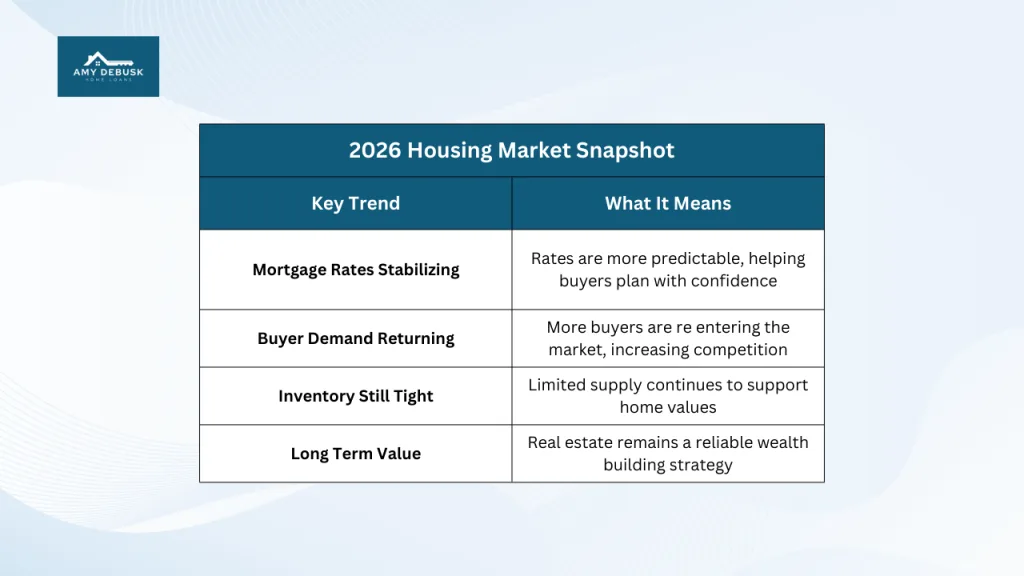
The housing market in 2026 is settling into a more stable rhythm after years of uncertainty. For buyers and homeowners, this creates a rare window where opportunity exists before competition fully returns.
Here's a simplified look at the most important trends shaping this year.
Why Timing Matters in 2026
Many homeowners are also exploring refinancing options to lower monthly payments or consolidate debt while rates remain relatively favorable.
As rates improve or confidence grows, demand is likely to rise quickly. Buyers who act before that happens often benefit from:
- More negotiating power
- Less competition
- Flexibility to refinance later
The key is making a move before the next demand surge, not after.
What This Means for You
If you're thinking about buying or refinancing in 2026, this is a year to stay informed and be proactive.
The market is shifting, and small changes in rates or demand can make a big difference in your monthly payment and long term equity.
Here's what to keep in mind:
- Mortgage rates can move quickly, often before major news or Fed announcements
- Waiting could mean higher home prices as inventory remains limited
- Competition may increase as more buyers re enter the market this spring and summer
- Acting earlier often gives you more choices, more negotiating power, and better flexibility
For homeowners, refinancing may still be a smart option to:
- Lower your monthly payment
- Consolidate high interest debt
- Tap into home equity for major expenses
- Adjust your loan term to meet your goals
The best strategy isn't trying to time the market perfectly. It's understanding your options early and being ready to act when the timing is right for you.
If you'd like a payment comparison for your situation using numbers you choose, call (916) 705-2557 or Apply. This site does not publish live pricing.
Should You Lock Your Rate Now or Wait?
This is one of the biggest questions of 2026.
And the answer depends on your goals, your timeline, and your comfort level.
Some buyers try to wait for the lowest possible rate, but the truth is, nobody can predict the exact bottom.
What we do know is this: When rates start improving, the best opportunities often happen early, before demand surges.
Locking at the right time can protect you from sudden jumps and give you peace of mind while you move through the homebuying process.
Check out our mortgage products to learn more about home loans, refinancing, and more.
❓Frequently Asked Questions About Mortgage Rates in 2026
❓1. Will mortgage rates go down more in 2026?
Mortgage rates may continue to fluctuate throughout 2026, but no one can guarantee how far they will drop. Rates often move ahead of economic news, so waiting too long can sometimes mean missing the best opportunity.
❓2. Should I wait for the Federal Reserve to cut rates?
Most buyers think rates fall after a Fed cut, but mortgage rates often improve before the Fed actually acts. By the time a cut happens, the market may have already adjusted.
❓3. What is the best credit score to get the lowest mortgage rate?
In general, borrowers with credit scores above 740 tend to qualify for the best interest rates. That said, many loan programs still offer great options for scores below that range.
❓4. Does a bigger down payment lower my interest rate?
Yes, a larger down payment can sometimes help you qualify for a better rate because it reduces the lender's risk. However, many buyers can still secure competitive rates with smaller down payments depending on the loan type.
❓5. How do I know when to lock my mortgage rate?
The best time to lock depends on your closing timeline and comfort with risk. If rates are improving and you find a payment that works for you, locking can protect you from sudden increases.
❓6. Can two people get different rates on the same day?
Absolutely. Mortgage rates are personal. Your credit score, debt-to-income ratio, loan type, and down payment all affect the rate you're offered, even if market rates are the same.
❓7. Is refinancing worth it in 2026?
Refinancing may be worth it if you can lower your rate, reduce your monthly payment, shorten your loan term, or access equity for other financial goals. Even a small rate drop can create long-term savings.
❓8. What's the first step to getting the lowest rate possible?
The first step is getting pre-approved and reviewing your financial profile early. The more prepared you are, the faster you can act when the right rate becomes available.
Mortgage rates may continue to fluctuate throughout 2026, but no one can guarantee how far they will drop. Rates often move ahead of economic news, so waiting too long can sometimes mean missing the best opportunity.
Most buyers think rates fall after a Fed cut, but mortgage rates often improve before the Fed actually acts. By the time a cut happens, the market may have already adjusted.
In general, borrowers with credit scores above 740 tend to qualify for the best interest rates. That said, many loan programs still offer great options for scores below that range.
Yes, a larger down payment can sometimes help you qualify for a better rate because it reduces the lender's risk. However, many buyers can still secure competitive rates with smaller down payments depending on the loan type.
The best time to lock depends on your closing timeline and comfort with risk. If rates are improving and you find a payment that works for you, locking can protect you from sudden increases.
Absolutely. Mortgage rates are personal. Your credit score, debt-to-income ratio, loan type, and down payment all affect the rate you're offered, even if market rates are the same.
Refinancing may be worth it if you can lower your rate, reduce your monthly payment, shorten your loan term, or access equity for other financial goals. Even a small rate drop can create long-term savings.
The first step is getting pre-approved and reviewing your financial profile early. The more prepared you are, the faster you can act when the right rate becomes available.
All Mortgage Made Easy articles · Book a Complimentary Discovery Call