
If you've been thinking about buying a home, you've probably asked yourself:
"Should I buy now… or wait?"
It's one of the most common questions I hear from buyers today, especially in markets like Sacramento and Roseville.
I'm Amy DeBusk, a Branch Manager with over 25 years of experience, and I've helped many buyers navigate this exact decision.
The truth is, waiting doesn't always save money, and in some cases, it can actually cost more.
In this guide, I'll walk you through what's happening in today's market and how to decide what makes the most sense for your situation.
If you want additional education, videos, and step-by-step tools created specifically for first-time buyer, be sure to visit our First-Time Home Buyer Hub on our website. Getting clear on the full process early can make these decisions much easier.
Let's break down what's really at stake when you stay on the sidelines too long.
The Market Doesn't Pause While You Wait
It's completely natural to hope for lower interest rates. And yes, rates could dip at some point.
The problem is that the housing market doesn't freeze while buyers wait on the sidelines. Homes continue to sell, demand continues to exist, and in many California markets prices keep moving upward. When that happens, even a lower rate may not deliver the savings buyers expect.
If rates fall but home prices rise at the same time, the benefit of that lower rate can be erased by a higher purchase price. In many cases, buyers end up borrowing more, putting more money down, and paying nearly the same monthly payment anyway, all while missing out on months or years of equity growth.
Let's look at two realistic scenarios.
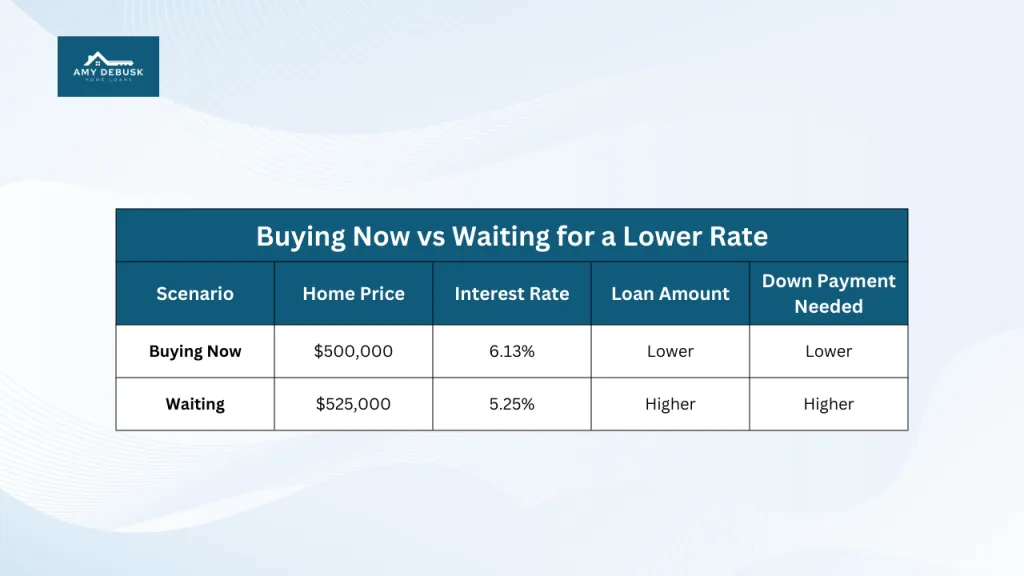
Even though the interest rate improves in the second scenario, the higher purchase price creates several trade-offs. You borrow more money, your required down payment increases, your monthly payment may end up very close to the same, and you lose the opportunity to build equity during the time you waited.
A lower rate sounds appealing, but it does not automatically mean a better deal if the home itself costs more. Your interest rate is only one part of the equation when it comes to your monthly payment.
What Waiting Really Costs You
Delaying your home purchase may feel like the safer choice, especially when the market feels uncertain. But in reality, waiting often comes with financial trade-offs that many buyers don't fully recognize until it's too late.
While you're sitting on the sidelines, the market continues moving, and the opportunity to build long-term wealth through homeownership may be slipping away.
Here are some of the biggest costs of waiting:
-
Lost Equity Growth
Every month you own a home, you're building equity and increasing your personal net worth. Your mortgage payment helps you gain ownership in an asset that can grow over time.
On the other hand, rent payments don't build future wealth, they simply cover the cost of living in someone else's property.
-
Rising Home Prices
Even modest appreciation can add up quickly. A home priced at $500,000 today could realistically be $525,000 or more next year, depending on inventory, demand, and market conditions in your area.
That increase means a larger loan, a higher down payment, and potentially higher monthly payments, even if interest rates improve.
-
More Competition Later
Many buyers assume they'll jump back in once rates drop, but so will everyone else.
When interest rates fall, buyer demand often surges, creating a much more competitive market. That can lead to:
- Multiple offer situations
- Bidding wars
- Fewer homes to choose from
- Higher final sales prices
Waiting for the "perfect time" may actually mean entering the market when it's harder and more expensive to win a home.
-
Missed Tax Benefits
Homeownership may also come with potential tax advantages that renters don't receive, including deductions such as mortgage interest and property taxes.
Buying sooner may allow you to start benefiting from these advantages earlier.
Always check with a qualified tax professional to understand what applies to your specific situation.
Renting Doesn't Protect You From Rising Costs
Another hidden cost of waiting to buy is what happens on the rental side of the equation.
Many buyers assume that renting for "just one more year" is the safer or cheaper option. But in California, rent rarely stays the same for long. In fact, rising rent is one of the biggest reasons people get priced out over time.
Even with statewide rent cap laws (such as AB 1482), landlords are often still allowed to raise rent each year by:
- Up to 5% plus inflation
- With a maximum cap of around 10% annually in many cases
That means rent can increase quickly, even in a regulated environment.
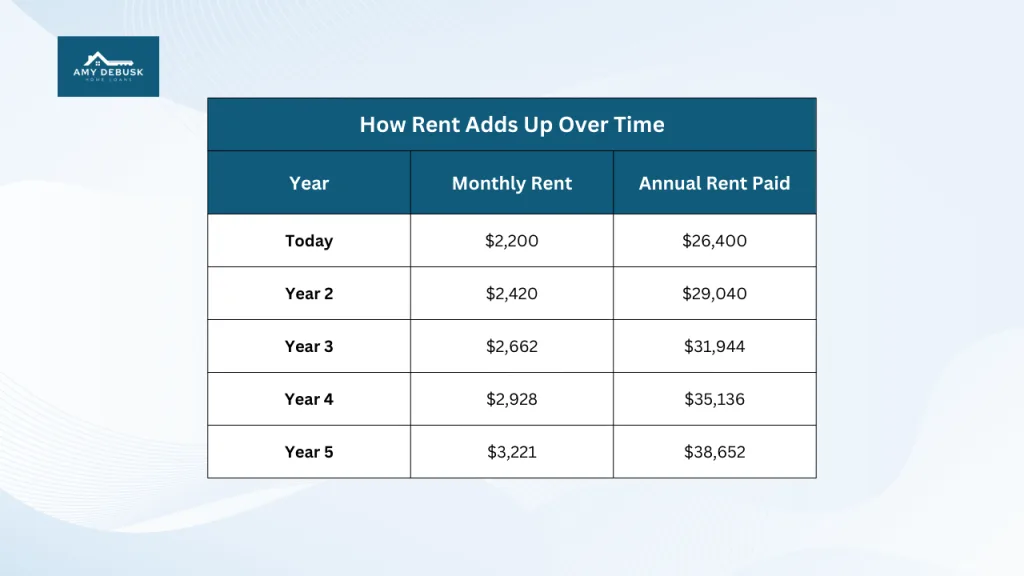
Over just five years, rent increases can cost a renter tens of thousands more, with no equity gained in return.
And over a decade, many renters may spend hundreds of thousands of dollars with nothing to show for it except higher monthly payments.
- No ownership
- No equity
- No long-term wealth building
Renting may feel flexible, but it becomes more expensive over time, while homeownership allows you to build stability, lock in housing costs, and invest in your future instead of paying into someone else's.
Schedule your free discovery call at talkingwithamy.com and take the next step with confidence.
The Power of Appreciation and Equity
One of the biggest advantages of buying a home is that you benefit from appreciation on the full value of the property, not just the amount you put down.
Even with a smaller down payment, you gain control of a large asset that has the potential to grow in value over time.
A Simple Example
- Home Price: $500,000
- Down Payment: 3% ($15,000)
- Estimated Appreciation: 5% annually
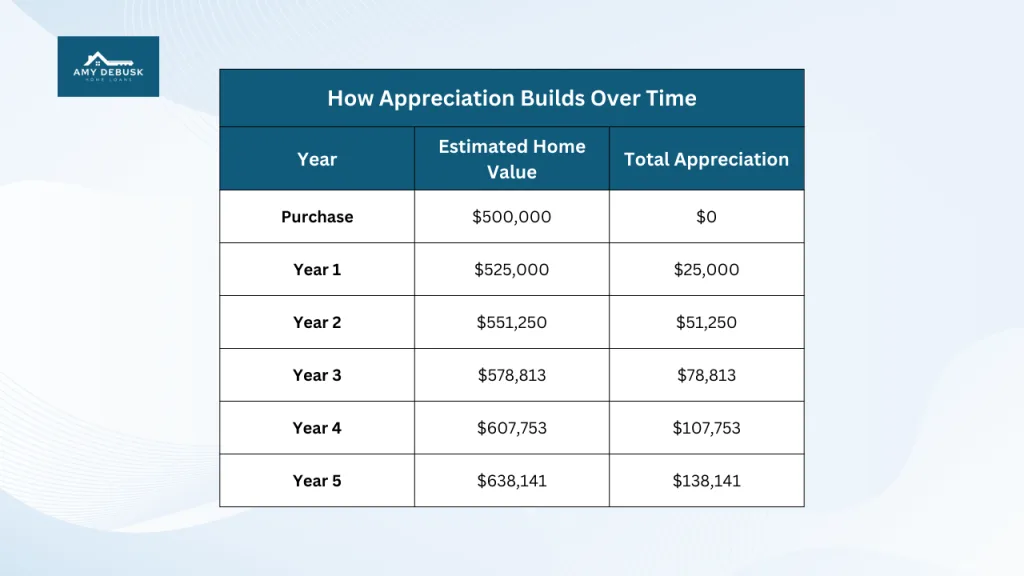
Over five years, the home gains more than $138,000 in value, while your original down payment was just $15,000.
On top of appreciation, every monthly payment reduces your loan balance and increases your ownership stake in the home.
Real estate remains one of the only investments where you can control a high-value asset, benefit from its growth, and build long-term wealth with a relatively small amount down.
Waiting means missing out on this compounding effect year after year.
Why Waiting Doesn't Always Save You Money
Many buyers assume that waiting will lead to lower prices or better interest rates.
But in today's market, that's not always how it works.
Home prices are still expected to rise gradually, and even a small increase in price can offset any potential savings from slightly lower interest rates.
At the same time, mortgage rates are not expected to drop dramatically, and they can change quickly based on economic conditions.
This means waiting can sometimes result in:
- Paying more for the same home
- Facing more competition when rates drop
- Losing out on opportunities available today
Many buyers move forward once they understand how today's numbers actually compare.
What I'm Seeing Right Now in Sacramento and Roseville
In the Sacramento and Placer County markets, I'm seeing more balanced conditions compared to the last few years.
Buyers have more opportunities to negotiate, and in some cases, sellers are offering incentives to help with closing costs.
This creates opportunities that didn't exist in previous markets, which is why many buyers are choosing to move forward now rather than wait.
Having a clear pre-approval in place makes it easier to take advantage of these opportunities.
Why Getting Home Ready Now Gives You the Advantage
You don't have to buy tomorrow.
But starting now can put you in a much stronger position when the right opportunity appears.
Smart buyers use this time to:
- Improve credit
- Build savings
- Explore loan options
- Get pre-approved early
- Understand what they can afford
Preparation is what separates confident buyers from stressed buyers.
Ready to Get Home Ready?
If you're not buying yet but want to be prepared, the Home Readiness Launch is designed for you.
This guided 4-month experience helps future homeowners understand their buying power, create a realistic plan, strengthen their financial profile, and get mortgage-ready with clarity.
❓Frequently Asked Questions about Home Buying in 2026
❓1. Is 2026 a good year to buy a home in California?
For many buyers, yes. While interest rates remain higher than historic lows, inventory and competition are often more balanced than during peak years. Buyers who are financially prepared may have more negotiating power than during heavy bidding-war markets.
❓2. Should I wait for interest rates to drop before buying?
Waiting for rates to drop can be risky. Even if rates fall from 6.125% to 5.25%, rising home prices can cancel out those savings. Many buyers end up paying more overall due to higher purchase prices and missed equity growth.
❓3. Can I refinance later if rates go down?
Yes. If rates improve in the future, refinancing may be an option, depending on your loan type, credit, equity, and market conditions at that time. Buying now and refinancing later can sometimes be a smarter strategy than waiting to buy.
❓4. How much do home prices typically increase each year?
Historically, U.S. home prices have appreciated around 3% to 5% annually on average. Some California markets experience higher or lower appreciation depending on location, inventory, and demand.
❓5. Is renting cheaper than buying in California?
Renting may feel cheaper in the short term, but rent typically increases over time and builds no equity. Homeownership offers long-term financial benefits through appreciation, equity growth, and potential tax advantages.
❓6. How much do I really need for a down payment?
Many loan programs allow low down payments.
- Conventional loans that allow about 3 percent down when you qualify
- FHA loans that often allow about 3.5 percent down when you qualify
- VA loans with 0% down for eligible buyers
Down payment requirements vary based on loan type and borrower qualifications.
❓7. What does it mean to be "home ready"?
Being home ready means your credit, income, savings, and documentation are aligned so you can qualify for a mortgage and make an offer confidently. It does not mean you have to buy immediately, just that you are prepared.
❓8. How long should I prepare before buying a home?
Preparation timelines vary. Some buyers need a few months, others a year or more. Starting early allows you to improve credit, plan savings, and understand your options so you can act when the timing feels right.
For many buyers, yes. While interest rates remain higher than historic lows, inventory and competition are often more balanced than during peak years. Buyers who are financially prepared may have more negotiating power than during heavy bidding-war markets.
Waiting for rates to drop can be risky. Even if rates fall from 6.125% to 5.25%, rising home prices can cancel out those savings. Many buyers end up paying more overall due to higher purchase prices and missed equity growth.
Yes. If rates improve in the future, refinancing may be an option, depending on your loan type, credit, equity, and market conditions at that time. Buying now and refinancing later can sometimes be a smarter strategy than waiting to buy.
Historically, U.S. home prices have appreciated around 3% to 5% annually on average. Some California markets experience higher or lower appreciation depending on location, inventory, and demand.
Renting may feel cheaper in the short term, but rent typically increases over time and builds no equity. Homeownership offers long-term financial benefits through appreciation, equity growth, and potential tax advantages.
Many loan programs allow low down payments.
- Conventional loans that allow about 3 percent down when you qualify
- FHA loans that often allow about 3.5 percent down when you qualify
- VA loans with 0% down for eligible buyers
Down payment requirements vary based on loan type and borrower qualifications.
Being home ready means your credit, income, savings, and documentation are aligned so you can qualify for a mortgage and make an offer confidently. It does not mean you have to buy immediately, just that you are prepared.
Preparation timelines vary. Some buyers need a few months, others a year or more. Starting early allows you to improve credit, plan savings, and understand your options so you can act when the timing feels right.
All Mortgage Made Easy articles · Book a Complimentary Discovery Call