

How First-Time Buyers Can Access Up to $5,000 in Assistance in Riverside, Sacramento, and San Bernardino
One of the most common questions buyers ask is simple and powerful:
Are there grants or down payment assistance programs to help me buy a house?
The answer is yes. Many first-time homebuyers in California qualify for down payment assistance and grant programs that can significantly reduce the cash needed to buy a home. One of the most impactful options available is often referred to as a $5,000 first-time homebuyer grant.
For buyers in Sacramento, Roseville, and throughout California, down payment assistance programs can significantly reduce the upfront cost of buying a home.
At Amy DeBusk Home Loans, helping buyers find and properly structure these programs is our specialty.
What Buyers Mean When They Search for "Grants for Buying a House"
When buyers search online for:
- grants for buying a house
- down payment assistance near me
- First-Time Home Buyer Grants in Riverside CA
- help with a down payment in California
They are usually looking for programs that:
- Reduce upfront costs
- Do not require repayment
- Make homeownership feel possible sooner
One example of this type of assistance is a $5,000 first-time homebuyer grant, officially offered through the Fannie Mae HomeReady First Special Purpose Credit Program when paired with a HomeReady conventional loan.
What Is the 5,000 Dollar First-Time Homebuyer Grant?
The 5,000 Dollar First Time Homebuyer Grant is a powerful assistance program designed to help eligible buyers reduce the upfront costs of purchasing a home. This program provides up to 5,000 dollars in grant funds that can be applied directly to key expenses involved in buying a home.
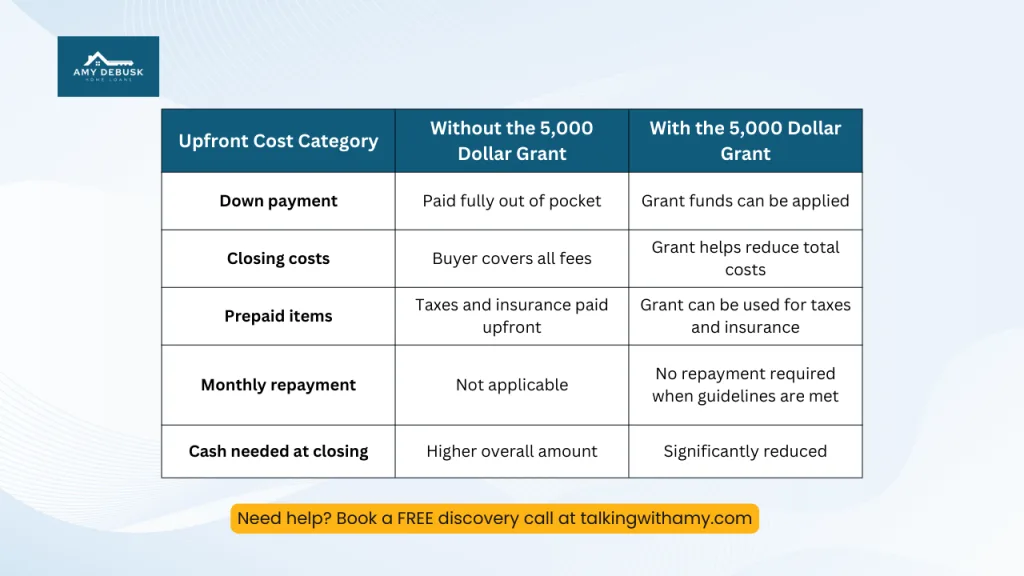
These funds may be used toward
- Down payment
- Closing costs
- Prepaid items such as property taxes and homeowners' insurance
One of the biggest benefits of this program is that the grant is not a loan. That means there are no monthly payments and no repayment required as long as all program guidelines are met. This can make a significant difference for first-time buyers who may have a stable income but limited savings.
It is important to note that this grant is tied to a specific loan type and comes with eligibility requirements related to income, credit, and property location. Because of this, the program must be reviewed and verified early in the homebuying process to ensure the buyer qualifies before moving forward. Working with a knowledgeable loan professional helps avoid surprises and ensures the grant is applied correctly from the start.
The Rule Most Buyers Do Not Know About Grants and Assistance
Here is the most misunderstood part of this program:
Eligibility is based on the buyer's current primary residence, not the home they are buying.
That means:
- Your current address must be in an approved census tract
- The home you purchase does not need to be in that census tract
This rule allows many buyers who currently live in qualifying areas to purchase homes elsewhere and still receive assistance.
This is checked through Fannie Mae's underwriting system, not a public map. At Amy DeBusk Home Loans, we verify this upfront so buyers do not miss out.
What Loan Is Required to Use This Grant?
To use this $5,000 assistance, buyers must qualify for a:
Fannie Mae HomeReady conventional loan
This is important:
- It is not available with FHA, VA, USDA, or Freddie Mac Home Possible loans
- The grant is specific to HomeReady
HomeReady loans allow:
- As little as 3 percent down
- Reduced mortgage insurance
- Flexible income guidelines
We explain how HomeReady compares to other first-time buyer loans in detail inside our First-Time Home Buyer Hub and at Home Readiness Launch.
What Credit Score Is Needed for the HomeReady First $5,000 Grant?
One of the most common questions first-time buyers ask is about credit score requirements. The good news is the HomeReady program was designed to be more flexible than many buyers expect, especially when paired with the HomeReady First $5,000 grant.
Minimum Credit Score to Qualify
In general, the minimum credit score to be eligible for a Fannie Mae HomeReady loan is 620.
That means:
- Buyers with a 620 score may qualify for the HomeReady mortgage
- Grant eligibility still depends on census tract, income limits, and full underwriting approval
- Automated underwriting approval is required
While a 620 score can open the door to homeownership, it is important to understand that qualifying does not always mean getting the best pricing. Buyers with higher credit scores often benefit from lower interest rates and reduced mortgage insurance costs, which can make a noticeable difference in monthly payments over time.
If your score is close to the minimum, a short period of credit improvement before applying may help you save money in the long run.
Even small improvements in your score can translate into real monthly savings. If you want a deeper breakdown of how timing and strategy affect your rate, here's a guide on how to get the lowest interest rate.
The Optimal Credit Score for Best Results
While 620 is the technical minimum, the optimal credit score range for the HomeReady program is typically 680 to 740.
Buyers in this range often benefit from:
- Lower mortgage insurance costs
- Better overall loan pricing
- Easier automated underwriting approvals
- More flexibility when layering down payment assistance
This is where a smart strategy can make a big difference. In some cases, taking a short amount of time to improve credit before applying can lead to significant long-term savings over the life of the loan. Even a modest score increase may improve affordability, strengthen approval odds, and create more options when layering assistance programs.
What If Your Credit Score Is Below 620?
If your credit score is not yet at 620, it does not mean homeownership is out of reach. It simply means you are in the preparation phase, and this phase can be one of the most powerful steps in the entire homebuying journey when done the right way.
Rather than guessing or waiting, having a clear plan can make all the difference. At Amy DeBusk Home Loans, we work closely with buyers to turn credit challenges into actionable next steps.
We help buyers
- Identify the specific credit factors holding their score down
- Build a clear and realistic plan to improve credit without unnecessary delays
- Align credit goals with the right homebuyer and grant programs from the start
With the right guidance, many buyers can make meaningful improvements in a shorter timeframe than they expect.
If you are unsure where you stand or want a personalized path forward, schedule a conversation at talkingwithamy.com and take the first confident step toward homeownership.
Boost Your Credit Score and Save on Your Mortgage
Your credit score plays a bigger role in your home loan cost than most buyers realize. Higher scores can unlock lower PMI, better interest rates, and stronger program options, especially with HomeReady. If your score isn't where you want it to be yet, don't worry. You don't have to guess what to do next.
We created a simple resource full of actionable credit score tips, easy steps, and clear guidance to help you raise your score faster and more effectively before you buy.
Visit: Boost Your Credit Score: Best Practices And Pro Tips
This page breaks down:
- What actually moves your score upward
- Mistakes that unintentionally lower your score
- How even small changes can reduce your mortgage costs long term
If your goal is to lower your monthly payment, expand your buying power, and qualify for better loan options, improving your credit score is one of the highest-impact steps you can take before starting the loan process.
Can This Grant Be Combined With Other Down Payment Assistance?
In many cases, yes. The HomeReady First 5,000 Dollar Grant can often be combined with other down payment assistance programs, which can significantly reduce the amount of cash a buyer needs to bring to closing.
Depending on eligibility, this grant may be layered with
- California Housing Finance Agency programs
- County and city-sponsored down payment assistance
- Forgivable second loans
- Local housing authority and community-based programs
Each assistance program has its own rules, including income limits, purchase price caps, and repayment terms. Because of this, proper structuring is critical. How these programs are combined can affect approval, loan terms, and overall affordability.
Working with a specialist helps ensure the programs are compatible and structured correctly from the start. When done right, layering assistance can reduce upfront costs and make homeownership possible sooner.
We break down real examples and program combinations inside our First Time Home Buyer Hub so you can see how these options work together.
Down Payment Assistance and Grants in Riverside, CA
Buyers searching for down payment assistance in Riverside, CA, often qualify for grant-based programs designed to reduce upfront costs.

Eligibility is typically based on household income, household size, and current residence. Because program rules vary by city and county, a personalized review is important to identify which options apply and how they can be combined with loan programs like HomeReady.
To see what may be available for your situation, schedule a personalized review at talkingwithamy.com and get clear guidance before you start shopping.
First-Time Homebuyer Grants in Sacramento, CA
Sacramento County includes many census tracts that qualify for first-time homebuyer grant and assistance programs. Buyers living in this area are often eligible for support that can help reduce down payment and closing costs.

Many buyers are surprised to learn that eligibility is often based on where they currently live, not where they plan to purchase. This means buyers living in these areas may qualify for assistance even when buying a home elsewhere.
A personalized review helps identify which grant programs apply and how they can be used alongside loan options to lower upfront costs and improve affordability.
Down Payment Assistance Programs in San Bernardino, CA
San Bernardino County offers strong opportunities for buyers looking for down payment assistance and grant-based programs. Many buyers in this area qualify for help that can significantly reduce upfront homebuying costs.

Eligibility is confirmed case by case and is typically based on current residence, household income, and program-specific guidelines. Some buyers living in these areas qualify for assistance even when purchasing in a different city.
California's primary housing agency, CalHFA, offers programs like the MyHome Assistance Program, which provides deferred-payment loans to help cover down payment and closing costs. (CalHFA)
Many buyers also compare state programs like CalHFA with options like Dream For All. If you are deciding between them, this breakdown of Dream For All vs CalHFA can help clarify which direction makes more sense.
Not All Down Payment Assistance Is a Grant
One of the biggest misconceptions is that all down payment assistance comes as free money.
In reality, assistance can come in several forms:
- Grants that do not require repayment
- Forgivable loans that are forgiven over time
- Deferred loans that are repaid when you sell or refinance
- Low-interest second loans
Understanding how each option works is important when choosing the right program for your situation.
Which Down Payment Assistance Option Is Best?
The right program depends on your financial goals, timeline, and how long you plan to stay in the home.
Some buyers prefer grants that don't require repayment, while others benefit from larger assistance amounts through deferred or forgivable loans.
This is something I help buyers evaluate every day, because the best option isn't always the one with the biggest dollar amount.
If you are still early in the process and want to see how everything fits together from pre-approval to closing, this complete first-time homebuyer guide walks you through each step in a simple way.
What Most Buyers Don't Realize About Down Payment Assistance
One of the biggest things I see is that many buyers assume they don't qualify or that these programs are too complicated.
In reality, there are often multiple programs available at the same time, and some can even be layered together depending on the loan type and eligibility.
The key is working with someone who understands how to structure these programs correctly so you maximize the benefit without creating issues later.
❓Grants and Down Payment Assistance for Buying a Home in California FAQs
❓1. Is the $5,000 HomeReady First assistance a loan, or do I have to pay it back?
The HomeReady First funds are a true grant, not a loan. That means there is no monthly payment and no repayment requirement when the program rules are followed. The grant is applied at closing and reduces the amount of cash you need to bring to the table. For many first-time buyers, this can be the difference between waiting and moving forward now
If you are new to grants and assistance programs, our First-Time Home Buyer Hub breaks down the difference between grants, forgivable loans, and standard down payment assistance in simple language.
❓2. Do I have to be a first-time homebuyer to qualify for the HomeReady First grant?
Most borrowers who use this program are first-time homebuyers, but being a first-time buyer is not the only qualifying factor. Eligibility is based on meeting Fannie Mae HomeReady guidelines, income limits, and census tract requirements tied to your current residence.
If you are unsure whether you are considered a first-time buyer or what that means legally, we explain it clearly at howtobuymyfirsthome.com, including common scenarios where buyers still qualify even if they owned a home in the past.
❓3. Does the home I am buying need to be located in an approved census tract?
No, and this is one of the most misunderstood parts of the program. The home you purchase does not need to be in an approved census tract. Instead, eligibility is based on where you live now.
Your current primary residence must be located in a qualifying census tract. This is verified through Fannie Mae's underwriting system, not a public map. We walk through how this works step by step inside our First-Time Home Buyer Hub, so buyers understand why this rule exists and how it helps more people qualify.
❓4. What type of loan is required to use the HomeReady First $5,000 grant?
The grant is only available when paired with a Fannie Mae HomeReady conventional loan. It is not available with FHA, VA, USDA, or Freddie Mac Home Possible loans.
HomeReady is designed specifically for buyers who have solid income but limited cash for a down payment. It allows for low down payment options, reduced mortgage insurance, and flexible qualifying guidelines. We explain how HomeReady compares to other first-time buyer loans in detail at howtobuymyfirsthome.com, so buyers can choose the right path confidently.
❓ 5. Can the HomeReady First grant be combined with other California down payment assistance programs?
In many cases, yes. The HomeReady First grant can often be layered with state, county, or city down payment assistance programs, as well as forgivable second loans and local housing authority grants.
However, every program has its own rules, and not all combinations are allowed. This is where expert structuring matters. Inside our First-Time Home Buyer Hub, we show real examples of how multiple programs can work together to minimize out-of-pocket costs while staying fully compliant.
❓6. How do I find out if my current address qualifies for the grant?
There is no public website where buyers can look this up themselves. Eligibility must be confirmed by running your current primary residence through Fannie Mae's underwriting system.
At Amy DeBusk Home Loans, we check this early in the process so there are no surprises later. If you want to get a head start before speaking with a lender, our free 2-minute quiz at mortgagemadeeasy.ai helps identify whether programs like this may fit your situation and provides a custom home buying plan.
❓7. What can the $5,000 HomeReady First grant be used for?
The $5,000 can be applied toward your down payment, closing costs, or prepaid items such as taxes and insurance. This flexibility allows us to structure the funds in a way that best supports your overall budget and long-term comfort.
Many buyers do not realize how closing costs work or how assistance is applied. We break this down visually and in plain language inside our First-Time Home Buyer Hub, so you always know where your money is going.
❓8. Is the HomeReady First grant available everywhere in California?
The HomeReady First grant is not available everywhere automatically. Availability depends on whether your current residence is located in an eligible census tract and whether you qualify for the HomeReady loan under current guidelines.
Because these details can change, the best first step is education. Our step-by-step roadmap at howtobuymyfirsthome.com explains the entire first-time home buying process from preparation to keys in hand, including how grants and assistance programs fit into the journey.
The HomeReady First funds are a true grant, not a loan. That means there is no monthly payment and no repayment requirement when the program rules are followed. The grant is applied at closing and reduces the amount of cash you need to bring to the table. For many first-time buyers, this can be the difference between waiting and moving forward now
If you are new to grants and assistance programs, our First-Time Home Buyer Hub breaks down the difference between grants, forgivable loans, and standard down payment assistance in simple language.
Most borrowers who use this program are first-time homebuyers, but being a first-time buyer is not the only qualifying factor. Eligibility is based on meeting Fannie Mae HomeReady guidelines, income limits, and census tract requirements tied to your current residence.
If you are unsure whether you are considered a first-time buyer or what that means legally, we explain it clearly at howtobuymyfirsthome.com, including common scenarios where buyers still qualify even if they owned a home in the past.
No, and this is one of the most misunderstood parts of the program. The home you purchase does not need to be in an approved census tract. Instead, eligibility is based on where you live now.
Your current primary residence must be located in a qualifying census tract. This is verified through Fannie Mae's underwriting system, not a public map. We walk through how this works step by step inside our First-Time Home Buyer Hub, so buyers understand why this rule exists and how it helps more people qualify.
The grant is only available when paired with a Fannie Mae HomeReady conventional loan. It is not available with FHA, VA, USDA, or Freddie Mac Home Possible loans.
HomeReady is designed specifically for buyers who have solid income but limited cash for a down payment. It allows for low down payment options, reduced mortgage insurance, and flexible qualifying guidelines. We explain how HomeReady compares to other first-time buyer loans in detail at howtobuymyfirsthome.com, so buyers can choose the right path confidently.
In many cases, yes. The HomeReady First grant can often be layered with state, county, or city down payment assistance programs, as well as forgivable second loans and local housing authority grants.
However, every program has its own rules, and not all combinations are allowed. This is where expert structuring matters. Inside our First-Time Home Buyer Hub, we show real examples of how multiple programs can work together to minimize out-of-pocket costs while staying fully compliant.
There is no public website where buyers can look this up themselves. Eligibility must be confirmed by running your current primary residence through Fannie Mae's underwriting system.
At Amy DeBusk Home Loans, we check this early in the process so there are no surprises later. If you want to get a head start before speaking with a lender, our free 2-minute quiz at mortgagemadeeasy.ai helps identify whether programs like this may fit your situation and provides a custom home buying plan.
The $5,000 can be applied toward your down payment, closing costs, or prepaid items such as taxes and insurance. This flexibility allows us to structure the funds in a way that best supports your overall budget and long-term comfort.
Many buyers do not realize how closing costs work or how assistance is applied. We break this down visually and in plain language inside our First-Time Home Buyer Hub, so you always know where your money is going.
The HomeReady First grant is not available everywhere automatically. Availability depends on whether your current residence is located in an eligible census tract and whether you qualify for the HomeReady loan under current guidelines.
Because these details can change, the best first step is education. Our step-by-step roadmap at howtobuymyfirsthome.com explains the entire first-time home buying process from preparation to keys in hand, including how grants and assistance programs fit into the journey.
Not Sure If You Qualify? Start With the Free 2-Minute Quiz
Instead of guessing, start with clarity. Take our free 2-minute quiz to get a quick snapshot of your homebuying options.
You will receive:
- A custom home buying plan
- Insight into grant and assistance options
- Clear next steps based on your readiness level
No pressure and no obligation. Just clear information to help you move forward with confidence.
Why First-Time Buyers Choose Amy DeBusk Home Loans
At Amy DeBusk Home Loans, first-time buyers are our specialty.
Buyers trust us because:
- We verify grant eligibility upfront
- We understand how to layer programs correctly
- We explain the process clearly
- We serve buyers across California
With over 25 years of experience, our mission is to make homeownership feel possible and organized.
Try Our Down Payment Assistance GPT
Instantly Explore Grant and Assistance Options
If you are searching for grants or down payment assistance to buy a home, you do not have to wait for a lender call just to get basic answers.
We built a free tool to help buyers explore options faster.

Try Our Down Payment Assistance GPT
This tool helps you:
- Explore down payment assistance and grant programs
- Understand which options may apply in your city or county
- Learn how assistance can reduce your out-of-pocket costs
- Get clarity before you apply for a loan
The Down Payment Assistance GPT is designed to educate, not sell. It gives you a clearer picture of what may be available so you can make informed decisions with confidence.
How This Tool Fits Into Your Home Buying Plan
Many buyers start by searching for "down payment assistance near me" or "grants for buying a house" and feel overwhelmed by conflicting information.
This tool works alongside our other resources:
- Our First-Time Home Buyer Hub for step-by-step education
- howtobuymyfirsthome.com for a full roadmap to homeownership
- Our free 2-minute quiz for a custom home-buying plan
When used together, these tools help you move from curiosity to clarity, replacing confusion with a clear path forward and confidence in your next step.
All Mortgage Made Easy articles · Book a Complimentary Discovery Call