If you're thinking about buying a home in Sacramento or Roseville, one of the biggest questions is:
How much do I actually need for a down payment?
Many buyers are surprised by how many options are actually available once you see them side by side.
I'm Amy DeBusk, a Branch Manager with over 25 years of experience, and I help buyers every day use FHA loans combined with down payment assistance programs to reduce upfront costs and make homeownership possible sooner than they expected.
The key is understanding what programs are available and how they fit into your overall loan strategy.
For buyers in Sacramento, Roseville, and throughout Northern California, FHA down payment assistance programs can significantly reduce the upfront cost of buying a home.
What Is the FHA Pathway Down Payment Assistance Program
The FHA Pathway Down Payment Assistance (DPA) Program was created to help buyers who qualify for an FHA loan but need help covering the upfront costs of purchasing a home. It pairs with a traditional 30-year fixed FHA mortgage, giving buyers a stable and predictable monthly payment while reducing the amount of cash required at closing.
Here is a simple breakdown:
- Your primary loan is an FHA 30-year fixed mortgage.
- The program provides either 3.5 percent or 5 percent of the purchase price or appraised value.
- These funds are used toward your down payment and closing costs.
- The assistance is offered as a second mortgage repaid over ten years at a fixed interest rate.
- There is no prepayment penalty.
This program is one of several FHA-based options buyers use to reduce upfront costs.
Down Payment Assistance Programs in Sacramento
Buyers in Sacramento have access to a range of down payment assistance programs at the state and local level.
Some of the most commonly used include:
- CalHFA programs, which offer deferred-payment assistance
- Sacramento Housing and Redevelopment Agency programs for income-qualified buyers
- Golden State Finance Authority programs that may offer forgivable assistance
Each program works a little differently depending on structure and repayment.
Why Sacramento and Roseville Buyers Choose the Pathway DPA Program
The Sacramento Valley and Placer County remain popular markets for first-time homebuyers because of strong schools, stable communities, and excellent long-term appreciation. Yet rising home prices mean buyers often need help with upfront costs, even when they can easily afford the monthly payment.
The Pathway DPA Program helps close that gap. It gives buyers the boost they need to cover the down payment and closing costs while keeping their first mortgage stable and affordable. This is one of the reasons so many buyers in Sacramento and Roseville choose this path.
Affordability often comes down to how the loan and assistance are combined.
How the FHA Loan with Down Payment Assistance Works
Understanding the steps of the FHA loan process can help you feel confident as you move toward homeownership. Here is a clear look at how the program works from start to finish.
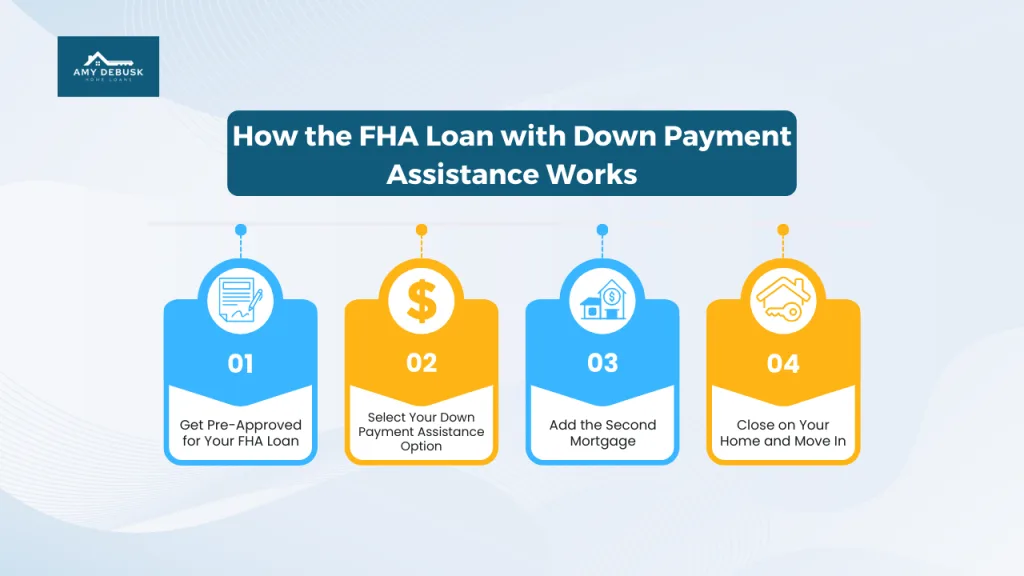
Step One: Get Pre-Approved for Your FHA Loan
The process begins with a full review of your income, credit, debt, and home buying goals. This allows your lender to determine how much you qualify for and what monthly payment fits your budget. A strong pre-approval not only sets realistic expectations but also positions you as a serious buyer when you begin shopping for a home.
Step Two: Select Your Down Payment Assistance Option
Eligible buyers can choose between 3.5 percent or 5 percent assistance based on the purchase price or the appraised value.
This assistance helps cover the required FHA down payment or closing costs, making the upfront cost of buying a home more manageable.
Step Three: Add the Second Mortgage
The assistance comes in the form of a second mortgage with a ten year fixed repayment term. The interest rate on this second lien is typically two percent higher than the rate on your primary FHA loan.
There is no penalty for paying the second mortgage off early, giving you flexibility as your financial situation improves.
Step Four: Close on Your Home and Move In
Once both loans are approved, you move forward to closing. You receive your keys and officially become a homeowner.
From the first day, you begin building equity while benefiting from predictable monthly payments and the stability of an FHA backed mortgage.
An FHA loan with down payment assistance can make buying a home more achievable and budget friendly. Ready to take the next step? Visit talkingwithamy.com to get started.
Key Benefits of the Pathway DPA Program
Before choosing a down payment assistance option, it helps to understand what sets the Pathway DPA Program apart. These key benefits highlight the flexibility and buyer friendly features that make this program a strong fit for many first time and repeat homebuyers.
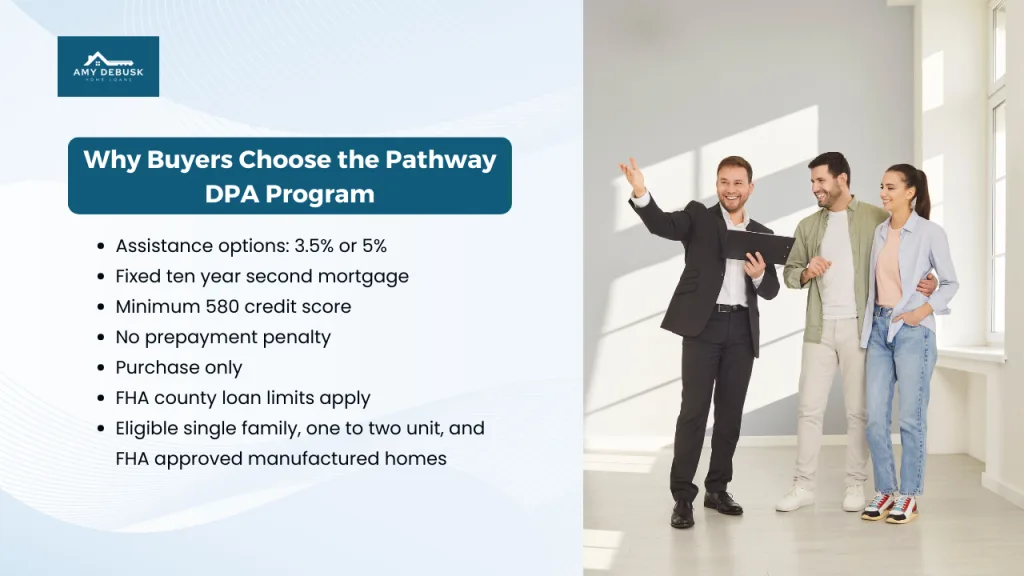
Assistance Options: Choose either 3.5 percent or 5 percent toward your down payment and closing costs, giving you flexibility based on your budget and home price.
Fixed Second Mortgage: Your assistance is structured as a second mortgage with a steady ten year repayment plan, making it simple to understand and plan for.
Credit Score Requirement: A minimum FHA credit score of 580 is required to qualify.
No Prepayment Penalty: You are free to pay off the second mortgage early at any time without any added cost.
Purchase Transactions Only: This program applies to home purchases only. It is not eligible for refinances.
Standard FHA Loan Limits: Your loan amount must fall within the FHA limits set for your county.
Eligible Property Types: Qualifying homes include single family residences, one to two unit properties, and FHA approved manufactured homes.
Not All Down Payment Assistance Is Free Money
One of the biggest misconceptions is that all down payment assistance comes as a grant.
In reality, assistance can come in different forms:
- Grants that do not require repayment
- Deferred loans with no monthly payments
- Forgivable loans that are forgiven over time
- Second mortgages that are repaid over time
- Understanding how each program works is key to choosing the right option.
How FHA Loans and Down Payment Assistance Work Together
FHA loans are one of the most commonly used loan types with down payment assistance programs.
For example, programs like CalHFA MyHome can provide around 3% to 3.5% of the purchase price as assistance to help cover your down payment or closing costs.
These are often structured as second loans with no monthly payment, with repayment triggered later when the home is sold or refinanced.
State Specific Guidelines: Alaska and South Carolina
In Alaska and South Carolina, the Pathway DPA Program requires the second mortgage to be at least five thousand dollars. If your calculated assistance amount comes in lower than that, it is automatically increased to meet the minimum requirement. This ensures the program follows state guidelines while still providing support toward your home purchase.
Should You Use FHA Down Payment Assistance?
This can be a great option if:
- You have steady income but limited savings
- You want to buy sooner instead of waiting years to save
- You qualify for FHA financing but need help with upfront costs
It may not be the best option if:
- You already have enough savings for a larger down payment
- You qualify for a conventional loan with better long-term pricing
- The assistance structure does not fit your long-term plans
This is why I help buyers compare all available options before moving forward.
Who Qualifies for the Pathway DPA Program
Qualifying for the Pathway DPA Program is often more accessible than buyers realize. Because it follows standard FHA guidelines, many applicants already meet most of the requirements. Here is what lenders look for when determining eligibility
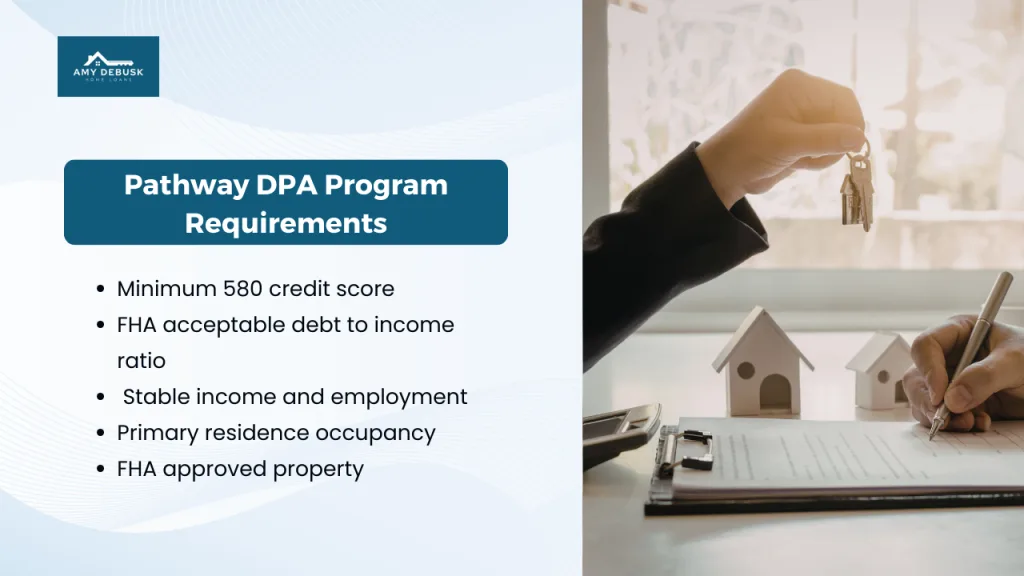
Minimum 580 credit score: A 580 score or higher allows you to qualify for FHA financing with the assistance option included. This makes the program flexible for buyers who are still building or rebuilding their credit.
FHA acceptable debt to income ratio: Your monthly debts compared to your monthly income must fall within FHA limits. This ensures that your new mortgage payment will remain manageable and sustainable long term.
Stable income and employment history: Lenders look for consistent earnings, whether you are salaried, hourly, or self employed. A steady income record helps demonstrate your ability to maintain mortgage payments.
Intent to occupy the home as your primary residence: The program is designed strictly for owner occupied homes, not investment or second properties. You must plan to live in the home full time.
FHA approved property: The home must meet FHA standards for safety, structural soundness, and market value. This ensures both the buyer and the lender are protected.
Many buyers are surprised to learn they already meet these guidelines or are very close. A brief conversation can reveal exactly where you stand and what steps can help you qualify even sooner.
Something else that matters more than people expect is the type of home itself. Not every property works the same with financing, so it's worth understanding that before you start looking.
If you want help reviewing your eligibility or have questions about the Pathway DPA Program, reach out anytime at talkingwithamy.com.
Important Notes for Borrowers
Understanding the program rules upfront helps keep your loan process smooth and prevents surprises along the way. Here are a few key guidelines to keep in mind
- Temporary buydowns are not permitted: Your interest rate must remain consistent without a temporary reduction at the start of the loan.
- The first and second liens are not assumable: Future buyers cannot take over your existing loans, even if terms are favorable.
- Homeowners insurance must include replacement cost coverage: This ensures that your home can be fully repaired or rebuilt in the event of a covered loss.
- Electronic signatures are allowed on most documents: You may e sign disclosures, but promissory notes and mortgage documents must be signed in person or using approved methods.
- You can prepay the second lien at any time: There is no penalty or fee if you decide to pay off the assistance loan early.
These guidelines help protect both the lender and the borrower while keeping the loan process transparent and efficient. If you need help understanding any part of the program, I can break it down for you.
CalHFA vs Flex Loans: Understanding the Differences
Many first time buyers in California are familiar with CalHFA, one of the most recognized down payment assistance options in the state. While CalHFA can be a solid fit for some borrowers, it also comes with strict requirements, mandatory fees, and higher upfront costs that not everyone can meet.
The Flex style FHA loan offers a more accessible path for buyers who need flexibility, fewer restrictions, and lower entry costs. Below is a simple breakdown that shows how the two programs differ and why the Flex option often becomes the more realistic choice for many buyers.
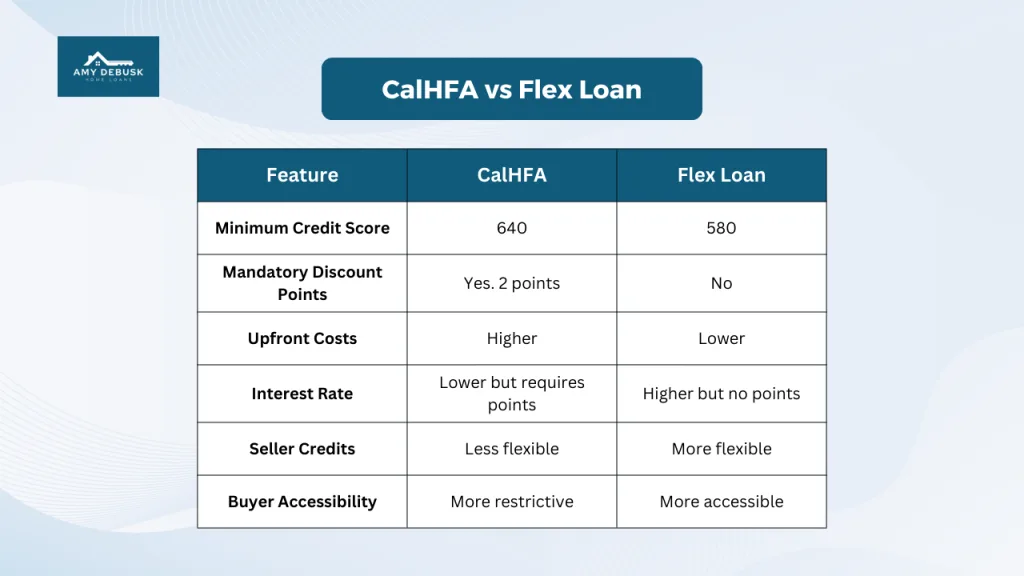
Credit Score Requirements
- CalHFA: Requires a minimum 640 credit score. Even a 639 disqualifies you.
- Flex Loan: Allows scores starting at 580, making it available to a much wider group of buyers.
Mandatory Discount Points
- CalHFA: Requires 2 discount points on the first mortgage. On a loan of 450 thousand dollars, that means nine thousand dollars in mandatory fees before even counting closing costs.
- Flex Loan: Has no mandatory discount points. This significantly lowers the upfront cost of buying a home.
Interest Rate Differences
- CalHFA: Advertises lower rates, but those lower rates require the mandatory discount points mentioned above.
- Flex Loan: Rates are usually about 1.50 percent higher. However, because the Flex loan does not require points, it often ends up being the more affordable option at closing.
Seller Credits: Why Flex Creates More Buying Power
Both programs allow seller credits, but the Flex loan makes those credits far more effective.
- CalHFA: Even if the seller contributes credits, buyers must still pay the mandatory discount points. This increases the amount of seller concessions needed, which is not always realistic in competitive markets.
- Flex Loan: Seller credits stretch much further since there are no required points. Credits can be used for
• Closing costs
• Prepaids
• Rate buydown
• Lowering cash to close
This gives Flex buyers more negotiating power and a smoother path to homeownership, especially for those working with limited funds.
To learn more about CalHFA in detail, be sure to read our previous blog, The Ultimate 2026 CalHFA Guide for First Time Homebuyers.
Real Buyer Success Story: How a 588 FICO Buyer Purchased a Home With a Pool in Modesto CA
One of my favorite moments in this business is watching families step into possibilities they did not believe were available to them. A recent Modesto family brought home that truth beautifully.
They came to me with a 588 FICO score, stable income, and a dream of owning their first home. They had been turned down by other lenders because they did not meet CalHFA's 640 score requirement. Their realtor referred them to me because they knew my specialty is helping buyers find solutions others overlook.
We used the FHA Flex Loan because it allows credit scores starting at 580 and does not require mandatory discount points. This immediately widened the path for them.
They found a lovely home in Modesto priced at $485,000, complete with a backyard swimming pool that captured their hearts. Because the market conditions favored buyers, I guided their realtor in negotiating a strong offer with an $18,000 seller credit.
We used the seller credit to:
- Lower their closing costs
• Buy their interest rate down
• Bring their monthly payment into a comfortable range
After applying the credit, their final rate landed at 6.125 percent, which made the payment affordable and aligned with their budget. They closed on their home with confidence and joy, thrilled to start their first summer in their own pool.
This story represents exactly what is possible when you combine the right loan strategy with expert guidance. Credit challenges did not stop them. The key was choosing the loan program that matched their needs and using negotiation strategy to shape a payment they felt great about.
What Most Buyers Don't Realize
One of the biggest things I see is buyers assuming they need to save for years before buying.
In reality, many buyers qualify for down payment assistance programs much sooner than they expect.
The challenge is not usually qualification. It's knowing what programs exist and how to structure them correctly.
❓FHA Pathway Down Payment Assistance Program for Sacramento and Roseville Homebuyers FAQs
❓ What is the FHA Pathway Down Payment Assistance Program?
The Pathway DPA Program is a repayable second mortgage that provides 3.5 percent or 5 percent assistance toward your down payment and closing costs. It pairs with a traditional FHA loan and helps reduce the upfront cash needed to purchase a home.
❓ What credit score do I need to qualify?
Buyers need a minimum FICO score of 580 based on FHA guidelines. This is one reason the Pathway Program is more accessible than CalHFA, which requires a strict 640 score to qualify.
❓ Is the assistance a grant that I do not have to repay?
No. The Pathway assistance is a second mortgage that is repaid over ten years at a fixed rate. There is no prepayment penalty, so you can pay it off early if you choose.
❓ Can I use this program for an investment property or second home?
No. The program is strictly for owner occupied primary residences. At least one borrower must live in the home full time.
❓ How does the Pathway DPA compare to CalHFA and Flex loans?
CalHFA requires a 640 credit score and charges 2 mandatory discount points, which increases your upfront costs. Flex loans allow buyers with scores as low as 580 and have no required discount points, which means seller credits go further and buyers can enter the market with less cash pressure.
❓ Can I use seller credits with the Pathway Program?
Yes. Seller credits can be used for closing costs, prepaid taxes and insurance, and buying down your interest rate. This helps reduce your cash to close and can improve your monthly payment.
❓ Do I need homebuyer education to qualify?
No. Homebuyer education is not required, although I always recommend guidance and coaching so buyers feel confident and prepared. My Home Readiness Launch program gives you the clarity and support you need for a successful purchase.
❓ Is the Pathway Program available nationwide?
The program is available in most states except New York. Alaska and South Carolina require a minimum assistance amount of five thousand dollars. I can help you understand the rules for your specific state.
The Pathway DPA Program is a repayable second mortgage that provides 3.5 percent or 5 percent assistance toward your down payment and closing costs. It pairs with a traditional FHA loan and helps reduce the upfront cash needed to purchase a home.
Buyers need a minimum FICO score of 580 based on FHA guidelines. This is one reason the Pathway Program is more accessible than CalHFA, which requires a strict 640 score to qualify.
No. The Pathway assistance is a second mortgage that is repaid over ten years at a fixed rate. There is no prepayment penalty, so you can pay it off early if you choose.
No. The program is strictly for owner occupied primary residences. At least one borrower must live in the home full time.
CalHFA requires a 640 credit score and charges 2 mandatory discount points, which increases your upfront costs. Flex loans allow buyers with scores as low as 580 and have no required discount points, which means seller credits go further and buyers can enter the market with less cash pressure.
Yes. Seller credits can be used for closing costs, prepaid taxes and insurance, and buying down your interest rate. This helps reduce your cash to close and can improve your monthly payment.
No. Homebuyer education is not required, although I always recommend guidance and coaching so buyers feel confident and prepared. My Home Readiness Launch program gives you the clarity and support you need for a successful purchase.
The program is available in most states except New York. Alaska and South Carolina require a minimum assistance amount of five thousand dollars. I can help you understand the rules for your specific state.
Why This Matters for Sacramento and Roseville Buyers
Buying a home is more accessible than many people believe. With the right guidance, the right program, and the right structure, homeownership becomes not only possible but sustainable.
This is why buyers trust me as the best mortgage broker in Sacramento and Roseville CA. My purpose is to simplify the process, remove confusion, and create a clear pathway that supports your goals and your financial wellbeing.
Final Thoughts
If saving for a down payment feels overwhelming, or if you have been told you do not qualify because of your credit score, the Pathway Down Payment Assistance Program or Flex loan may be the solution that changes everything.
You are likely closer to homeownership than you think. One conversation can reveal the possibilities waiting for you.
All loans subject to approval. Equal Housing Lender.
Next Steps on Your Path to Homeownership
No matter where you are starting from, the right guidance and tools can turn your goals into real progress. When you are ready to move forward, support is here every step of the way.
Join the Home Readiness Launch
This sixteen-week program helps you build a stronger financial foundation and a confident buyer mindset. You will learn practical strategies, establish healthy financial habits, and prepare yourself to step into the market with clarity.
Try SaveBot
SaveBot turns saving into a simple, engaging challenge. It helps you build momentum toward your down payment by making progress feel achievable and fun.
Schedule Your Personalized Mortgage Review
Let us look at your full financial picture and compare the options that best fit your goals. Whether it is the Pathway DPA Program, a Flex style FHA loan, CalHFA, or another strategy, you will receive a clear plan tailored to your path to ownership.
All Mortgage Made Easy articles · Book a Complimentary Discovery Call