
If you're thinking about buying a home and wondering if an FHA loan might be the right option, this is one of the most common starting points for first-time buyers.
FHA loans are one of the most widely used mortgage programs in California because they allow buyers to qualify with lower credit scores, smaller down payments, and more flexible guidelines.
I'm Amy DeBusk, a Branch Manager with over 26 years of experience, and I help buyers across Sacramento, Roseville, and Northern California navigate FHA loans every day.
In this guide, I'll walk you through how FHA loans work, the requirements in 2026, and how to decide if this program fits your situation.
If you're a first-time homebuyer wondering if it's possible, Rehnaz's story will inspire you.
Before you begin, feel free to grab your free tools created to help you get clarity fast:
- Take the free 2 minute quiz
- Get your free custom plan
- Access your free educational tools
What is an FHA Loan?
Let us start with the basics in a way that actually makes sense. An FHA loan is a mortgage backed by the Federal Housing Administration. The lender is the one giving you the money, but FHA provides insurance that reduces the lender's risk. Because of that protection, you get access to guidelines that are far more flexible than most traditional loan programs.
In practical terms, FHA loans are designed to help real people buy homes even when their financial picture is not perfect. They support first time buyers, borrowers with credit challenges, people carrying student debt, and buyers who simply need a more forgiving path into homeownership. FHA has become a trusted stepping stone for anyone who wants stability now and long term wealth later.
Think of FHA as the loan that says, "Life happens. You still deserve a chance to buy a home." It offers realistic credit requirements, low down payment options and more inclusive income rules. You can even use an FHA loan to buy a multi unit property, live in one unit and rent out the others, which is one of the easiest ways to begin building generational wealth.
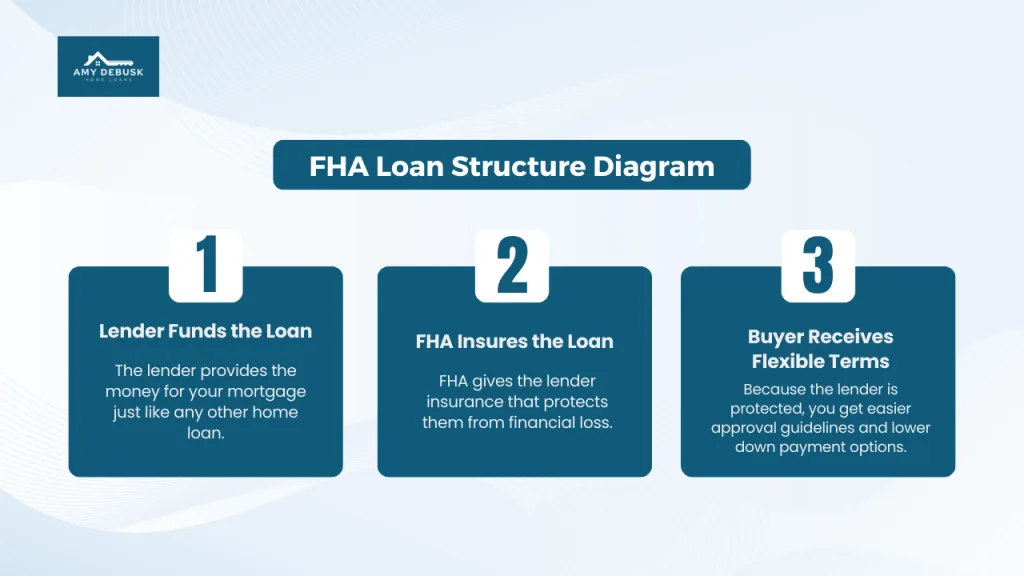
FHA loans are a powerful option for buyers who may not fit the traditional lending mold. They're designed to make homeownership more accessible for people who:
• Have lower credit scores
• Have limited funds for a down payment
• Are carrying student loan debt
• Earn non traditional or variable income
• Prefer a smoother entry point into the housing market
• Want to buy a duplex, triplex or fourplex and start building wealth through rental income
This guide breaks down how FHA loans work, why they were created and how they can open the door to homeownership sooner than you might expect. It's everything you need to understand whether FHA is the right path for you.
If you're exploring every option available, don't forget to read our previous blog: The Ultimate 2026 CalHFA Guide for First-Time Homebuyers. It's the perfect companion resource for your homebuying journey.
Why First Time Buyers Choose FHA Loans
FHA loans remain one of the most popular options for first time homebuyers because they are built with real life in mind. Not everyone has perfect credit, a large savings account or a long employment history, and FHA recognizes that. It is designed to make homeownership achievable for buyers who simply need a more flexible starting point.
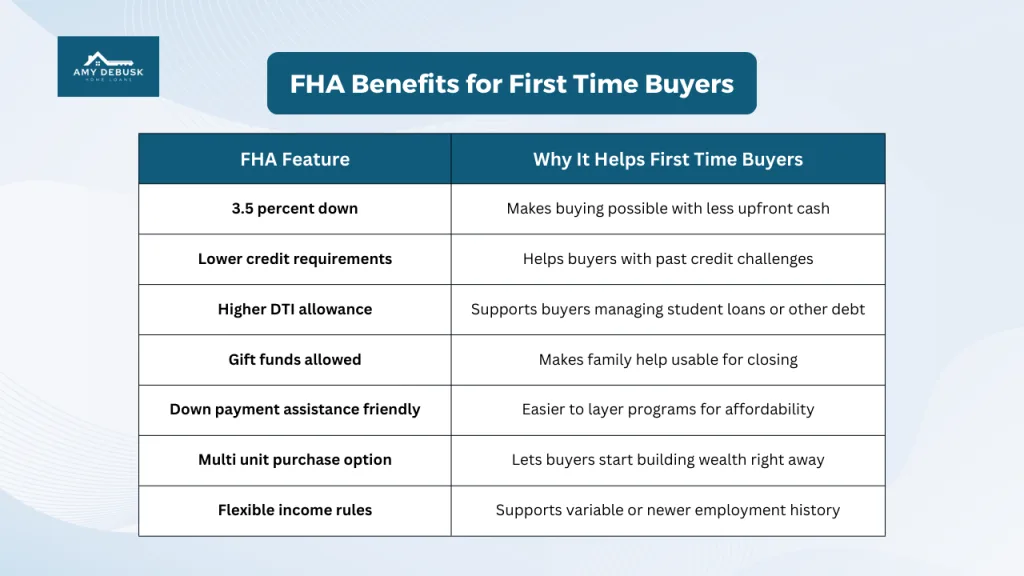
These features exist for one purpose to help you step into homeownership sooner instead of waiting years to save more money or build perfect credit. FHA is often the bridge between wanting to buy a home and finally getting the keys.
FHA Down Payment Requirements
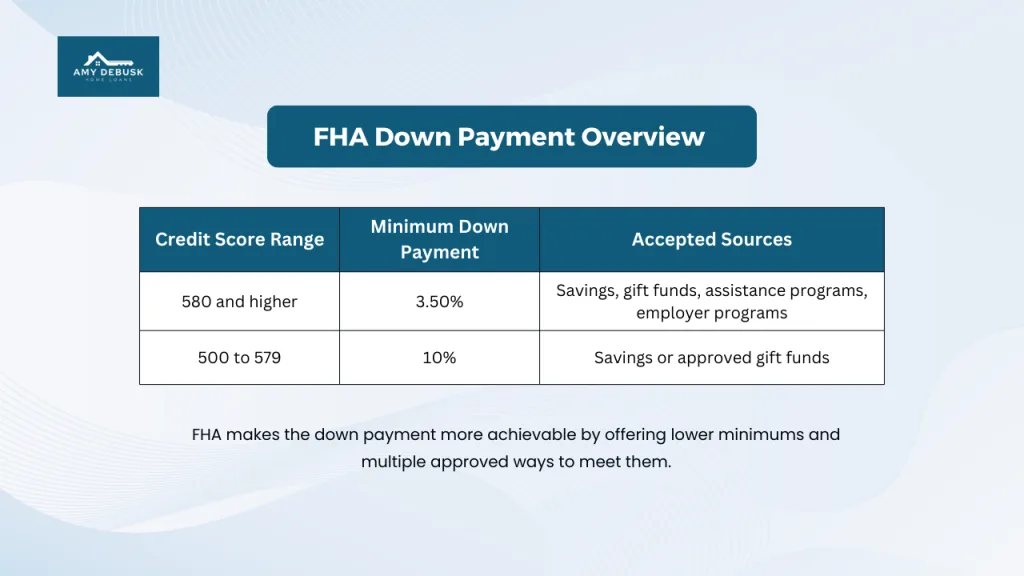
One of the biggest advantages of an FHA loan is how accessible the down payment can be. Unlike many traditional loan programs that expect buyers to bring in large upfront funds, FHA is designed to support buyers who are still building savings or working on their credit. This is what makes the program especially powerful for first-time homebuyers and anyone who needs a more realistic entry point into the market.
Another important benefit is that FHA allows several flexible ways to cover your down payment. Many buyers combine their own savings with help from family, a down payment assistance program or even employer-sponsored housing benefits. This flexibility opens doors for buyers who might otherwise believe they need to wait years before they can buy.
The truth is that the old idea of needing 20 percent down is one of the biggest myths in homeownership. FHA was created to break that barrier and give qualified buyers the chance to purchase a home much sooner. With clearer guidelines and more inclusive options, it often becomes the program that helps buyers move forward confidently instead of feeling stuck on the sidelines.
If you want a quick estimate of how much down payment you would personally need, you can take the free 2-minute quiz.
Credit Score Requirements: The Truth About FHA Credit Rules
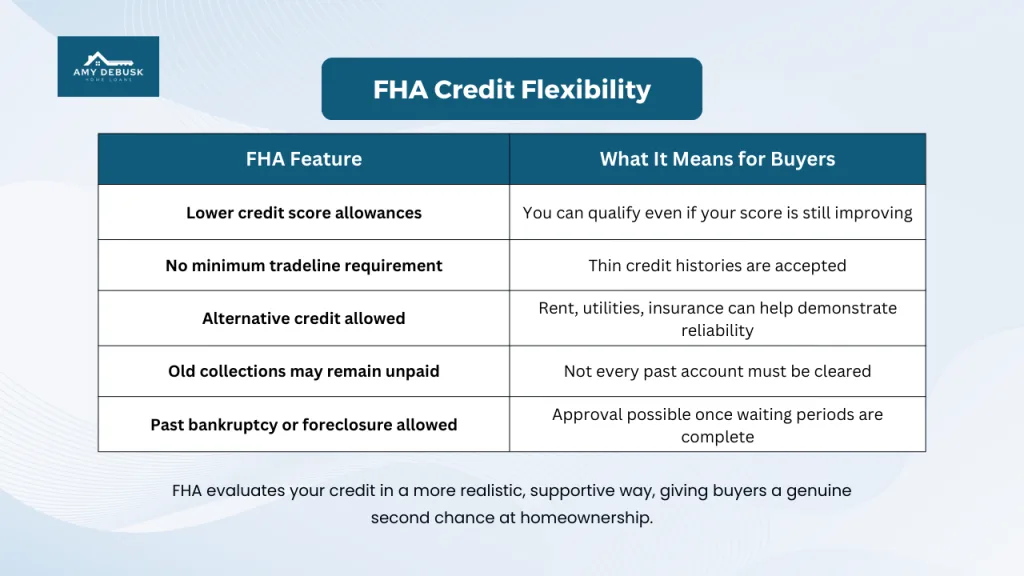
FHA was never created for buyers with perfect credit. It was designed for everyday people who are rebuilding, improving or simply trying to move forward after life has happened. Instead of judging borrowers on past mistakes, FHA focuses on whether you are ready to take a responsible step into homeownership today.
One of the biggest advantages of FHA is how flexible it is when evaluating credit history. The program recognizes that many qualified buyers have thinner credit histories, use alternative forms of credit or have older accounts that do not reflect their current stability. FHA also offers clear, structured paths for buyers who have experienced major life events such as bankruptcy or foreclosure, as long as the required waiting periods have passed.
Because of these features, FHA often becomes the program that sees possibilities where other loan options see risk. It gives buyers room to grow, rebuild, and re-enter the housing market with confidence rather than discouragement.
Credit is one of the biggest levers in your loan. Even small changes can shift your payment more than most people expect.
How FHA Loans Actually Work
One of the biggest misconceptions is that FHA loans are complicated.
In reality, they are designed to help buyers who may not qualify for traditional financing.
For example:
- You can qualify with a lower credit score
- You can use gift funds or assistance for your down payment
- You may qualify with higher existing debt
This flexibility is what makes FHA one of the most commonly used loan programs for first-time buyers.
Pros and Considerations of FHA Loans
Buying a home with an FHA loan can open doors, especially for buyers who may not qualify for conventional financing. But like any loan program, it comes with both advantages and trade-offs worth considering.
Pros
- Low down payment starting at 3.5%
- More flexible credit requirements
- Higher allowable debt-to-income ratios
- Access to down payment assistance programs
Considerations
- Mortgage insurance is required
- Property must meet FHA condition standards
- Loan limits vary by location
Taking a closer look at both the benefits and the limitations can help you decide if an FHA loan aligns with your financial goals and homeownership plans.
FHA is often the starting point, but it's not the only option. A lot of buyers compare it side by side with conventional loans before deciding what fits long-term.
What I'm Seeing in Sacramento and Northern California
In the Sacramento, Roseville, and Placer County markets, FHA loans continue to be one of the most common entry points for first-time buyers.
Many buyers are combining FHA loans with down payment assistance programs to reduce upfront costs and move into homeownership sooner.
Real Life Success Story: Rehnaz and Ali's Journey to a Brand New Home

When Rehnaz and her husband Ali reached out to us, they were convinced homeownership was years away. Ali's credit score was 562 and they felt stuck. We created a personalized credit plan, focused on a few key changes and tracked their progress closely. Over time, Ali's score rose to 582 and that twenty-point increase made all the difference.
With a qualifying score for FHA's 3.5 percent down program, they were able to buy a brand new home in Lincoln, California for $620,00. The seller covered their closing costs, so all they needed was the down payment. Today, they are living in their new home feeling proud and relieved, knowing they achieved something they once thought was out of reach. Their journey shows what becomes possible with the right guidance and a plan that actually works.
If you are ready to explore your own path to homeownership, start your conversation today at TalkingWithAmy.com.
Where to Find Official FHA Information
FHA loans are insured by the Federal Housing Administration under the U.S. Department of Housing and Urban Development. You can review official FHA guidelines here.
Employment and Income: What Really Matters When You Prepare for an FHA Loan
Your employment story matters just as much as your credit and savings. FHA needs to see that your income is steady and likely to continue, but the rules are far more flexible than most people expect. The goal is to understand your overall pattern, not hold you to a perfect work history.

How Long You Have Been Employed
FHA does not require you to stay with the same employer for two years. What it does require is a two year work history, which can include job changes, school or training programs, military service or different roles within the same field. FHA is looking for stability, not a flawless resume.
How Many Jobs You Have Had
Job changes alone are not a red flag. Employment gaps are what matter most. If you have moved from job to job without long breaks, FHA sees that as progress and continuity. Changes made for higher pay or career growth are viewed positively. But multiple gaps in a short period tell a different story and require deeper review.
If you want personalized guidance on how your work history fits FHA rules, visit TalkingWithAmy.com to get expert help tailored to your situation.
The Kiss of Death: Two Employment Gaps in a Single Year
FHA allows one employment gap without major concern. But two employment gaps of 30 days or more within a 12 month period create a pattern of instability.
This is known as the "kiss of death" in underwriting.
It does not mean you cannot ever qualify. It means you need:
- Six months back on the job consistently
• A renewed pattern of stability
• No additional gaps
If this is your situation, take the free quiz so we can build a recovery plan for you.
Hourly Employees: Why Your Hours Matter
Hourly employees are approved based on their average hours worked, not the scheduled hours listed.
FHA reviews:
- Hourly rate
- Hourly consistency
- Variability of schedule
- Whether hours trend up or down
A steady pattern is stronger than fluctuating hours.
Part-Time Employees
FHA allows part time income when:
- You have worked part time for at least two years
- Your hours are consistent
- The income is likely to continue
If you have less than two years, the application may still be approved if stability is clear.
Full-Time Employees
This is the simplest income type. FHA only needs:
- Current full time status
- Paystubs
- W2s
- Employer confirmation that income is expected to continue
Job changes are allowed.
Working Two Jobs
FHA will count second job income only when:
- You have worked the second job for at least one year
- Both jobs appear stable
- Both jobs are expected to continue
New second job income cannot be used.
Overtime, Bonus, and Commission Income
These income types can be used when:
- You have a 12 month history
- The income is stable or increasing
- There are no significant recent declines
FHA uses income averages to establish stability.
Debt to Income Ratio (DTI): What It Means in Real Life
Your debt to income ratio is a math problem lenders use to see how much of your monthly income already goes toward bills.
Think of it like this:
If your monthly income is a pizza with 8 slices, FHA wants to know how many slices are already being eaten by bills like:
- Car loans
- Student loans
- Credit cards
- Personal loans
The fewer slices used for bills, the more slices you still have available for a house payment.
FHA is more flexible than conventional loans. It lets you use more of your "pizza" for a house payment. That is why many buyers who cannot qualify for conventional loans can still qualify with FHA.
Many people qualify even if more than half of their income is being used for bills. FHA is designed to help real people with real budgets.
FHA Mortgage Insurance: What It Is and Why You Have It
FHA loans come with something called mortgage insurance. It protects the lender in case the buyer stops making payments. And that protection is what allows FHA to offer low down payments and helpful rules.
There are two parts to FHA mortgage insurance:
- Upfront Mortgage Insurance Premium (UFMIP)
This is a one time fee of 1.75 percent of the loan amount. Most buyers do not pay this out of pocket. It is added into the loan. - Monthly Mortgage Insurance
This is a small amount added to your monthly payment.
Here is the part most people do not know:
- If you put 10 percent down or more, the monthly mortgage insurance lasts 11 years.
- If you put less than 10 percent down, the mortgage insurance lasts for the entire loan. It is permanent unless you refinance into another type of loan.
A Simple Way to Understand It
Think of FHA mortgage insurance like a built in seatbelt. It keeps the lender safe so you can buy a home with a smaller down payment and more flexible approval rules. The seatbelt stays in place because it is part of what allowed you to get into the home with less upfront cost.
How You Can Fund Your FHA Down Payment
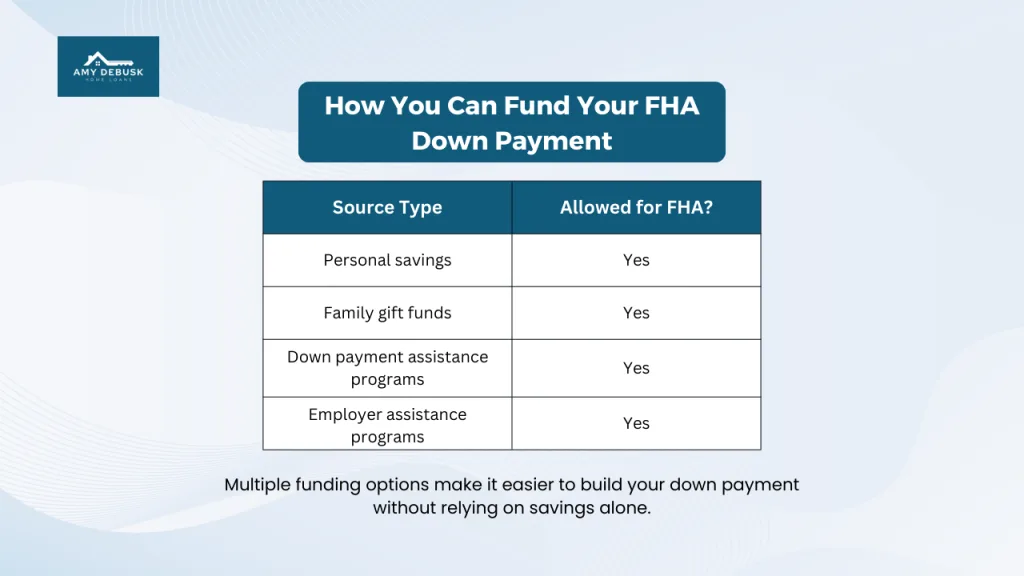
FHA loans give buyers far more flexibility when it comes to pulling together a down payment. Unlike some conventional programs that limit where your funds can come from, FHA allows a wide range of approved sources that can help reduce the pressure of saving everything on your own.
This flexibility is especially helpful for first-time buyers who are still building financial stability. Whether you're receiving help from family, benefiting from employer programs or using down payment assistance, FHA makes it easier to take the next step toward homeownership without waiting years to save up. By combining multiple funding sources, you can create a realistic and achievable path to buying your home sooner.
If you want to find out which programs you qualify for, take the quick 2-minute quiz and get instant clarity on your best next steps.
Credit Score Requirements: The Truth About FHA Credit Rules
FHA is not a program designed for perfect credit. It is designed for people rebuilding, people improving, and people who simply need a path forward.
FHA allows:
- Lower credit scores
- No minimum number of credit tradelines
- Alternative credit (rent, utilities, insurance)
- Old collections to remain unpaid in many cases
- Past credit challenges such as bankruptcy or foreclosure once waiting periods are complete
This program sees possibility where other programs may see risk.
Below is a real life example of what credit transformation can look like.
FHA Property Requirements: What the Home Must Look Like
FHA wants to make sure the home you buy is safe and livable. It does not have to be fancy. It does not have to be perfect. But it must meet basic safety and health rules.
Think of it as a "Mom Test."
If your mom walked into the house, she would want to know:
- Are there broken windows
- Is there chipped paint
- Are the handrails loose or missing
- Is the roof leaking
- Are the smoke detectors and carbon monoxide detectors working
FHA is simply making sure you are not buying a home with safety problems the seller should fix.
You are still allowed to buy older homes, fixer uppers, and homes that need cosmetic updates. FHA only cares about safety, not style.
Understanding FHA Terms in Simple Everyday Language
Buying a home comes with a lot of new vocabulary, but it does not have to feel overwhelming. Here are the key FHA terms explained in a way that actually makes sense.
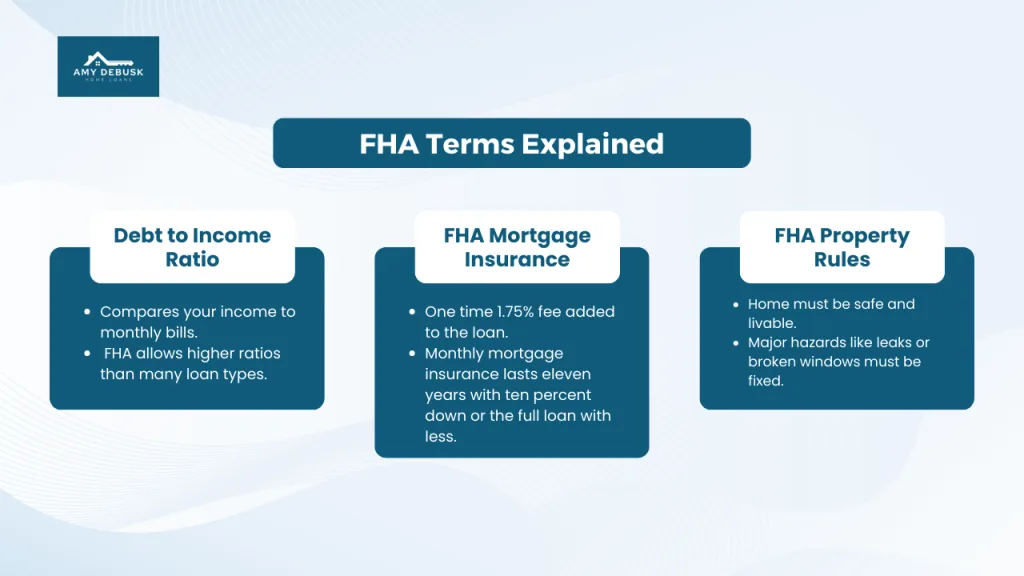
Debt to Income Ratio
This is just a comparison of how much money you earn each month versus how much goes toward bills. FHA allows a higher percentage of your income to be used for your house payment than many conventional loans do. This is especially helpful if you have student loans, car loans or other monthly obligations.
FHA Mortgage Insurance
FHA requires mortgage insurance because it allows you to buy a home with a smaller down payment. There are two parts. The first is a one time fee of 1.75 percent, and most buyers roll it into the loan. The second is monthly mortgage insurance. If you put ten percent down or more, it lasts eleven years. If you put less than ten percent down, it stays for the life of the loan. This insurance protects the lender and makes it easier for you to qualify.
FHA Property Rules
FHA wants to make sure the home is safe to live in. It does not have to be new or updated. It just cannot have safety hazards like broken windows, missing handrails, peeling paint, roof leaks or missing carbon monoxide detectors. These rules exist to protect you, not to complicate the process.
FHA is not trying to be strict. It is simply making sure you get a home that is safe, affordable and ready for you to enjoy. If you understand these basics, the rest of the process becomes much easier.
Buying a Multi Unit Property With FHA: Your Wealth Building Shortcut
FHA allows you to buy a duplex, triplex, or fourplex with only 3.5 percent down as long as you live in one unit.
This is where first time buyers become investors.
But there is a rule most people never hear:
You Can Only Use Rental Income if You Have a Documented Rental History
To use projected rental income from the other units, FHA must verify that you have paid rent consistently in the past.
FHA Terms Explained
- Canceled checks
- Bank statements showing rent withdrawals
- Verification of rent from a landlord
If you currently live with family and do not have documented rent payments, FHA will not allow the projected rental income to help you qualify.
You can still buy the property, but your personal income must support the payment.
How FHA Calculates Rental Income
FHA uses:
- The appraiser's market rent analysis
- Seventy-five percent of projected rents
- The self-sufficiency test for triplexes and fourplexes
This can dramatically boost buying power when allowed.
Take the free 2-minute quiz to see whether your income supports a multi-unit purchase.
Mindset, Meditations, and Your Path Home
Buying a home is not just a financial process. It is an emotional and energetic shift. You are stepping into a new identity. A homeowner identity. A wealth builder identity. A creator identity.
Your mindset shapes your outcome. The energy you bring to this journey matters.
This is why I created guided meditations on my podcast to support you. These meditations help you:
- Feel grounded
- Visualize homeownership
- Release fear
- Align your energy with possibility
- Connect with your future self as a homeowner
Your path home begins inside you long before you ever sign loan papers.
Should You Use an FHA Loan?
An FHA loan may be a strong fit if:
- Your credit score is below 680
- You have limited savings
- You need flexible approval guidelines
- You are buying your first home
It may not be the best option if:
- You have strong credit and qualify for a conventional loan
- You want to avoid long-term mortgage insurance
- You are buying an investment property
The goal is not just approval. It's choosing the right loan for your long-term financial path.
Final Thoughts: Your Path Home Begins Inside You
Buying your first home is not just a financial decision. It is an energetic decision. It is a moment when you choose stability, possibility, and a new level of identity. It is a shift from "I hope someday" into "I am someone who creates the life I desire."
Your mindset matters.
Your energy matters.
The way you speak to yourself matters just as much as the paperwork.
This is why I integrate mindset, clarity, and the Law of Attraction into everything I teach. Your inner world is the foundation of your outer results. When you believe you are worthy of owning a home and feel aligned with that reality, your decisions begin to match your vision.
If you want help strengthening that belief, I created guided meditations for you on my podcast. They are calming, grounding, and intentionally designed to align your energy with the experience of homeownership. They help you feel what it is like to open your front door, to settle into a space that belongs entirely to you, and to trust the process that is unfolding.
Your path home is not defined by where you start.
It is defined by the steps you take, the support you choose, and the belief that your life is always expanding in your favor.
If You Want Deeper Support, Start Here
Your journey does not end with reading a guide. It begins when you take action. That is exactly why I created the course at HowToBuyYourFirstHome.com, a complete learning experience built to give first time buyers the confidence, clarity and strategy they need to win in today's market.
Inside the course, you will learn everything that truly moves the needle for new buyers, including:
- Mindset that helps you stay focused and prepared
- Money fundamentals that set you up for success
- Credit tips that can improve your approval chances
- Loan programs and how to choose the right fit
- Strategies used by top one percent buyers
- Step by step guidance from a trusted expert
It is the roadmap I wish every first time buyer had when starting their journey.
 FHA Loans FAQs
❓ Can I buy a home with a low credit score using an FHA loan?
Yes. FHA allows lower credit scores than most other loan programs. Many buyers qualify with scores in the 500s. If your score is 580 or higher, you can put just 3.5 percent down.
❓ Do I need a big down payment for an FHA loan?
No. FHA is known for small down payments. Most buyers only need 3.5 percent. This helps people buy homes sooner instead of waiting years to save up.
❓ Is the mortgage insurance on FHA loans permanent?
Sometimes yes. If you put less than 10 percent down, the monthly mortgage insurance stays for the whole loan. If you put 10 percent or more down, it only lasts 11 years.
❓ Can I use gift money to buy a home with FHA?
Yes. Family members can help with your down payment and closing costs. FHA is very flexible about this.
❓ Can I buy a duplex or triplex with FHA?
Yes. You can buy up to a 4 unit property with only 3.5 percent down as long as you live in one of the units. This is a powerful way to build wealth.
❓ Can I use rental income from the other units to help me qualify?
Only if you have a documented rental history yourself. If you currently live with family and do not pay rent, FHA will not let you use future rental income to qualify.
❓ Can I qualify for an FHA loan if I work part time or hourly?
Yes. FHA can use part time or hourly income if it is steady and likely to continue. Your hours matter just as much as your hourly rate.
❓ Is buying a fixer upper allowed with FHA?
Yes, as long as the home is safe. FHA cares about safety and livability, not whether the home is pretty. Cosmetic issues are fine. Safety issues may need repair before closing.
Yes. FHA allows lower credit scores than most other loan programs. Many buyers qualify with scores in the 500s. If your score is 580 or higher, you can put just 3.5 percent down.
No. FHA is known for small down payments. Most buyers only need 3.5 percent. This helps people buy homes sooner instead of waiting years to save up.
Sometimes yes. If you put less than 10 percent down, the monthly mortgage insurance stays for the whole loan. If you put 10 percent or more down, it only lasts 11 years.
Yes. Family members can help with your down payment and closing costs. FHA is very flexible about this.
Yes. You can buy up to a 4 unit property with only 3.5 percent down as long as you live in one of the units. This is a powerful way to build wealth.
Only if you have a documented rental history yourself. If you currently live with family and do not pay rent, FHA will not let you use future rental income to qualify.
Yes. FHA can use part time or hourly income if it is steady and likely to continue. Your hours matter just as much as your hourly rate.
Yes, as long as the home is safe. FHA cares about safety and livability, not whether the home is pretty. Cosmetic issues are fine. Safety issues may need repair before closing.
Meet Savebot the Game Your Fun Way to Learn How Saving Really Works

Savebot the Game is a simple and surprisingly fun way to understand how saving money leads you closer to owning a home. Think of it like a video game where every dollar you save helps your character grow stronger and unlock new levels.
You begin with a tiny Savebot. It does not look like much at first, but it has one mission to collect money for your future home. Each time you save, Savebot powers up. Ten dollars makes it stronger. Fifty dollars helps it level up. The more consistent you are, the more powerful your Savebot becomes.
Savebot also protects your savings from impulse spending. It is like having a friendly little robot that pops up and asks, "Do we really need this right now or are we building toward your house?" It keeps you focused without making saving feel restrictive.
The magic of Savebot is consistency. Saving is not about one huge deposit. It is about small, steady steps that add up over time. Savebot celebrates every win, no matter how tiny, and reminds you that each step counts.
When your Savebot reaches the final level, it unlocks Homeownership Mode. That is the moment you have saved enough for your down payment or closing costs and you are ready to meet with your mortgage advisor.
Why Savebot Matters
It teaches discipline in a fun, low stress way.
It makes saving feel like a game instead of a chore.
It keeps you connected to your long term goals.
And most importantly, it keeps your eyes on the prize owning your first home.
Savebot becomes your financial sidekick, cheering you on, keeping you focused and helping you feel proud of every single step forward.
All Mortgage Made Easy articles · Book a Complimentary Discovery Call