How First-Time Home Buyers Can Buy a Home With $0 Down
When most buyers in Roseville and Placer County think about buying a home, they assume they need a down payment, perfect credit, or years of savings.
What many people don't realize is that USDA home loans in Sacramento and Placer County allow qualified buyers to purchase a home with zero down, competitive interest rates, and affordable monthly payments.
USDA loans in Roseville, CA and the surrounding Sacramento and Placer County areas can provide an affordable path to homeownership for buyers who meet income and property eligibility requirements.
One of the biggest advantages of a USDA loan is the ability to purchase a home with 100% financing, meaning no down payment is required for eligible buyers. This is where buyers start comparing USDA with other zero-down and low-down options to see what fits best.
This guide explains exactly how USDA loans in Roseville, CA work, who qualifies, which homes are eligible, and how to determine USDA loan eligibility in Northern California.
If you're exploring USDA loan options in Roseville, Sacramento, or surrounding areas, you can schedule a quick call with me to review your eligibility and next steps.
What Is a USDA Loan?
A USDA loan is a government-backed mortgage program designed to help low to moderate-income buyers purchase owner-occupied homes in eligible rural and suburban areas.
The program is backed by the U.S. Department of Agriculture and focuses on expanding homeownership by reducing upfront costs and improving affordability.
USDA loans offer several key benefits, including:
- 100 percent financing with no down payment required
- Competitive fixed interest rates
- Lower mortgage insurance costs compared to FHA loans
- Flexible credit guidelines
- Affordable monthly payments
Despite common misconceptions, USDA loans are not for farms, ranches, or agricultural businesses. They are designed for everyday buyers purchasing a primary residence in qualifying areas.
For buyers who meet the income and location requirements, a USDA loan can be one of the most affordable paths to homeownership available.
USDA Loan Eligibility Requirements in Roseville, CA
Understanding USDA loan eligibility is one of the most important steps before starting your home search.
To qualify, buyers must meet three key requirements:
- Income limits: USDA loans are designed for low to moderate income households. Total household income must fall within county limits, which vary based on household size.
- Location eligibility: The home must be located in a USDA eligible area. Many suburban areas around Roseville and throughout Placer County still qualify.
- Property type: The home must be a primary residence, single unit, and meet USDA safety and livability standards.
Because USDA eligibility in Northern California can vary by location and household situation, it's important to review these factors early. This is usually the point where getting fully pre-approved helps avoid surprises once you start looking at homes.
Are USDA Loans Available in Roseville and Sacramento?
One of the most common questions I get is whether USDA loans are actually available in areas like Roseville and Sacramento.
While USDA loans are designed for rural and suburban areas, many locations just outside major cities may still qualify.
In Placer County and surrounding areas, I often see USDA-eligible homes in communities like Lincoln, Wheatland, and Sheridan, which can provide great opportunities for buyers looking for more affordable options.
These areas are often overlooked by buyers, but they can be some of the best opportunities for using a USDA loan effectively.
Eligibility is based on USDA property maps, so it's important to verify the exact location before assuming a property qualifies.
I help buyers check eligibility early in the process so there are no surprises.
USDA Loans Near Roseville, CA: The Big Misconception
One of the biggest myths about USDA loans is that they only apply to homes located far away from cities. That is not true.
USDA eligibility is based on population density, not how close a property is to a major city. As a result, many areas just outside of Roseville still qualify for USDA financing.
Eligible locations often include:
- Lincoln, CA
- Sheridan, CA
- Portions of Placer County
- Portions of Yuba County
- Portions of El Dorado County
- Smaller surrounding communities
Homes located just minutes from shopping, schools, and major roadways may still meet USDA eligibility requirements.
At Amy DeBusk Home Loans, we help buyers verify property eligibility early in the process so there is no guesswork once house hunting begins.
Are There USDA Eligible Areas in Roseville and Sacramento?
One of the most common questions is whether USDA loans are actually available in areas like Roseville and Sacramento.
While USDA loans are designed for rural and suburban areas, many locations just outside major cities, including parts of Placer County and surrounding communities, may still qualify.
Eligibility is based on USDA property maps, not city boundaries. This means homes just outside high-density areas can still meet USDA loan eligibility requirements.
Amy DeBusk helps buyers verify eligibility early in the process so there are no surprises once they begin house hunting.
How to Check If a Home Qualifies for a USDA Loan
Buyers can start by checking property eligibility using the official USDA property eligibility map. By entering the home's address, the map will indicate whether the property is located in a USDA-eligible area.
While this tool is helpful, it should only be considered a starting point. USDA eligibility maps can change, some properties require additional review, and the condition of the property must still meet USDA standards.
Because of these factors, it is important to confirm eligibility with an experienced USDA mortgage broker before writing an offer. Doing so helps prevent surprises later in the process and ensures the home meets all program requirements before you move forward.
Key Benefits of USDA Loans for First-Time Buyers
USDA loans can be especially powerful for first-time buyers in and around the Roseville area because they remove several of the most common barriers to homeownership.

Zero Down Payment
USDA loans allow buyers to finance 100 percent of the purchase price, meaning no down payment is required. This can be a major advantage for first-time buyers who may have strong income but limited savings. Instead of draining cash reserves, buyers can preserve funds for emergencies, furnishings, moving expenses, or future financial goals.
Competitive Interest Rates
Because USDA loans are backed by the federal government, lenders are able to offer competitive fixed interest rates. In many cases, these rates are lower than those available on conventional loans, which can significantly reduce monthly payments and long-term interest costs.
Lower Mortgage Insurance Costs
USDA mortgage insurance is typically lower than FHA mortgage insurance. While USDA loans do require both an upfront and an annual guarantee fee, the overall cost is often more affordable over time. Lower mortgage insurance helps keep monthly payments manageable and improves long-term affordability.
Seller Credits Allowed
USDA loans allow sellers to contribute toward the buyer's closing costs. This can further reduce the amount of cash needed to close, making homeownership more accessible for first-time buyers. When combined with zero down payment, seller contributions can make it possible to purchase a home with very little money out of pocket.
For buyers who meet the income and location requirements, USDA loans can offer one of the most affordable and flexible paths to first-time homeownership available today.
For buyers still early in the process, it also helps to understand the full homebuying path before choosing a loan.
USDA Credit Score Requirements Explained
USDA loans are often more flexible than buyers expect, especially when compared to conventional financing. While a credit score is important, USDA approval is based on the strength of the overall loan application rather than a single number.
In many cases, buyers can qualify for a USDA loan with a credit score as low as 580. Approval at lower scores depends on several supporting factors and strong overall credit behavior.
What matters most for USDA approval includes consistent on-time payment history, stable income and employment, reasonable debt levels, and the absence of recent major derogatory credit events such as foreclosure or bankruptcy.
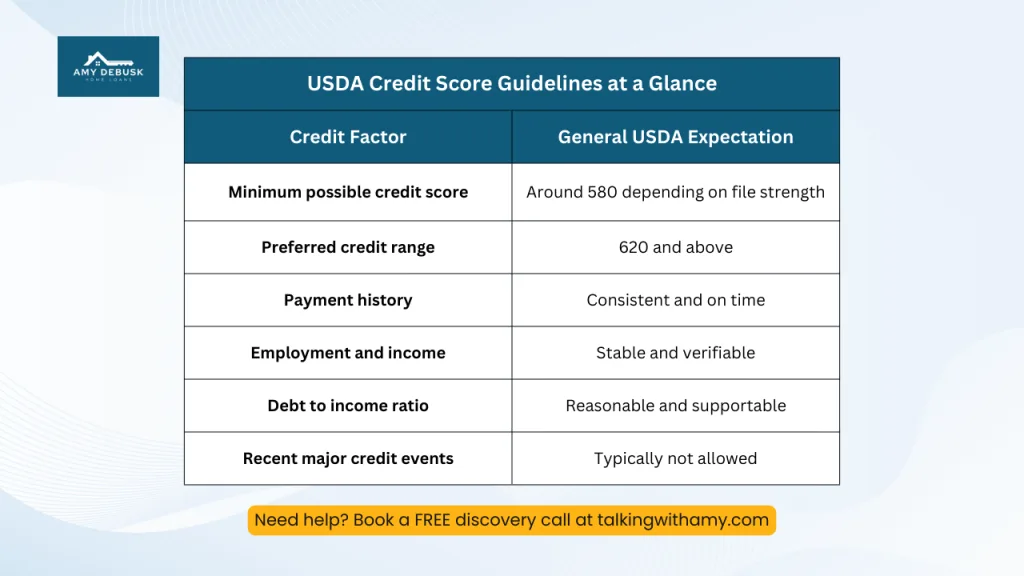
Important Credit Score Clarifications
USDA lenders use true mortgage FICO scores, not the scores shown in Credit Karma or similar consumer apps. Credit is pulled from all three major credit bureaus, Experian, Equifax, and TransUnion.
The qualifying credit score is the middle score of the three bureaus. It is not the highest score, and not an average of all three.
Many buyers assume they qualify based on what they see online, only to learn later that their mortgage FICO score is lower or different. Reviewing your true credit profile early allows time to make improvements if needed and helps avoid disappointment once you begin shopping for a home.
Understanding how USDA credit qualification works puts buyers in a stronger position and leads to a smoother home-buying process.
Your credit score doesn't just affect approval; it directly impacts your monthly payment. Even small improvements can make a noticeable difference. Here's a breakdown of how to get the lowest interest rate and position yourself for better terms.
USDA Income Limits: Why This Matters More Than You Think
USDA loans are designed for low-to-moderate income households, which means income is reviewed carefully.
USDA looks at total household income, not just the income of the borrowers on the loan.
This includes:
- Wages
- Overtime
- Bonuses
- Business income
- Income from other adults living in the home
If someone lives with you and earns income, that income may be counted even if they are not on the loan.
Income limits vary by county and household size, which is why working with a local USDA mortgage broker matters. A knowledgeable lender can calculate household income correctly, confirm the applicable limits, and help you determine eligibility before you begin house hunting.
Understanding USDA income limits early can save time, reduce frustration, and prevent surprises later in the process.
USDA Debt-to-Income Ratios Are More Restrictive
One of the most important differences between USDA loans and other mortgage programs is how strictly debt-to-income ratios are applied.
USDA loans typically limit total debt-to-income ratios to around 41 percent. This means your combined monthly debts plus the new mortgage payment must stay within that range.
In practical terms, this often affects buyers in the following ways:
- Car payments reduce how much home you can afford
- Student loans can significantly limit purchasing power
- Credit card balances impact approval more than many expect
- Higher-priced homes may fall outside USDA limits
Some flexibility may exist when a borrower has strong compensating factors such as higher credit scores, stable long-term income, or additional cash reserves. Even so, USDA underwriting remains more conservative overall.
Important Note
Because of these stricter ratios, getting pre-approved early is critical. Buyers who wait until they find a home often discover too late that their debt-to-income ratio limits their options.
If you want to understand your USDA buying power before you start house hunting, schedule a free conversation at talkingwithamy.com.
What Types of Homes Are Eligible for USDA Loans?
USDA loans are intended for modest, safe, owner-occupied homes that will serve as a buyer's primary residence. The program is designed to support everyday homeownership, not investment or rental activity.
If you are unsure which property types work best with different loan programs, this guide breaks down the types of homes first-time buyers can purchase and how financing applies to each.
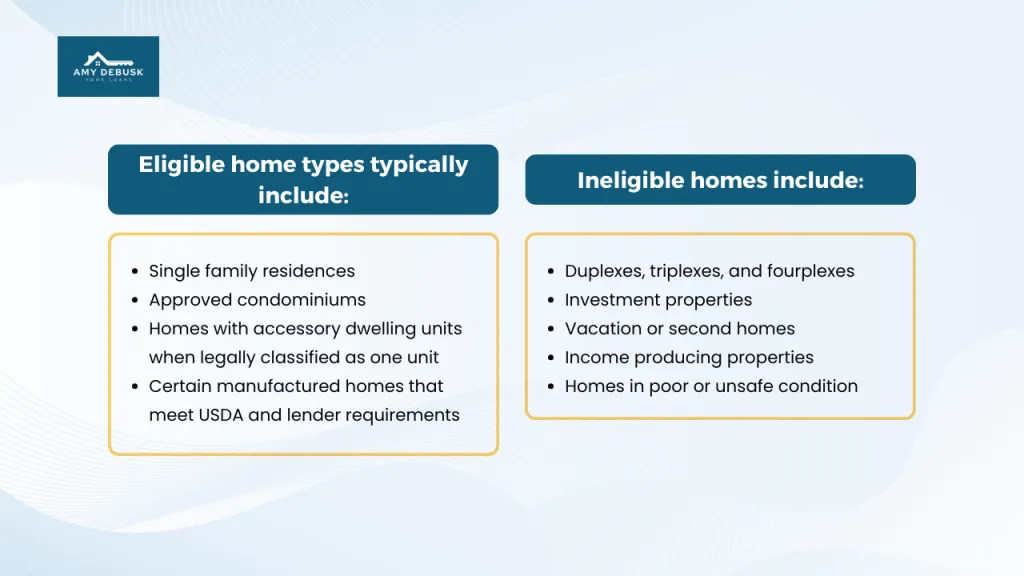
To be approved for a USDA loan, the property must be one unit, owner-occupied, and structurally sound and safe. Confirming property eligibility early can prevent costly delays and ensure a smoother home-buying process.
Manufactured Homes and USDA Loans
Manufactured homes can qualify for USDA financing, but only when very specific requirements are met. USDA applies stricter standards to manufactured housing because of long term safety and durability concerns.
To be eligible for a USDA loan, a manufactured home must meet all of the following criteria:
- Be permanently affixed to an approved foundation
- Carry proper HUD certification
- Have approved tie downs and anchoring systems
- Not having been moved from its original installation site
Because these requirements are strict and subject to lender review, manufactured homes are an area where USDA experience matters significantly. Confirming eligibility early with an experienced USDA lender can help prevent delays, contract issues, and unexpected denials later in the process.
USDA Appraisal and Property Condition Standards
USDA appraisals place a strong emphasis on the overall condition of the home. The goal is to ensure the property is safe, structurally sound, and fully livable at the time of closing.
During a USDA appraisal, the appraiser closely evaluates the following areas:
- Safety
- Structural integrity
- Habitability
If issues are identified, repairs may be required before the loan can move forward. Common items that often trigger repair requirements include:
- Roof damage or leaks
- Electrical or plumbing problems
- Health and safety hazards
- Peeling or chipping paint on older homes
USDA does not allow homes to close with unresolved safety or livability concerns. This is why evaluating property condition early is especially important, particularly when making an offer on an older home.
At Amy DeBusk Home Loans, we help buyers understand USDA appraisal standards upfront and identify potential red flags early, helping prevent costly delays and last-minute surprises during escrow.
USDA vs FHA vs Conventional Loans
USDA loans are not the right fit for every buyer. However, when a buyer qualifies, USDA can often be the most affordable option available. Understanding how USDA compares to FHA and conventional loans helps buyers choose the loan that best matches their financial situation.
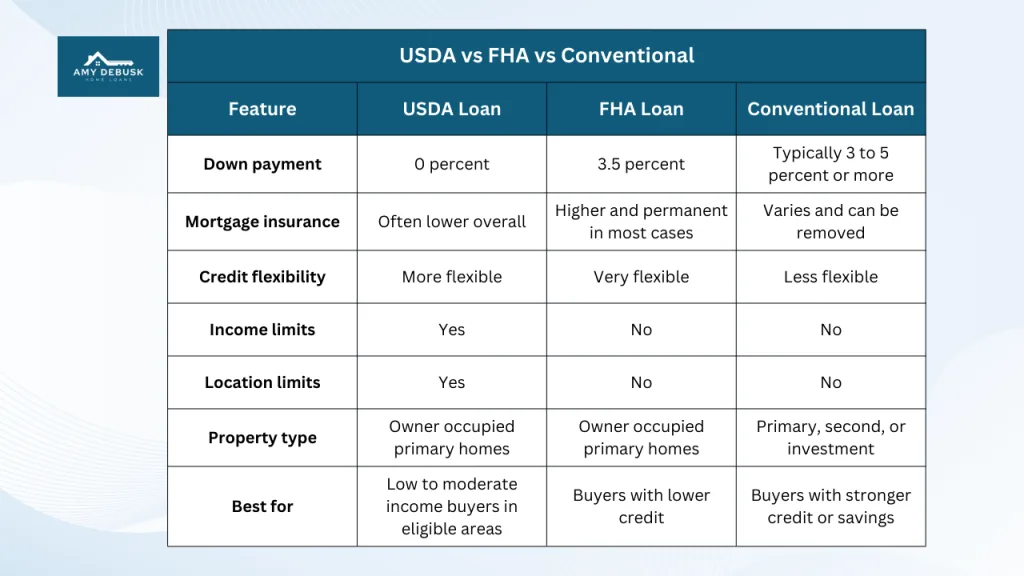
USDA vs FHA Loans
USDA loans offer zero down payment, while FHA requires at least 3.5 percent down. USDA mortgage insurance is often lower than FHA, which can result in lower monthly payments over time. FHA loans do not have geographic or income limits, making them more widely accessible, while USDA loans are restricted by both location and household income.
USDA vs Conventional Loans
USDA loans allow 100 percent financing, which can significantly reduce upfront costs. Conventional loans often require higher credit scores or a larger down payment, especially for the best rates. Conventional loans do not have income or location limits and offer more flexibility for different property types.
Choosing the right loan depends on your full financial picture, including credit, income, savings, location, and long-term goals. A loan that looks good on paper may not always be the most affordable option over time.
If you want a deeper breakdown of how FHA and conventional loans compare, read our previous blog FHA vs Conventional Loans: The Real Differences Every Homebuyer Needs To Know.
Why USDA Loans Are Popular Around Roseville and Placer County
USDA loans are especially popular in and around Roseville and Placer County because they align well with local home prices and property types just outside major population centers.
In communities such as Lincoln, Sheridan, and the surrounding areas, USDA loans often work exceptionally well for several reasons:
- Purchase prices tend to be more moderate compared to central Roseville
- Properties in these areas are more likely to fall within USDA-eligible zones
- Buyers benefit the most from zero down financing when home prices are reasonable
Many buyers are surprised to learn how close USDA-eligible areas are to Roseville, often just a short drive from shopping, schools, and major commuter routes.
For buyers who want to stay near Placer County while minimizing upfront costs, USDA loans can be a powerful and often overlooked option.
Why Working With the Best USDA Mortgage Broker Matters
USDA loans are not difficult, but they are very specific. Small missteps can create major problems if they are not caught early in the process.
Some of the most common issues we see include:
- Incorrect household income calculations
- Missing income from other adults living in the home
- Misunderstanding property eligibility
- Debt-to-income ratios are pushing buyers out of range
At Amy DeBusk Home Loans, USDA loans are reviewed carefully before buyers ever write an offer. This proactive approach helps eliminate surprises in the middle of a transaction and protects buyers from losing time or earnest money.
We specialize in helping first-time buyers determine:
- Whether USDA is the right loan option
- What purchase price truly makes sense
- Which areas and properties qualify
- How to structure the loan correctly from the start
If you are considering a USDA loan near Roseville or Placer County and want clear answers before house hunting, schedule a free consultation at talkingwithamy.com.
Steps to Take If You're Interested in a USDA Loan
If you are considering a USDA loan, these steps will help you determine eligibility, set expectations, and avoid surprises later in the process.
Check property eligibility using the USDA map
Start by confirming that the home is located in a USDA-eligible area. Many homes just outside city limits qualify, but eligibility must be verified by address. This step helps narrow your home search early.
Review the total household income
USDA reviews income from all adults living in the household, not just the borrowers on the loan. This can include wages, overtime, bonuses, or other income sources. Reviewing this early helps confirm whether you fall within county income limits.
Pull the true mortgage FICO score
Mortgage lenders use FICO scores from Experian, Equifax, and TransUnion. The qualifying score is the middle of the three. Free credit apps often show different scores, so knowing your real mortgage credit is critical.
Get pre-approved with a USDA-experienced lender
Pre-approval includes reviewing credit, income, debt-to-income ratios, and documentation under USDA guidelines. This step confirms how much home you can realistically afford and whether USDA is a good fit.
Compare USDA to FHA and conventional loan options
While USDA offers zero down financing, it is not always the best choice for every buyer. Comparing loan programs helps ensure you choose the option that aligns with your credit, income, location, and long-term goals.
Preparation creates confidence. When these steps are completed early, buyers can move forward knowing exactly where they stand and which homes truly work for their situation.
For many buyers, FHA becomes the most common alternative depending on location and income limits.
Should You Use a USDA Loan?
A USDA loan can be one of the most affordable ways to buy a home, but it depends on your situation.
This program may be a strong fit if:
- You are within USDA income limits
- You are purchasing in a USDA eligible area
- You want to minimize your upfront cash investment
- You are buying a primary residence
It may not be the best option if:
- The property is outside USDA eligible areas
- Your income exceeds USDA limits
- You are purchasing an investment property
This is why I always walk buyers through all available options before choosing the right loan strategy.
The Bottom Line
USDA loans are one of the most powerful zero-down loan options available for first-time buyers in and around Roseville, CA, when they are used correctly.
They offer meaningful advantages, including:
- Zero down payment
- Affordable monthly payments
- Competitive interest rates
At the same time, USDA loans require careful planning and proper guidance. Buyers must be prepared for:
- Detailed household income review
- More conservative debt-to-income limits
- Strict property and location eligibility
When these details are handled correctly, USDA loans can open doors to homeownership that many buyers did not realize were possible. The key is understanding the rules early and working with a lender who knows how to navigate them properly.
If you want to see how real buyers navigate these decisions and successfully purchase with the right strategy, here's a real first-time homebuyer success story you can learn from.
❓ USDA Loans in Roseville, CA FAQs
❓ 1. Do USDA loans really require no down payment?
Yes. USDA loans allow 100 percent financing, meaning no down payment is required. This is one of the biggest advantages of the program and a major reason USDA loans are so popular with first-time buyers who want to preserve savings.
❓ 2. Can I use a USDA loan if I live near Roseville, CA?
Possibly. USDA eligibility is based on property location, not proximity to a city. Many areas just outside Roseville qualify, including parts of Lincoln, Sheridan, and surrounding Placer and Yuba County communities. The only way to know for sure is to check the address on the USDA property eligibility map and confirm with a USDA-experienced mortgage broker.
❓ 3. What is the minimum credit score for a USDA loan?
USDA loans can allow credit scores as low as 580, depending on the overall strength of the application. Higher scores make approvals smoother, but payment history, income stability, and overall financial behavior matter just as much as the score itself.
❓ 4. Why is USDA income calculated differently than other loans?
USDA looks at total household income, not just the income of the borrowers on the loan. This includes income from other adults living in the home, even if they are not on the mortgage. This is one of the most misunderstood USDA rules and why early review is critical.
❓ 5. Why do USDA loans have lower buying power than FHA or conventional?
USDA loans typically limit debt-to-income ratios to around 41 percent, which is more conservative than FHA or conventional loans. This can make it harder to qualify for higher purchase prices, especially if you have car payments, student loans, or other monthly debts.
❓ 6. What types of homes are not allowed with USDA loans?
USDA loans cannot be used for:
• Duplexes or multi-unit properties
• Investment or rental properties
• Vacation or second homes
• Income-producing properties
• Homes that do not meet basic safety and livability standards
USDA loans are strictly for one-unit, owner-occupied homes.
❓ 7. Are manufactured homes allowed with USDA loans?
Yes, but only if they meet strict requirements, including a permanent foundation, HUD certification, and proper installation standards. Manufactured homes are one of the most technical areas of USDA lending and should always be reviewed early.
❓ 8. Is USDA better than FHA or conventional loans?
There is no one-size-fits-all answer. USDA loans are often the most affordable option for buyers who qualify, but FHA or conventional loans may offer more flexibility in higher-priced areas or for buyers with higher incomes. The best loan depends on your full financial picture.
Yes. USDA loans allow 100 percent financing, meaning no down payment is required. This is one of the biggest advantages of the program and a major reason USDA loans are so popular with first-time buyers who want to preserve savings.
Possibly. USDA eligibility is based on property location, not proximity to a city. Many areas just outside Roseville qualify, including parts of Lincoln, Sheridan, and surrounding Placer and Yuba County communities. The only way to know for sure is to check the address on the USDA property eligibility map and confirm with a USDA-experienced mortgage broker.
USDA loans can allow credit scores as low as 580, depending on the overall strength of the application. Higher scores make approvals smoother, but payment history, income stability, and overall financial behavior matter just as much as the score itself.
USDA looks at total household income, not just the income of the borrowers on the loan. This includes income from other adults living in the home, even if they are not on the mortgage. This is one of the most misunderstood USDA rules and why early review is critical.
USDA loans typically limit debt-to-income ratios to around 41 percent, which is more conservative than FHA or conventional loans. This can make it harder to qualify for higher purchase prices, especially if you have car payments, student loans, or other monthly debts.
USDA loans cannot be used for:
• Duplexes or multi-unit properties
• Investment or rental properties
• Vacation or second homes
• Income-producing properties
• Homes that do not meet basic safety and livability standards
USDA loans are strictly for one-unit, owner-occupied homes.
Yes, but only if they meet strict requirements, including a permanent foundation, HUD certification, and proper installation standards. Manufactured homes are one of the most technical areas of USDA lending and should always be reviewed early.
There is no one-size-fits-all answer. USDA loans are often the most affordable option for buyers who qualify, but FHA or conventional loans may offer more flexibility in higher-priced areas or for buyers with higher incomes. The best loan depends on your full financial picture.
Want to See How Close You Are? Try Our Free SaveBot GPT App
If you're curious where you stand financially and want to explore your next steps in a low-pressure way, we created a free tool to help.This interactive tool helps you:
- Understand your starting point
- See how savings, credit, and monthly habits impact buying power
- Learn what moves the needle fastest

Think of it like a game that helps you see what's possible, without any commitment.
It's free, it's educational, and it's designed to help first-time buyers make smarter decisions.
Ready for a Real Conversation?
If you want to see whether a USDA loan works for you, or compare it to FHA or conventional options, the next step is simple.
Amy DeBusk Home Loans is a trusted USDA mortgage broker serving Roseville, CA and surrounding areas, specializing in first-time home buyers.
All loans subject to approval. Equal Housing Lender.
All Mortgage Made Easy articles · Book a Complimentary Discovery Call