
A Complete Breakdown of How Conventional Mortgages Work and Who They're Best For
A conventional home loan is one of the most powerful and flexible mortgage options available, yet it is often misunderstood. Many buyers assume conventional loans require perfect credit or a large down payment, while others default to FHA without ever comparing the long-term cost differences.
This guide is designed to give you clarity.
Whether you are a first-time homebuyer, a move-up buyer, or planning your next purchase, this is a complete, easy-to-understand explanation of how conventional loans work, how they compare to other loan programs, and how to decide if a conventional mortgage is the right fit for your goals.
What Is a Conventional Loan?
A conventional loan is a mortgage that is not insured or guaranteed by a government agency. This means it is not an FHA loan, VA loan, or USDA loan.
Instead, conventional loans follow underwriting guidelines set by Fannie Mae and Freddie Mac. These guidelines establish consistent standards for credit, income, assets, debt ratios, and property eligibility.
Because conventional loans are widely accepted and standardized, they offer competitive interest rates, flexible down payment options, and strong long-term stability for qualified buyers.
Conventional Loans Are Fully Documented Loans
Conventional loans are considered full documentation loans. This means the lender verifies your financial profile using standard documentation.
This includes:
- Income verification through pay stubs, W-2s, or tax returns
- Employment history and stability
- Bank statements for down payment and reserves
- Credit history and existing debts
This full documentation process helps ensure the loan is sustainable over time and supports future refinancing flexibility.
Down Payment Options for Conventional Loans
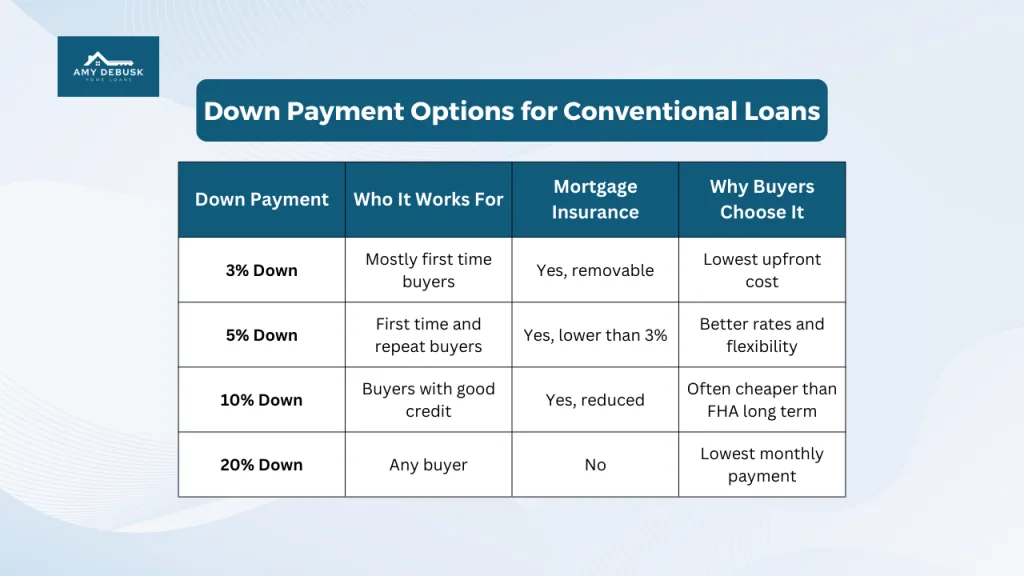
One of the most common misconceptions is that a conventional loan requires 20% down. In reality, conventional loans offer multiple down payment options.
3% Down Conventional Loans
Certain conventional programs allow eligible buyers to purchase a home with just 3% down.
Key points to understand:
- Minimum credit score is typically 620
- The home must be a primary residence
- Income eligibility may apply depending on the program and location
- Mortgage insurance is required but can be removed later
- Full documentation is required
While 620 is often the minimum qualifying score, buyers with higher credit scores often receive better interest rates and significantly lower mortgage insurance costs.
5% Down Conventional Loans
A 5% down conventional loan is available to both first-time and repeat buyers. This option often provides:
- Greater flexibility
- Lower mortgage insurance than 3% down options
- Stronger approval profiles
This is a popular choice for buyers who want to preserve cash while still improving long-term affordability.
10% Down Conventional Loans
At 10% down, conventional loans often outperform FHA loans for buyers with good credit.
Benefits can include:
- Lower monthly mortgage insurance
- Competitive interest rates
- Lower total monthly payments over time
Many buyers are surprised to learn that even with a slightly higher rate, a conventional loan at 10% down can cost less than FHA in the long run.
20% Down Conventional Loans
With 20% down, mortgage insurance is not required.
This results in:
- Lower monthly payments
- Maximum long-term savings
- A simpler loan structure
This option is ideal for buyers focused on minimizing lifetime loan costs.
Credit Score Requirements for Conventional Loans
Conventional loans are credit-sensitive, meaning your credit score directly affects your pricing and mortgage insurance costs.
- Minimum credit score is typically 620
- Better pricing often begins around 680
- The most favorable pricing is usually seen at 720 or higher
Higher credit scores reduce lender risk, which is why borrowers are rewarded with lower costs. Even a small increase in score can lead to meaningful monthly and long term savings, especially on mortgage insurance.
This is why credit preparation before buying a home can be just as important as saving for a down payment.
Understanding your credit is the first step toward buying a home. Learn how strategic credit planning works with Blue Water Credit.
Debt-to-Income Ratio Guidelines for Conventional Loans
Debt to income ratio, often called DTI, is one of the key factors lenders use when reviewing a conventional loan application. It measures how much of your gross monthly income goes toward monthly debt obligations.
Conventional loans generally allow a maximum DTI of up to 50 percent, though approval at higher levels depends heavily on the overall strength of the loan application. Lower DTIs are always preferred, but higher ratios can still be approved when other factors are strong.
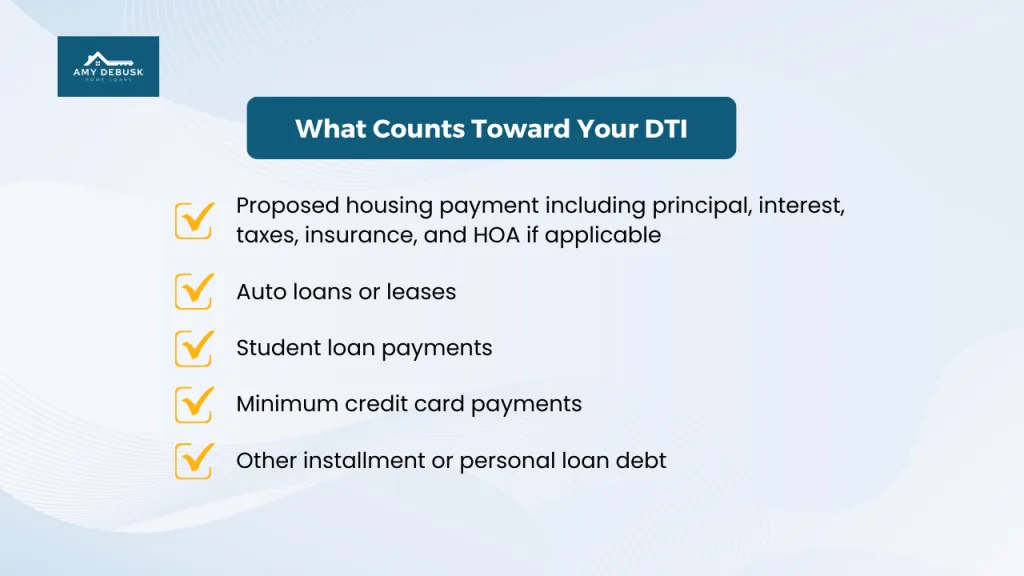
Lenders look at the full picture when evaluating DTI. Borrowers with strong credit scores, stable and documented income, and adequate cash reserves are often able to qualify with higher ratios. On the other hand, weaker credit or limited reserves may require a lower DTI to offset risk.
Even small changes to your DTI can make a meaningful difference. Paying down revolving balances, reducing monthly obligations, or increasing verified income can all improve approval odds and loan terms.
This is why understanding your DTI early in the home-buying process is important. It allows buyers to plan strategically and avoid surprises during underwriting.
Mortgage Insurance on Conventional Loans
Mortgage insurance is required on conventional loans when putting less than 20 percent down, but it offers far more flexibility than government backed options.
Key advantages of conventional mortgage insurance
- Risk based pricing tied to credit score and down payment
- Lower monthly costs for borrowers with strong credit
- No upfront mortgage insurance fee
- Mortgage insurance can be removed once sufficient equity is reached
Because mortgage insurance is not permanent, many borrowers are able to reduce their monthly payment over time. This ability to cancel mortgage insurance is one of the biggest long term financial advantages of a conventional loan.
Appraisals on Conventional Loans
The appraisal process is one area where conventional loans often provide a clear advantage for both buyers and sellers.
A conventional appraisal focuses primarily on:
- Market value of the property
- Overall safety and habitability
Unlike government backed loans, conventional appraisals are generally more flexible and market driven. The appraiser's main role is to confirm that the home supports the agreed upon purchase price based on comparable sales.
Minor cosmetic issues, normal wear and tear, and deferred maintenance that does not affect safety are usually acceptable. The home does not need to be perfect. It simply needs to be safe, livable, and appropriately valued for the current market.
Conventional vs FHA Appraisals
One key difference between conventional and FHA loans is how the property is evaluated during the appraisal process. While both loans require an appraisal to confirm value, FHA appraisals include stricter property condition standards.
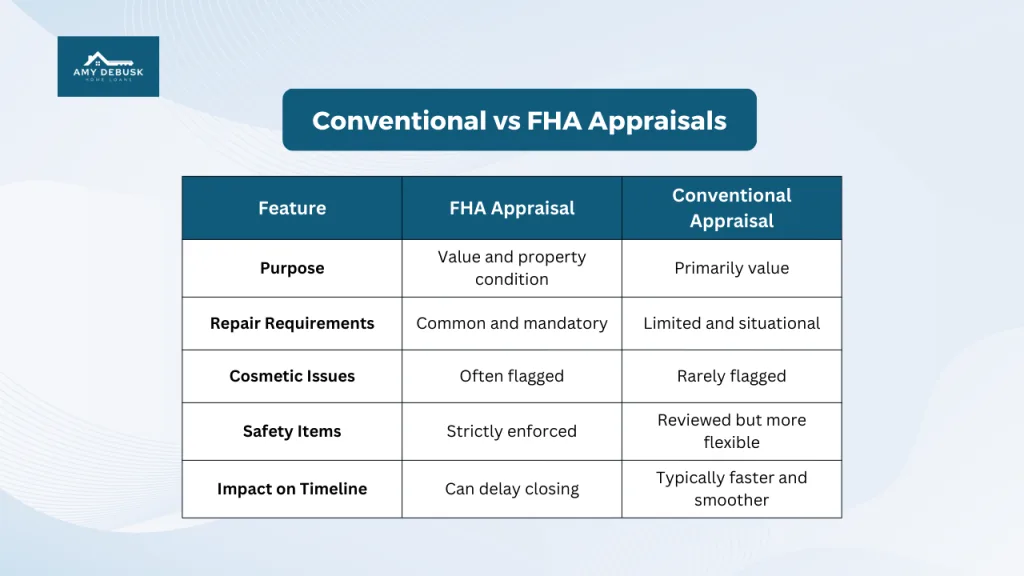
FHA appraisals are designed to protect the government insurance fund, which means the appraiser must evaluate both the value and the safety, soundness, and livability of the home. As a result, FHA appraisals commonly call out repair items that must be completed before closing.
These required repairs must typically be completed before the loan can move forward, which can delay closing or complicate negotiations between buyers and sellers.
Conventional appraisals focus primarily on property value, not condition. While major safety or structural issues can still be flagged, conventional loans are far less likely to require repairs for cosmetic or minor items. This flexibility often makes conventional financing more attractive in competitive markets or for older homes.
Conventional vs VA Appraisals
VA loans are a valuable benefit for eligible Veterans and active duty service members. As part of the VA loan process, the appraisal includes Minimum Property Requirements, often called MPRs, which are designed to ensure the home is safe, structurally sound, and suitable for everyday living.
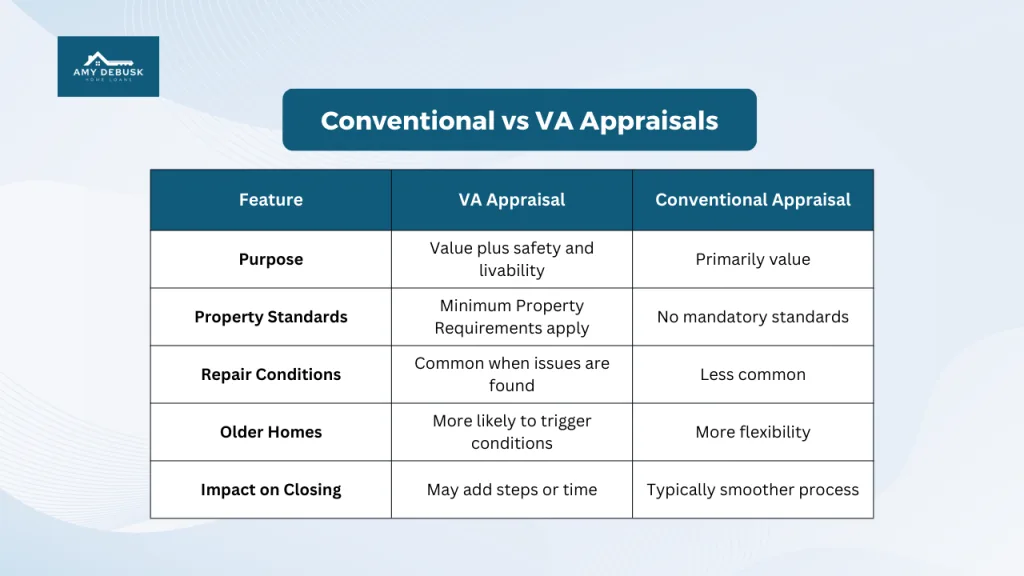
In addition to confirming value, VA appraisals evaluate the property for safety and livability concerns. While many homes pass without issue, older properties are more likely to receive additional appraisal conditions that must be addressed before closing.
Common VA appraisal concerns may include:
- Safety hazards or structural deficiencies
- Roof condition and remaining roof life
- Heating, electrical, and plumbing functionality
- Adequate access and proper utilities
These conditions must typically be resolved prior to loan approval, which can add steps to the transaction or create negotiation challenges between buyers and sellers.
Conventional appraisals focus primarily on market value, with no mandatory minimum property standards tied to government guidelines. While major safety issues can still be noted, conventional loans are generally more flexible and less likely to require repairs, making them attractive for older homes or competitive markets.
Conventional Loan vs FHA, VA, and USDA Loans
There are several loan programs available to homebuyers, and each one serves a different purpose. Understanding the key differences can help buyers choose the option that best fits their financial goals and long-term plans.
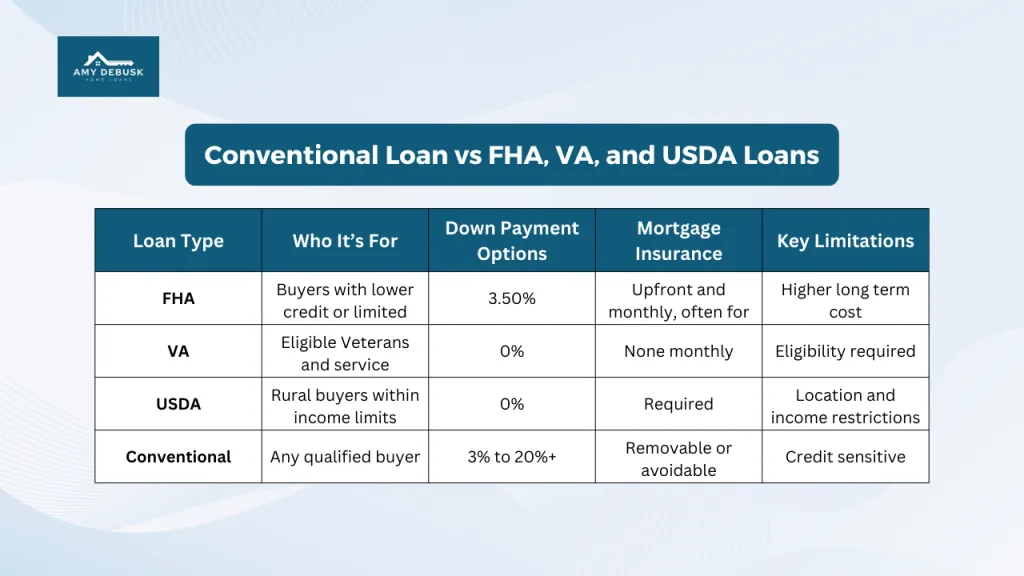
FHA loans are often easier to qualify for on paper, particularly for buyers with lower credit scores or limited down payment funds. However, FHA loans include both an upfront mortgage insurance premium and ongoing monthly mortgage insurance. In many cases, this insurance remains in place for the life of the loan, which can significantly increase total costs over time.
VA loans provide one of the strongest benefits available to eligible Veterans and active duty service members. These loans allow for 100 percent financing with no monthly mortgage insurance. While this is a powerful advantage, VA loans are limited to qualified military borrowers and still require a VA appraisal and funding fee in most cases.
USDA loans also offer 100 percent financing and low interest rates, but eligibility is restricted. The property must be located in an approved rural area, and borrowers must meet household income limits. These factors can make USDA loans less flexible in certain markets.
Conventional loans are available nationwide and are open to any buyer who meets credit and income guidelines. They offer a wide range of down payment options and provide more control over mortgage insurance, which can often be reduced or removed as equity increases. For many buyers, this flexibility leads to lower lifetime loan costs and stronger long term financial outcomes.
Conventional Loans for First-Time Homebuyers
Conventional loans are not just for repeat buyers. Many first time homebuyers qualify and are surprised to learn they can buy sooner than expected.
Why first time buyers choose conventional loans
- Down payments around 3 percent for eligible buyers when the program allows it
- Available in all locations
- Not limited by military or rural eligibility rules
- Mortgage insurance can be reduced or removed over time
With strong credit and proper planning, conventional financing is often one of the most cost-effective paths to homeownership and long term equity building.
Conventional Loans for Self-Employed Borrowers
Conventional loans are available to many self-employed borrowers when income can be documented using standard guidelines.
What to know
- Typically requires two years of personal and business tax returns
- Income is calculated using documented, verifiable earnings
- Strong credit and stable business history help approval
When tax returns support qualifying income, conventional loans offer excellent long term stability, competitive pricing, and flexible options. If reported income does not reflect true cash flow, alternative loan programs may be considered.
❓Conventional Home Loans FAQs
Below are some of the most common questions we hear from homebuyers considering conventional financing.
❓ What is the minimum credit score for a conventional loan?
Most conventional loans allow a minimum credit score of 620.
❓ Can I really buy a home with 3% down using a conventional loan?
Yes. Eligible buyers can purchase with 3% down through approved conventional programs.
❓ Is mortgage insurance permanent on a conventional loan?
No. Mortgage insurance can be removed once sufficient equity is reached.
❓ What is the maximum debt-to-income ratio allowed?
Conventional loans allow up to 50% debt-to-income in many cases.
❓ Are conventional loans fully documented?
Yes. Income, assets, employment, and credit are fully verified.
❓ Are conventional loans better than FHA loans?
It depends on your credit profile, down payment, and long-term goals. Many buyers with good credit save more with conventional financing.
❓ Can conventional loans be used for condos?
Yes, as long as the condo project meets eligibility guidelines.
❓ Are conventional loans available nationwide?
Yes. Conventional loans are available across the U.S.
Final Thoughts
A conventional loan is not just a mortgage option, it is a strategic financial tool.
When structured correctly, a conventional loan can lower long-term costs, provide flexibility, allow mortgage insurance removal, and support wealth-building through homeownership.
The right loan is never about chasing the lowest rate. It is about understanding the full picture and choosing a solution that aligns with your goals, timeline, and financial future.
I'm Amy DeBusk, a Branch Manager and Mortgage Advisor with over 25 years of experience helping buyers and investors navigate the home loan process with clarity and confidence.
If you are considering buying or refinancing and want a clear comparison of your options, my team and I are here to help.
📞 (916) 705-2557
🌐 amydebuskhomeloans.com
📅 Schedule a consultation at talkingwithamy.com
All loans are subject to approval. Equal Housing Lender.
All Mortgage Made Easy articles · Book a Complimentary Discovery Call