

If you're a first-time homebuyer in California, one of the biggest questions is:
What programs are actually available to help me buy?
The California Housing Finance Agency, also known as CalHFA, offers some of the most widely used first-time homebuyer programs in the state, including down payment assistance and flexible loan options.
I'm Amy DeBusk, a Branch Manager with over 26 years of experience, and I help buyers across Sacramento, Roseville, and Northern California navigate CalHFA programs every day.
In this guide, I'll walk you through the most important CalHFA programs, how they work, and how to decide which one may fit your situation.
CalHFA: Making Homeownership Possible for More Californians
CalHFA is California's Housing Finance Agency, created to make homeownership more accessible for everyday Californians. Instead of leaving buyers to navigate expensive down payments and strict loan requirements on their own, CalHFA offers programs designed to be more flexible, more supportive, and more affordable.
The mission is simple.
Help qualified buyers purchase a home without needing a large amount of cash upfront.
How CalHFA Programs Actually Work
CalHFA does not lend money directly. Instead, it works through approved lenders who offer these programs alongside your main mortgage.
Most buyers use:
- A CalHFA first mortgage such as FHA or Conventional
- Combined with one or more assistance programs
This structure allows buyers to reduce upfront costs while still qualifying for a traditional home loan.
Why CalHFA Matters
CalHFA is especially impactful for buyers who are ready for homeownership but need help overcoming the biggest financial barriers. Many first-time buyers turn to CalHFA because it offers real solutions to common challenges, including:
-
Limited savings
-
High home prices
-
Rising rents that make saving difficult
-
Difficulty competing with all-cash buyers or buyers with large down payments
By combining down payment assistance with buyer-friendly loan options, CalHFA opens the door for more first-time homebuyers to finally step into a home of their own. This is also where a lot of confusion comes in, especially around what counts as a grant and what doesn't.
Who CalHFA Is Perfect For
CalHFA is an excellent fit for first-time homebuyers who can comfortably handle a monthly mortgage payment but struggle to gather the upfront funds needed to buy. Many Californians earn enough income to afford a home, yet saving for a down payment feels out of reach because of rising living costs.
CalHFA bridges that gap.
It gives buyers the support they need so they can move forward confidently instead of waiting years to save a large down payment.
The Reality of CalHFA Programs in 2026
One of the biggest misconceptions is that CalHFA programs are always available or easy to access.
In reality:
- Some programs have limited funding
- Some operate on lottery systems
- Some open and close quickly
- All have income and eligibility requirements
For example, programs like Dream For All can offer significant assistance but are only available during limited registration windows.
This is why preparation matters just as much as qualification.
A Snapshot of the Ideal CalHFA Buyer
Here's a quick look at the types of buyers who benefit most from CalHFA programs:
-
First-time homebuyers ready for monthly mortgage payments
-
Renters who want to build wealth but can't save fast enough
-
Buyers with stable income but limited upfront cash
-
Families looking for programs that reduce out-of-pocket costs
-
Anyone wanting a more affordable path into homeownership

A Real CalHFA Success Story: How Rachel Bought Her First Home with Only $500 Out of Pocket
One of our most recent CalHFA success stories comes from Rachel, a single buyer who dreamed of owning a home with a swimming pool. She wanted a peaceful place to unwind, entertain friends, and build long-term wealth through homeownership. With rising rents and tough competition in the Sacramento Valley, she wasn't sure this dream was possible, but she reached out to us to explore her options.
Rachel found a beautiful 3-bedroom, 2-bath home in Fair Oaks, California, complete with the swimming pool she always wanted. Once she fell in love with the home, our team helped her structure the financing using a CalHFA first mortgage paired with the MyHome down payment assistance program. This reduced the upfront cash she needed dramatically.
That's when the magic really happened.
Thanks to the skilled negotiation of our premier realtor partner, Annie Dube with Miller Realty, Rachel received a seller credit that covered all of her closing costs. Rachel brought a $1,000 earnest money deposit to open escrow and actually received $500 back at closing. Her total out-of-pocket cost to become a homeowner was just $500.
Stories like this are exactly why CalHFA exists and why partnering with the right lender and the right realtor matters so much. Our premier agents specialize in working with first-time homebuyers, negotiating on their behalf, and helping them secure seller credits, concessions, and the strongest possible terms.
When you combine the right financing strategy with an expert realtor who knows how to advocate for you, the door to homeownership opens wider than you ever imagined.

Why These Buyer Traits Matter For CalHFA Programs
Now let's look at why these traits matter and how they align with CalHFA first time homebuyer programs, down payment assistance, and affordable homeownership in California.
Many buyers qualify for CalHFA support when they:
• Have a stable income
• Want a manageable monthly payment
• Need help with the down payment or closing costs
• Feel pressured by rising home prices
• Believe competition has pushed them out of the housing market
If saving for a down payment feels out of reach no matter how hard you try, CalHFA can provide the lift that finally turns homeownership into a real next step. These programs help reduce upfront costs, lower monthly payments, and allow buyers to move forward sooner instead of waiting.
When you're ready to explore your options and see exactly what you qualify for, book a free call at talkingwithamy.com. You'll receive personalized guidance from a trusted expert who makes mortgages easy and aligned with your goals.
All loans subject to approval. Equal Housing Lender.
CalHFA Requirements You Need To Know
Before diving into specific CalHFA loan programs, it helps to understand what the agency expects from qualified buyers. The criteria are simple, consistent, and far more achievable than most people realize.
CalHFA focuses on helping buyers who are ready for long-term homeownership but need support getting past the upfront financial barriers.
To qualify, buyers generally need to meet the following:
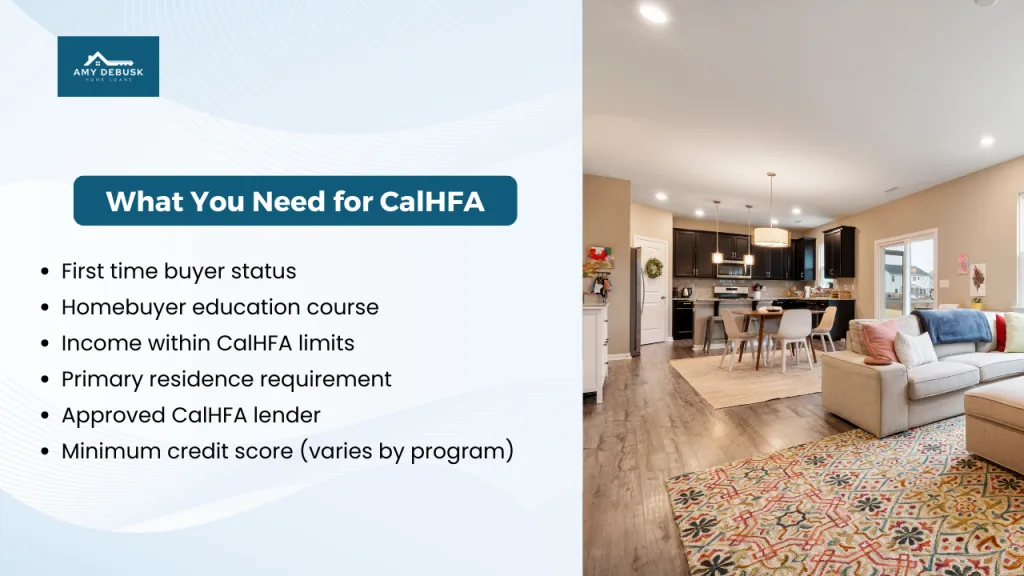
- First-time buyer status: You must not have owned a home in the last three years.
- Homebuyer education: CalHFA requires a short, easy-to-complete homebuyer education course to help set you up for long-term success.
- Income within CalHFA limits: Income ceilings vary by county and are updated each year. For example, the latest 2025 income limits include
- Sacramento County: $239,000
- Placer County: $239,000
- El Dorado County: $239,000
- Yolo County: $239,000
These numbers help ensure assistance goes to buyers who need it most.
- Primary residence requirement: The home must be used as your primary residence, not an investment property.
- Approved CalHFA lender: You must work with a lender that is officially approved to offer CalHFA programs.
- Minimum credit score
CalHFA's minimum scores typically fall between- 640 for borrowers that are qualifying on a FHA loan
- 680 for borrowers qualifying on a Conventional loan Specific programs may vary slightly.
These requirements are designed to create a fair and supportive path into homeownership, especially for buyers who have stable income but need a financial lift to cover upfront costs.
What I'm Seeing in Sacramento and Northern California
In the Sacramento, Roseville, and Placer County markets, more first-time buyers are relying on programs like CalHFA to bridge the gap between rising home prices and limited savings.
Buyers who are fully prepared and pre-approved before applying for these programs tend to have a much higher success rate, especially in competitive markets.
Popular CalHFA Loan Options for 2026
CalHFA offers several loan structures that work alongside your main mortgage, giving first-time buyers more flexibility and more buying power. Instead of replacing your loan, CalHFA layers its assistance on top of traditional mortgage types so you get added support without changing the type of mortgage you prefer.
These programs can pair with three main mortgage options
- CalHFA FHA
- CalHFA Conventional
- CalHFA USDA
Each option supports buyers in a different way, whether you need flexible credit requirements, lower long-term costs, or a zero down payment path in eligible rural areas. And if you want to explore even more financing choices beyond CalHFA programs, you can visit our Mortgage Products page to compare additional loan options that may fit your situation
These brief summaries help buyers understand the difference
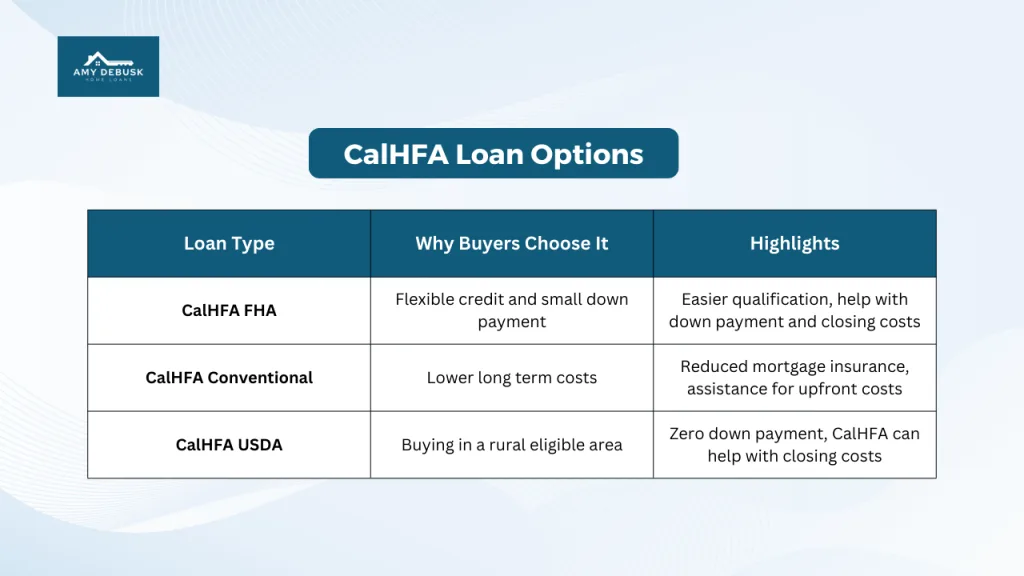
- CalHFA FHA offers flexible credit guidelines and small down payments, with CalHFA assistance covering down payments or closing costs.
- CalHFA Conventional works for buyers with stronger credit who want lower mortgage insurance and long-term affordability.
- CalHFA USDA is available in eligible rural zones and offers zero down payment plus affordable fixed rates, with CalHFA help for closing costs.
To make the differences easier to see, here is a simple comparison table:
CalHFA Down Payment Programs You Should Know
CalHFA offers two powerful assistance options that help first-time buyers overcome the biggest barrier to homeownership: upfront costs. These programs are designed to reduce how much cash you need to bring in, making the whole process more achievable even if saving has been tough. Both options pair with your main mortgage and give you the financial lift needed to move forward sooner.
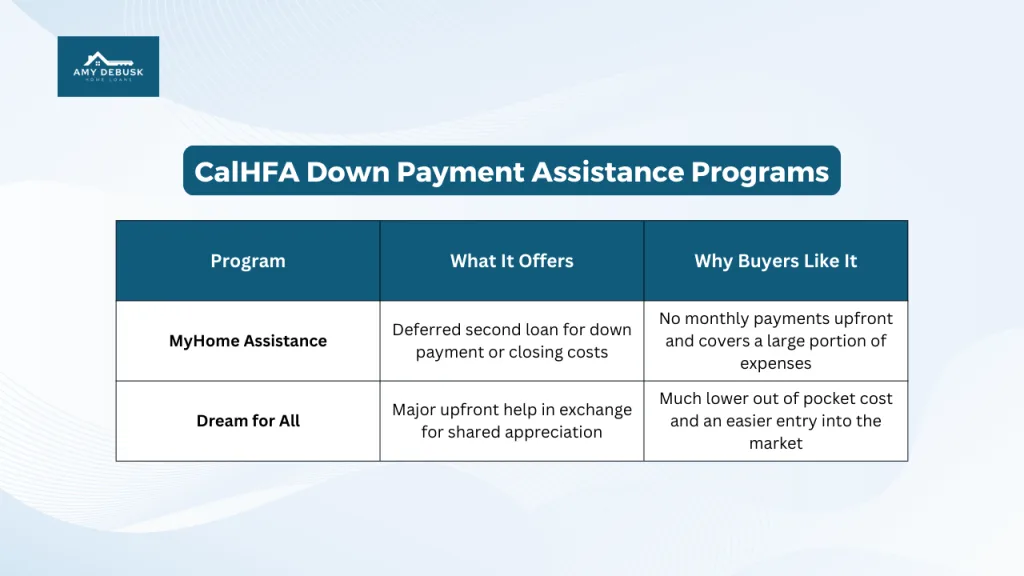
MyHome Assistance Program
MyHome provides a deferred second loan that can be used toward your down payment or closing costs. Deferred simply means you do not make payments on it right away, which keeps your upfront expenses low and protects your monthly budget. Many buyers use MyHome to cover a meaningful portion of out-of-pocket costs, allowing them to hold on to more of their savings for life after closing.
Dream for All Shared Appreciation Program
Dream for All gives eligible buyers significant upfront help in exchange for sharing a portion of the home's future appreciation. It is one of the most impactful programs CalHFA offers because it dramatically reduces what you need to pay at the start. For buyers who have the income to support a mortgage but are struggling to save a large amount, this program can make homeownership possible much sooner.
Programs like Dream For All can be powerful, but they're not always available when buyers are ready. Having a backup plan matters more than most people expect.
What the 2026 CalHFA Updates Mean for You
CalHFA reviews its programs every year to keep up with California's shifting housing market. These updates usually include new income limits, refreshed guidelines, and adjustments to how much assistance is available. The goal is to make sure the programs continue supporting buyers who need them the most, especially in a state where prices and affordability challenges change quickly.
For 2026, buyers can expect expanded access for moderate income households and clearer pathways for first-time buyers who may have struggled to qualify in previous years. Updated rules and assistance amounts are designed to help more families compete in today's market, reduce upfront barriers, and step into homeownership with more confidence and stability. If you have been on the fence about buying, these changes could open doors that were not available before.
Which CalHFA Program Is Right for You?
The biggest mistake buyers make is choosing a program based on what sounds the most attractive.
The better approach is to match the program to your financial situation and long-term goals.
A CalHFA program may be a strong fit if:
- You have steady income but limited savings
- You want to reduce upfront costs
- You meet income limits
- You are buying a primary residence
It may not be the best option if:
- You already have enough savings
- You want to avoid repayment structures
- You qualify for better pricing without assistance
This is why I walk buyers through multiple scenarios before making a recommendation.
How To Apply for CalHFA in 2026
Applying for CalHFA is a simple process when you follow a few key steps and work with the right lender. CalHFA does not lend money directly, so your journey starts with connecting to a professional who understands the programs and knows how to guide first-time buyers through each requirement.
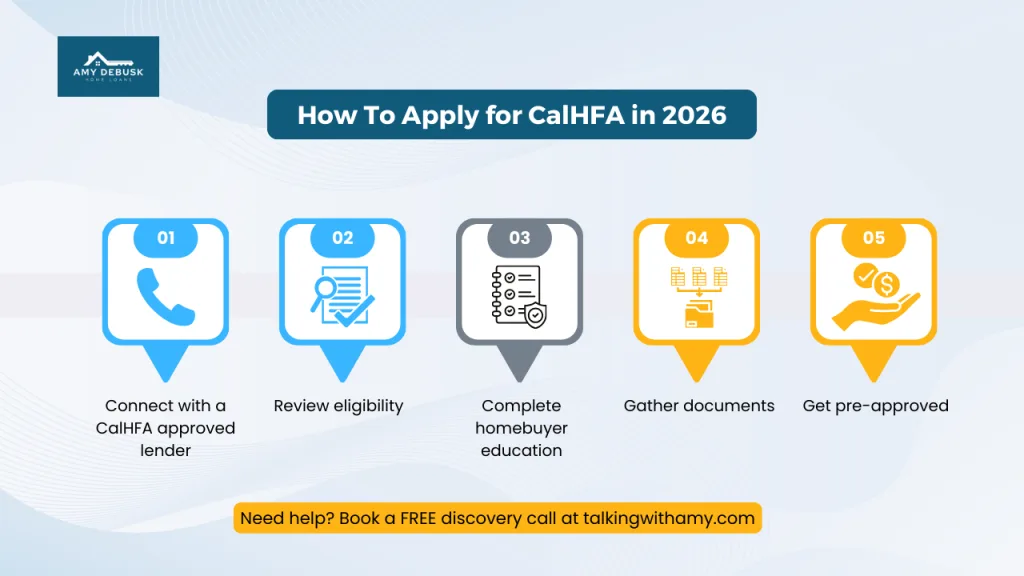
Step 1: Connect with a CalHFA-approved lender
Your first step is choosing a lender who is authorized to offer CalHFA programs. This ensures you get accurate guidance from someone who understands the rules, income limits, and assistance options. Amy DeBusk is a CalHFA-approved lender, and you can book a free call at talkingwithamy.com to get started.
Step 2: Review Your Eligibility
Your lender will look at your income, credit score, and homebuying goals to determine which CalHFA programs you qualify for. This is where you will learn whether options like MyHome or Dream for All are a strong match.
Step 3: Complete Your Homebuyer Education Course
CalHFA requires a short homebuyer education course. It is simple to complete online and helps prepare you for long-term homeownership.
Step 4: Gather Your Documents
Your lender will guide you on what to collect, such as pay stubs, tax returns, bank statements, and ID, keeping everything organized for a smooth application process.
Step 5: Get Pre-Approved
Once your information is reviewed, your lender will issue a pre-approval so you can confidently start shopping for homes within your price range.
Working with the right lender makes the CalHFA process feel clear, supported, and achievable. Booking a call with Amy at talkingwithamy.com is a great first step toward becoming a homeowner in 2026.
Tips To Boost Your Chances of Approval
There are simple steps you can take right now to strengthen your CalHFA application and make the approval process go more smoothly. Even small improvements can make a noticeable difference in how confidently you qualify.
Here are a few easy things you can start doing
- Check your credit report for accuracy
- Avoid opening new accounts or taking on additional debt
- Set aside a little extra savings each month
- Keep your bank activity steady and predictable
- Gather important documents early so there are no delays
If you are unsure where your credit stands or think you may need help improving it, reach out to Amy and her team at talkingwithamy.com. They work with a trusted credit repair company and can point you in the right direction so you are set up for success before applying.
Final Thoughts
CalHFA continues to be one of the strongest paths for new buyers who want to turn homeownership into a reality. Whether you are dreaming of a cozy condo or a spacious family home, the right CalHFA program can give you the boost you need to move forward with confidence.
If 2026 is the year you plan to stop renting and finally step into a home of your own, CalHFA might be the key that unlocks that door. And if you want to explore more loan options or compare what might work best for your situation, you can read our previous blog, explaining the home loan pre-approval process
Where to Find Official CalHFA Information
CalHFA programs are administered by the California Housing Finance Agency. You can review official program details here.
Understanding how these programs work together is key to maximizing your options.
❓CalHFA Guide for First-Time Homebuyers FAQs
Buying a home with CalHFA comes with a lot of moving parts, and it is completely normal to have questions along the way. Here are some of the most common ones buyers ask when exploring these programs.
❓ Do I have to be a first-time homebuyer to use CalHFA?
Yes, most CalHFA programs require you to be a first-time homebuyer, which simply means you have not owned a home in the last three years. Some exceptions exist for specific programs, but this rule applies to the majority.
❓ Can CalHFA cover my entire down payment?
CalHFA can cover a large portion of your down payment and sometimes all of it, depending on the program you qualify for. MyHome and Dream for All both offer significant upfront assistance.
❓ Is my credit score important when applying for CalHFA?
Yes, credit matters. Most programs require a minimum credit score between 640 and 680, depending on your income level. If you need help improving your credit, Amy's team can connect you with a trusted credit repair company. Check our our tips for boosting your credit score.
❓ Does CalHFA work with FHA and conventional loans?
Absolutely. CalHFA partners with FHA, conventional, and in some cases, USDA loans. This gives you flexibility to choose the structure that fits your financial situation best.
❓ How do I start the application process?
Your first step is to connect with a CalHFA-approved lender. You can book a free call with Amy at talkingwithamy.com to review your eligibility, explore your options, and begin the pre-approval process.
❓ Do borrowers have to repay CalHFA's down-payment assistance loans right away?
No. CalHFA's assistance loans, such as MyHome and ZIP, are "deferred-payment" loans. That means you make no monthly payments on them while you live in the home. They become due only when you sell, refinance, pay off the first mortgage, or transfer the home. It's designed to keep your monthly payment affordable while helping you get into your home sooner.
❓ What are the basic eligibility requirements to get a CalHFA loan?
To qualify, your income must fall under your county's CalHFA income limits, the home must be your primary residence, and you must complete a CalHFA-approved homebuyer education course. Most programs also require a minimum credit score, and underwriting rules are slightly more conservative than standard loans.
❓ What types of loan programs does CalHFA offer for homebuyers?
CalHFA offers several powerful options for first-time buyers including FHA, Conventional, VA, and USDA first-mortgage programs. These can be paired with CalHFA's down-payment and closing-cost assistance programs like MyHome or ZIP. These assistance loans are designed to reduce upfront costs and make purchasing a home more achievable for California buyers. Check out our down payment assistance hub
Yes, most CalHFA programs require you to be a first-time homebuyer, which simply means you have not owned a home in the last three years. Some exceptions exist for specific programs, but this rule applies to the majority.
CalHFA can cover a large portion of your down payment and sometimes all of it, depending on the program you qualify for. MyHome and Dream for All both offer significant upfront assistance.
Yes, credit matters. Most programs require a minimum credit score between 640 and 680, depending on your income level. If you need help improving your credit, Amy's team can connect you with a trusted credit repair company. Check our our tips for boosting your credit score.
Absolutely. CalHFA partners with FHA, conventional, and in some cases, USDA loans. This gives you flexibility to choose the structure that fits your financial situation best.
Your first step is to connect with a CalHFA-approved lender. You can book a free call with Amy at talkingwithamy.com to review your eligibility, explore your options, and begin the pre-approval process.
No. CalHFA's assistance loans, such as MyHome and ZIP, are "deferred-payment" loans. That means you make no monthly payments on them while you live in the home. They become due only when you sell, refinance, pay off the first mortgage, or transfer the home. It's designed to keep your monthly payment affordable while helping you get into your home sooner.
To qualify, your income must fall under your county's CalHFA income limits, the home must be your primary residence, and you must complete a CalHFA-approved homebuyer education course. Most programs also require a minimum credit score, and underwriting rules are slightly more conservative than standard loans.
CalHFA offers several powerful options for first-time buyers including FHA, Conventional, VA, and USDA first-mortgage programs. These can be paired with CalHFA's down-payment and closing-cost assistance programs like MyHome or ZIP. These assistance loans are designed to reduce upfront costs and make purchasing a home more achievable for California buyers. Check out our down payment assistance hub
Learn Even More on Our YouTube Channel
If you want a deeper understanding of CalHFA, loan programs, credit tips, and step-by-step guidance for first-time buyers, our YouTube channel is packed with helpful videos. We break things down in a simple, conversational way so you always know exactly what to expect during your homebuying journey.
🤖 Meet Savebot, your little digital sidekick who loves cheering you on every time you take a step toward financial clarity. It's part game, part gentle mindset shift, part money confidence booster. Savebot celebrates the wins you might normally overlook and helps you build the kind of habits that make homeownership feel exciting and achievable.

Savebot works on one simple truth:
When you acknowledge your progress, you create momentum. And when you create momentum, you move faster toward the life and home you truly want.
How to Play
Playing Savebot is easy, and that's the magic of it.
-
Decide your "thing."
Choose one tiny daily action that moves your financial life forward. Checking your credit, saving 5 dollars, making your lunch instead of eating out, watching one Home Readiness lesson, whatever feels good and doable. -
Tell Savebot what you did.
Every time you complete your action, you report it to Savebot. The moment you do, Savebot lights up with appreciation, motivation, and a little celebration. It's like a high-five from the universe in bot form. -
Collect your streaks.
Savebot tracks your consistency. One "win" becomes two, then three, then suddenly you're building new habits with ease. You're literally gamifying your journey into homeownership. -
Watch your confidence grow.
The more streaks you build, the more your energy shifts. Savebot is designed to help you feel your progress so you stop focusing on how far away the goal seems and start noticing how close you're getting.
Why People Love Savebot
It's fun. It's simple. It feels good.
Savebot transforms the sometimes overwhelming path to buying a home into a series of small victories that raise your vibration and strengthen your belief in what's possible.
And that belief is everything.
All Mortgage Made Easy articles · Book a Complimentary Discovery Call