
Review Your Spending Habits
Use the Homeowners Money Guide to organize approximate expense totals, spot recurring costs and brainstorm a spending plan around your priorities.
Fine-Tune My Spending PlanMortgage Made Easy | Your next chapter
When several payments compete for your paycheck, it can be hard to see a way forward. You deserve a clear conversation without judgment. Let's look at what you owe, what you want to change and whether using equity could support a lasting plan.
Book Your Complimentary Discovery Call
Life can bring expenses you did not plan for. Other times, several manageable payments gradually become too much together. Whatever brought you here, I want to understand your goals before suggesting a loan.
A smaller monthly payment needs to work beyond the first few months. Let me help you understand the borrowing costs, repayment time and what happens to your home equity before you decide.
Amy DeBusk | Branch Manager & Mortgage Advisor
Amy DeBusk Home Loans, powered by loanDepot
We'll look at your current mortgage, other debts, monthly income and spending plan. The goal is a payment strategy you can live with today and sustain over time.
If you decide to refinance, choose how you will use any change in monthly cash flow: rebuild savings, prepare for irregular bills, and decide how to avoid rebuilding balances you have paid off. The Fine Tune Your Spending Plan guide provides action items. You can also use Save More Money GPT to organize ideas, then verify its suggestions against your actual expenses.
Moving unsecured debt into a mortgage puts your home behind that debt. Compare total costs and repayment time as well as the monthly payment before deciding.
Small changes. More room for your life.
Before we talk about a new loan, let's look at how your money supports your life today. I want you to have room for the essentials, the unexpected and the people and experiences you love. A spending plan should help you feel more in control, not make every purchase feel like a mistake.
Start with your recent spending and group it into a few simple categories: housing, food, transportation, recurring bills, debt payments and the extras you enjoy. Include expenses that do not arrive every month, such as car registration, gifts and home repairs. Then choose one or two adjustments you can realistically keep.
Give any money you free up a purpose, whether that is building a cushion, paying down a balance or setting something aside for your family. A short weekly check-in can help you notice what is working and adjust what is not.
Use the Homeowners Money Guide to organize approximate expense totals, spot recurring costs and brainstorm a spending plan around your priorities.
Fine-Tune My Spending PlanUse the Refinance & Debt Consolidation GPT to organize balances, compare questions about repayment options and prepare for our conversation.
Explore the Refinance GPT“Help me review my spending habits without judgment. Ask me one question at a time, help me organize my approximate monthly expenses and suggest three realistic changes that fit my priorities. Then help me decide what questions to bring to my mortgage advisor.”
Use rounded category totals. The tools do not automatically connect to your accounts. Keep account numbers and personal identification out of the chat, and review AI suggestions before acting on them.
You do not need to tackle everything at once. Pick the idea that feels easiest to try this week and build from there.
Review streaming services, apps, memberships and delivery subscriptions. Cancel what you no longer use, or rotate services instead of keeping all of them active. Check cancellation terms and save the confirmation.
Plan a few easy meals around what you already have, shop with a list and leave room for a favorite meal out. Having a quick dinner ready for busy nights can help you avoid an unplanned delivery order and its extra fees.
Compare what you actually use with what you pay for. Ask your provider about a less expensive plan and look at the full cost, including equipment, fees and what happens when a promotional price ends.
Keep a wish list and give nonessential purchases a day or two before checking out. Turn off shopping alerts that tempt you to buy, and consider borrowing or buying secondhand for something you will only use occasionally.
Set bill reminders and review account fees. If payment timing is the problem, ask whether a due date can change. Use automatic payments only when you can keep enough money available, so avoiding a late fee does not create an overdraft.
These ideas are starting points, not a promise that small cuts can solve every shortfall. If the essentials already take everything you earn, you deserve a broader conversation about your options. We can look at the mortgage piece together without assuming you need a new loan.
Prefer to work on paper? The CFPB toolkit includes spending-tracker and cutting-expenses worksheets.
A home equity loan or HELOC may allow you to borrow separately from your first mortgage. That can be worth exploring if you want to preserve your current first-loan terms. You'll still have an additional payment. With a HELOC, review variable rates, the draw period and how repayment can change.
Compare home equity loans and HELOCs.
A cash-out refinance replaces your existing mortgage with a new, larger loan and can provide funds to pay other debts. We need to compare the rate and costs on the entire new mortgage, not just the amount you want to access.
Keeping your mortgage and working through debts separately may be the better fit. Payment arrangements with creditors or help from a qualified nonprofit credit counselor are also worth exploring.
Consolidation moves debt; it does not erase it. Spreading balances over more years can increase total interest even if the monthly payment falls. Turning unsecured debt into debt secured by your home also means missed payments could put your home at risk of foreclosure.
We'll compare closing costs, repayment time, total cost and how much equity remains. A plan for keeping paid-off balances from growing again matters just as much.
You do not have to organize everything perfectly before reaching out. We can start with the questions that feel most pressing.
For more background, read the CFPB's debt-consolidation guidance.
Your complimentary 30-minute discovery call is a chance to ask questions and talk through what matters to you. We can meet by Zoom or phone, or at my office by appointment.
Book Time With AmyNeed to reach me sooner? Call or text (916) 705-2557, or send me a question.
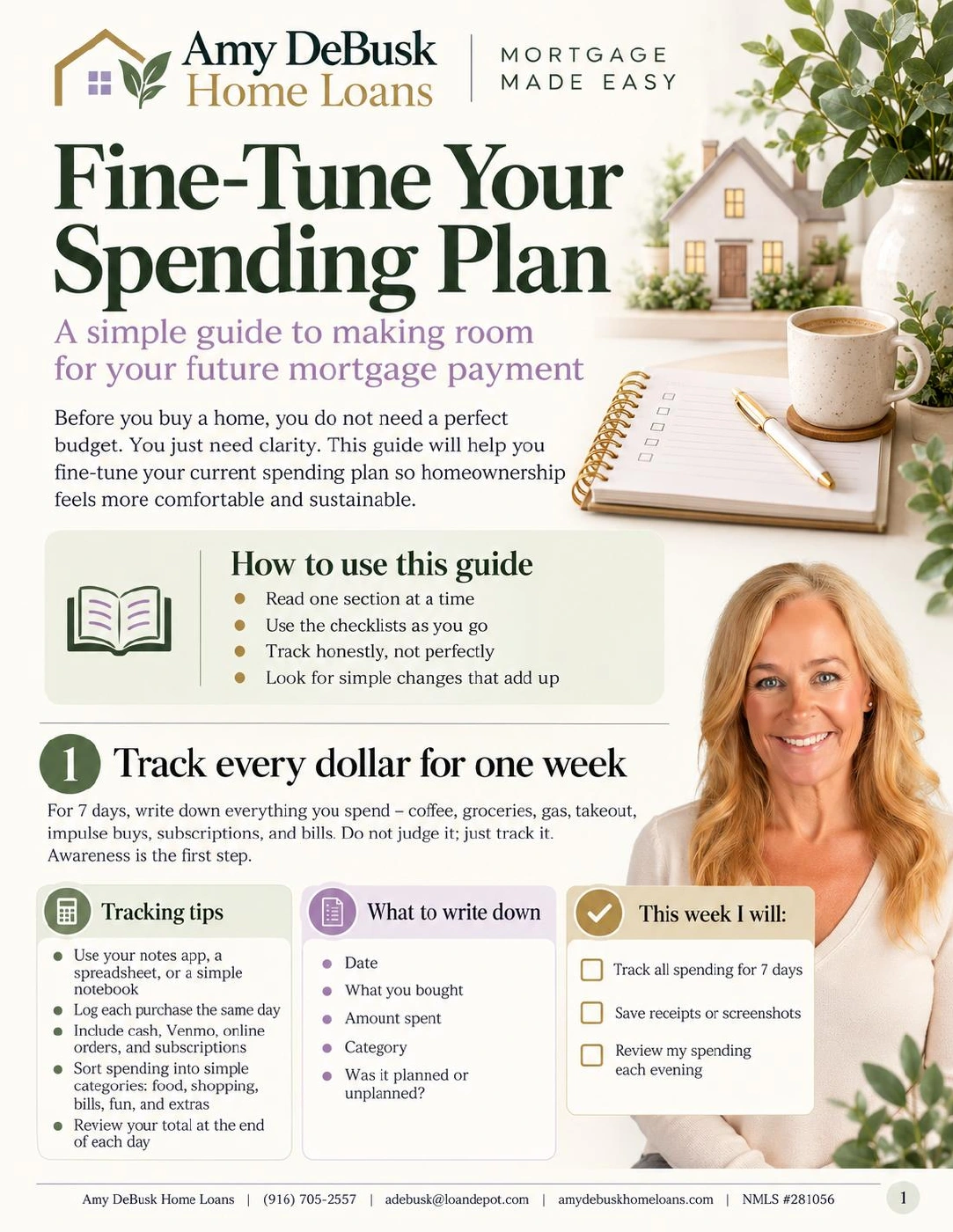
Complimentary guide · 4-page PDF
When you are taking a fresh look at your mortgage, it is a wonderful time to look at your everyday spending, too. I want to help you create more breathing room for your family, your goals and the moments that make home special.
My guide gives you simple action items to spot spending patterns, revisit recurring costs and choose changes that feel manageable. You can use it whether you decide to refinance or keep the mortgage you have.
Start with one small change. The goal is a spending plan that supports the life you want to live.
Download My Complimentary GuidePreview the PDF · Explore the interactive spending-plan tool