

What First-Time Home Buyers in California Need to Know and How to Prepare
The California Dream For All program has quickly become one of the most talked-about homebuyer programs in the state, especially because it can offer up to $150,000 toward your down payment.
But here's what most buyers don't realize:
This program is not always available, and not everyone who qualifies will receive it.
I'm Amy DeBusk, a Branch Manager and mortgage advisor with over 25 years of experience, and I help buyers in Sacramento, Roseville, and throughout California navigate programs like this alongside other loan options.
The key isn't just understanding how Dream For All works, it's knowing how to plan for it and what to do if you don't get selected.
What Is the California Dream For All Program?
The California Dream For All program is a shared appreciation down payment assistance program administered by the California Housing Finance Agency, known as CalHFA.
The program provides eligible first-time home buyers with help toward down payment and closing costs. In exchange, CalHFA receives a percentage of the home's future appreciation.
It is critical to understand this point clearly.
This is not free money.
This is not a grant.
A lot of buyers misunderstand how assistance works in general.
The assistance is a loan and it must be repaid.
Repayment is required when:
- The home is sold
- The home is refinanced
- Or the mortgage reaches maturity
At repayment, the borrower pays back the original assistance amount plus a percentage of the home's appreciation earned during the time the assistance was in place.
The California Dream For All program can help buyers purchase a home sooner, but it comes with long-term obligations that must be fully understood before moving forward.
How the Dream For All Program Works
The Dream For All program is a shared appreciation loan offered through CalHFA.
It can provide up to 20% of the home's purchase price, capped at $150,000, to help cover your down payment or closing costs.
There are no monthly payments on this assistance.
Instead, repayment happens when you sell, refinance, or transfer the home, and includes the original loan amount plus a percentage of the home's appreciation.
This structure reduces upfront costs, but it's important to understand the long-term trade-offs before choosing this program.
How Shared Appreciation Works
To understand how shared appreciation works, let's look at a simple example using a $500,000 home purchase and a California Dream For All shared appreciation loan.
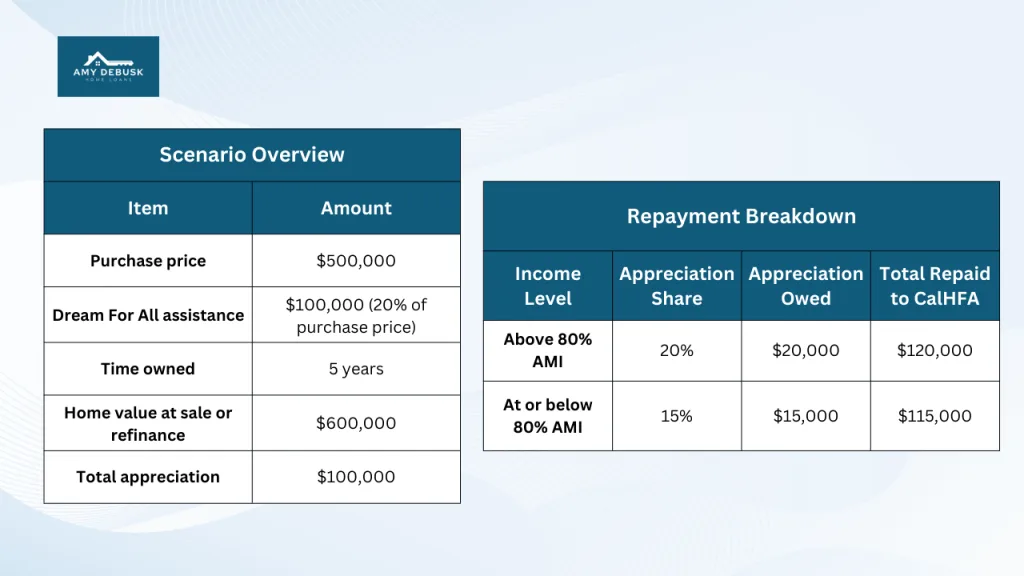
In both cases, the borrower repays the original $100,000 assistance plus a percentage of the home's appreciation. The higher the home value increases, the more shared appreciation is owed.
This example shows why it is important to understand that the California Dream For All program is not free money and not a grant. It is a shared equity loan with long term financial implications.
Why This Matters
Repayment under the California Dream For All program does not occur on a month-to-month basis. You only repay the shared appreciation loan when you sell the home, refinance, transfer ownership, or otherwise pay off the first mortgage or the shared appreciation loan.
The shared appreciation amount is based on the actual increase in the home's value. It is not a flat fee or a penalty. If the home does not appreciate, there is no appreciation to share.
Just as important, the program includes a built-in protection for borrowers. The shared appreciation is capped at 2.5 times the original Dream For All loan amount. This limits the amount of appreciation CalHFA can claim, even in highly appreciating markets.
Using the prior example, a $100,000 Dream For All loan would have a maximum shared appreciation repayment of $250,000. This cap helps prevent excessive repayment and adds predictability for long-term planning.
Understanding these details helps buyers make informed decisions and avoid surprises down the road.
What Most Buyers Don't Realize
One of the biggest misconceptions is that Dream For All is the only way to buy with low upfront costs.
In reality, there are multiple down payment assistance programs available in California, and some can be used without waiting for a lottery.
Most buyers don't realize how many options are already out there. We put together a full page on down payment assistance and grants so you can see what might actually apply to your situation.
The key is understanding how to structure your loan and assistance options together based on your situation.
Putting It in Perspective
In our example:
- You bought at $500,000
- Home appreciated by $100,000 in 5 years
- Shared appreciation owed to CalHFA is either $15,000 or $20,000 depending on income level
- Total repayment includes the original $100,000 shared appreciation loan
This means that your equity growth stays in your pocket except for the percentage you agreed to share, which is defined clearly in the program rules.
Quick Takeaway
The California Dream For All program can help you buy a home sooner by reducing the amount of cash you need upfront.
Instead of making monthly payments on the down payment assistance, repayment happens later and is tied directly to how your home performs in value over time. This creates flexibility in the early years of homeownership, but it also requires thoughtful long-term planning.
Dream For All is a shared equity program, not a grant, and it is designed for a specific group of eligible buyers. Understanding how repayment works is essential before deciding if this program is right for you.
How Much Assistance Can Buyers Receive?
Under the current California Dream For All program guidelines, eligible buyers may receive shared appreciation assistance based on the home's purchase price.
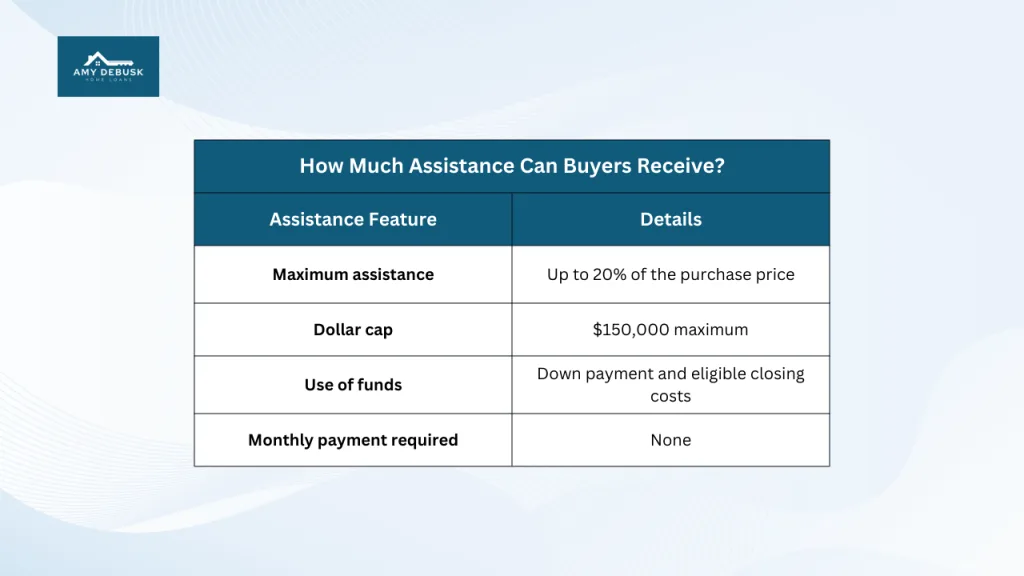
The assistance amount is limited to the lesser of 20% of the purchase price or $150,000.
There are no monthly payments required on the Dream For All shared appreciation loan. Repayment occurs later when the home is sold, refinanced, transferred, or when the mortgage reaches maturity, and the amount repaid is tied to future home value appreciation.
This structure can reduce upfront cash requirements while shifting repayment to a future event, making it important for buyers to plan ahead and fully understand how shared appreciation works.
If you want to see whether the California Dream For All program could work for your situation, start a conversation at talkingwithamy.com.
When Is Dream For All Expected to Reopen?
The California Dream For All Shared Appreciation Loan program is expected to reopen voucher registration in early 2026. Current projections point to mid February 2026, although exact dates are not announced far in advance.
What is known so far:
- Funding will be limited
- Demand will be extremely high
- Vouchers will be distributed by lottery
Because of these factors, buyers who prepare early are in a much stronger position. Having documents ready, working with an experienced lender, and understanding program requirements ahead of time can make a meaningful difference once registration opens.
How the Dream For All Lottery System Works
Dream For All operates on a lottery system, not first-come, first-served.
Here is how it works:
- CalHFA opens a voucher registration portal
- Eligible buyers register during a limited window
- A randomized lottery selects voucher recipients
- Selected buyers receive a voucher and a limited time to purchase a home
There is priority for first-generation first-time homebuyers, as required by program guidelines.
If you are not pre-approved and document-ready when registration opens, you may miss your opportunity even if your name is selected.
Who Qualifies for the California Dream For All Program
This is the most important section of this guide. The California Dream For All program is one of the most restrictive homebuyer programs in the state, and many otherwise qualified buyers are disqualified by these rules alone.
Requirement 1: All Borrowers Must Meet the 7-Year First-Time Homebuyer Requirement
For Dream For All, every borrower on the loan must be a first-time homebuyer, meaning they have not owned a home in the past 7 years.
If any borrower on the application has owned a home within the last 7 years, the household is not eligible.
This is a stricter definition than what's used for some other loan programs, so it's important to verify ownership history for each borrower on the loan.
Requirement 2: At Least One Borrower Must Be a First-Generation Homebuyer
In addition to the 7-year first-time homebuyer requirement above, at least one borrower must qualify as a first-generation homebuyer to be eligible for the California Dream For All Shared Appreciation Loan.
A first-generation homebuyer is defined as someone who meets one of the following:
Option 1: First-Generation Homebuyer (Parent Ownership Test)
The borrower:
-
Has not been on title, held an ownership interest, or been named on a mortgage for a home in the United States in the last 7 years, and
-
To the best of the borrower's knowledge, the borrower's parents (biological or adoptive):
-
Do not currently have any ownership interest in a home in the United States, or
-
If deceased, did not have any ownership interest in a home in the United States at the time of death
-
Option 2: Foster Care or Institutional Care
The borrower has at any time been placed in:
-
Foster care, or
-
Institutional care (out-of-home residential care for large groups of children by non-related caregivers)
Only one borrower needs to meet the first-generation requirement. However, all borrowers must still meet the 7-year first-time homebuyer requirement described above.
Real World Eligibility Examples
- If both borrowers owned a home within the past 7 years, the household does not qualify.
- If one borrower owned a home within the past 7 years, the household does not qualify.
- If both borrowers are currently renting and neither has owned a home in the past 7 years, the household may qualify.
- If neither borrower meets the first-generation requirement, the household does not qualify.
Because these rules are strict and unforgiving, reviewing your eligibility carefully before applying is essential.
Additional Program Requirements
Credit Requirements
The California Dream For All program must be paired with a Dream For All Conventional first mortgage. Credit approval follows conventional loan guidelines and is based on the full credit profile, not just a single credit score.
This is an area where many buyers get confused, especially when relying on free credit monitoring apps that do not reflect the scores mortgage lenders actually use.
Credit Score Requirements for the California Dream For All Program
To use the Dream For All Shared Appreciation Loan, buyers must qualify for a Dream For All Conventional first mortgage. This establishes a clear minimum credit standard.
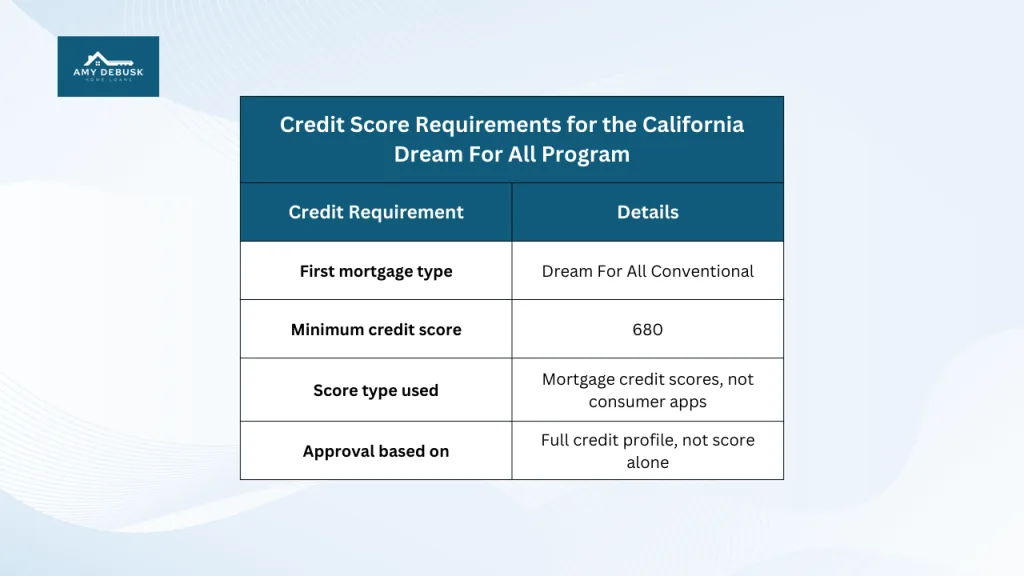
While approval considers factors beyond credit score, borrowers cannot move forward in the program if their score falls below this threshold. Understanding this requirement early helps buyers avoid delays and set realistic expectations.
It's also important to note that this program only pairs with a conventional loan, so buyers will need to meet conventional loan guidelines in addition to the score requirement.
Important: This Is a FICO Score, Not a Credit Karma Score
This point is critical. Mortgage lenders do not use Credit Karma scores when qualifying buyers for the California Dream For All program.
Credit Karma displays a VantageScore, which is a completely different scoring model. VantageScores are often higher than the scores lenders actually use, which can create confusion and false expectations.
For Dream For All and most mortgage programs, lenders use FICO credit scores. They pull credit reports from all three major credit bureaus: Experian, Equifax, and TransUnion.
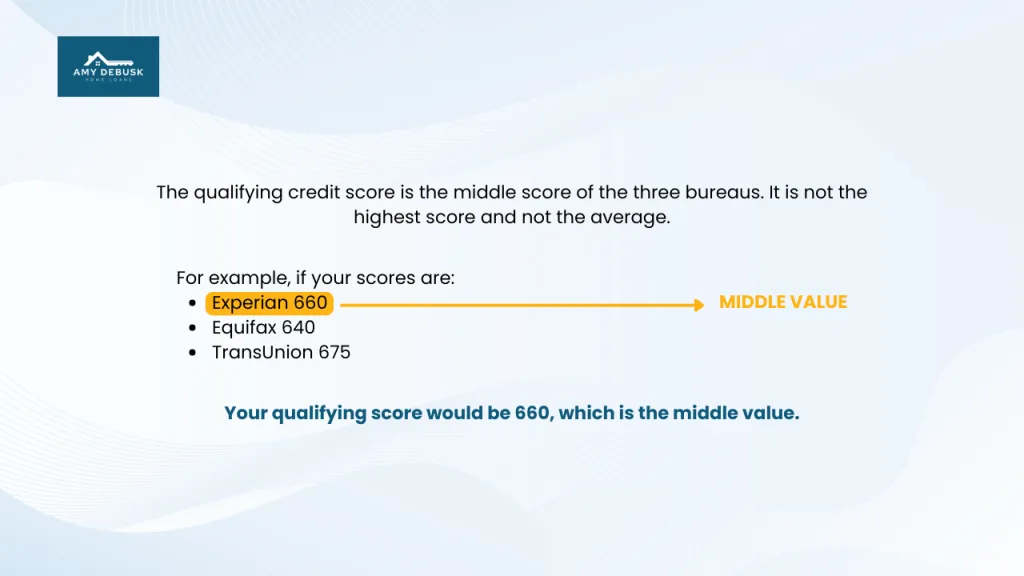
This is very different from what most buyers see in free credit apps, which is why understanding how mortgage credit scoring works is so important before applying.
If you want to know where you actually stand before applying for Dream For All, schedule a conversation at talkingwithamy.com.
Why Credit Karma Can Be Misleading
Credit Karma is a helpful educational tool, but it is not a mortgage qualification tool.
Common issues include
- Scores shown are often 30-60 points higher than mortgage FICO scores
- Mortgage-specific factors are weighted differently
- Buyers think they qualify when they do not yet
This is why early pre-approval matters.
What Else Matters Beyond the Credit Score
While 680 is the minimum threshold, approval also depends on:
- Payment history
- Debt-to-income ratios
- Credit depth and trade lines
- Recent late payments or collections
- Overall financial stability
A borrower with a 680 score and clean history may be stronger than someone with a higher score but recent issues.
The Smart Move: Check Your Real Mortgage Credit Early
The only way to know where you truly stand is to have your credit reviewed by a CalHFA certified lender who understands Dream For All guidelines.
At Amy DeBusk Home Loans, we pull true mortgage FICO scores, review all three credit bureaus, clearly explain where you stand, and create a realistic plan if improvement is needed.
This approach allows you to prepare well before the lottery opens instead of scrambling after you are selected.
Why This Matters for the Lottery
Because Dream For All is a lottery based program, buyers who are not credit ready at the time they are selected often lose their opportunity. There is very little time to fix issues once vouchers are issued.
Knowing your true middle FICO score early helps protect you from disappointment later and puts you in a stronger position when the program reopens.
Book your free discovery call with Amy DeBusk Home Loans.
All loans subject to approval. Equal Housing Lender.
Dream For All 2025 Income Limits
Household income must fall within CalHFA income limits for the county where the home is purchased. These limits apply to Sacramento, Placer, El Dorado, Yolo, Yuba, and surrounding counties and are updated regularly.
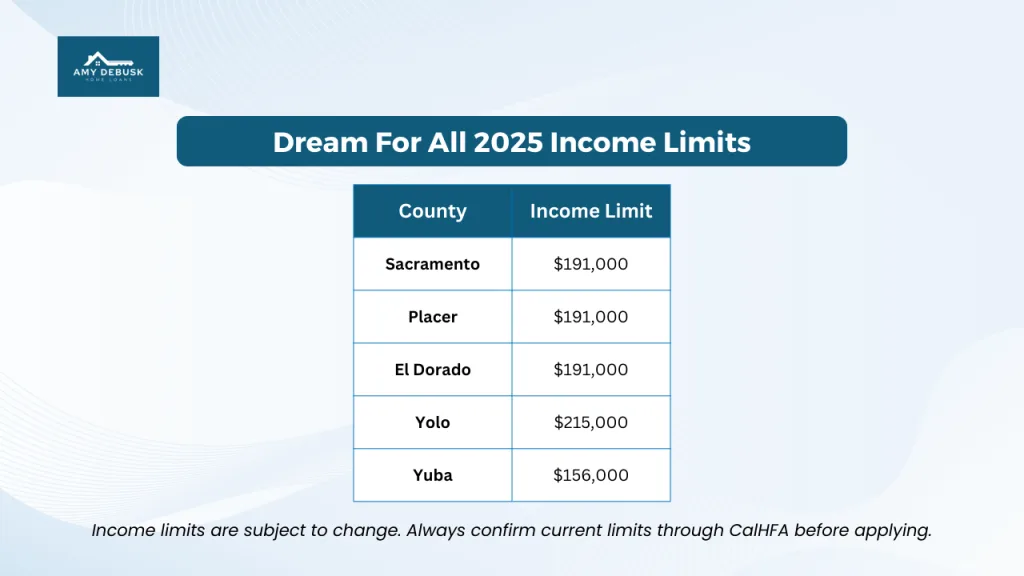
The income limits in the table above reflect the maximum household income allowed for Dream For All eligibility in each county. If your income is at or below 80 percent of AMI, you may still qualify and receive a reduced shared appreciation repayment amount.
Why Working With a CalHFA-Certified Lender Matters
CalHFA does not work directly with buyers.
To participate in Dream For All, you must work with a CalHFA-certified lender.
Amy DeBusk Home Loans is a CalHFA-approved lender that specializes in:
- First-time home buyers
- CalHFA loan programs
- Dream For All preparation and strategy
This matters because:
- Eligibility must be verified correctly
- Documentation must be prepared in advance
- Pre-approval must meet CalHFA standards
- Lottery registration must be handled properly
This is not a program to attempt without guidance.
Should You Wait for Dream For All?
This is one of the most common questions I get.
While the program can provide significant financial support, there are a few important factors to consider:
- Not everyone who applies is selected
- The program may not be open when you're ready to buy
- Waiting could mean missing other opportunities
A lot of people think waiting will put them in a better position, but that's not always how it plays out. I wrote more about that here if you want to see how timing can actually work against buyers.
In some cases, buying now with the right strategy can be more beneficial than waiting.
Steps to Take Now to Get Your Name in the Dream For All Lottery
If you are serious about participating in the California Dream For All program, preparation is what matters most. These steps should be completed well before the lottery opens.
Step 1: Confirm True First Time and First Generation Eligibility
Start by confirming that you meet the strict ownership and first-generation requirements. Many buyers assume they qualify, only to discover later that a past ownership history disqualifies the entire household.
Step 2: Get Pre Approved With a CalHFA Certified Lender
Preapproval must be completed before the lottery opens. This includes a full credit review, income verification, and gathering the documentation required to meet CalHFA standards.
Step 3: Complete the Required Homebuyer Education
CalHFA-approved homebuyer education is mandatory for Dream For All. Completing this early prevents delays once the application window opens.
Step 4: Prepare Documentation in Advance
Lottery registration periods are short. Buyers who have documents organized and ready can move forward quickly. Buyers who wait often miss their opportunity.
Step 5: Register for the Voucher Lottery When the Portal Opens
Once registration opens, your lender will guide you through submitting your information correctly and on time.
Preparation is what gets your name in the bucket. Timing alone is not enough.
If you want help preparing now so you are ready when the Dream For All lottery opens, start the conversation at talkingwithamy.com.
The Bottom Line
The California Dream For All program can be a powerful path to homeownership for the right buyer, but it is not a fit for everyone.
Success with this program depends on understanding the rules clearly, preparing well in advance, and working with an experienced CalHFA certified lender who knows how to navigate the details.
When approached the right way, Dream For All can open doors. When misunderstood or rushed, it can lead to missed opportunities. Preparation and guidance make all the difference.
❓ California Dream For All Program FAQs
❓ 1. Is the California Dream For All program free money or a grant?
No. Dream For All is not a grant and it is not forgiven. It is a shared appreciation loan, meaning the state provides down payment and closing cost assistance in exchange for a share of the home's future appreciation. The original assistance amount plus a percentage of appreciation is repaid when you sell, refinance, or pay off the loan.
❓ 2. Do all borrowers really have to be true first-time homebuyers?
Yes. For Dream For All, every borrower on the loan must be a true first-time homebuyer, meaning they have never owned a home in the United States at any point in their life. This is stricter than many other programs. If any borrower has ever owned a home, even many years ago, the household does not qualify.
❓ 3. What does "first-generation first-time homebuyer" actually mean?
At least one borrower must also meet the first-generation first-time homebuyer requirement. In general terms, this means:
- The borrower has never owned a home, and
- The borrower's parents did not own a home during the borrower's childhood
Only one borrower must meet this first-generation requirement, but all borrowers must still be true first-time buyers.
❓ 4. How much money can I get from Dream For All?
Eligible buyers may receive up to 20% of the purchase price, capped at $150,000, to be used toward down payment and closing costs. The exact amount depends on the purchase price and program limits at the time you apply.
❓ 5. How much appreciation do I have to share with the state?
The shared appreciation amount depends on your income level:
- If your household income is above 80% of Area Median Income (AMI), you share 20% of the home's appreciation
- If your household income is at or below 80% of AMI, you share 15% of the home's appreciation
This amount is paid only when you sell, refinance, or pay off the loan, not monthly.
❓ 6. What credit score do I need for Dream For All?
The minimum credit score requirement is generally 640, because Dream For All must be paired with a Dream For All Conventional first mortgage.
This score must be a true mortgage FICO score, not a Credit Karma or VantageScore.
Lenders use:
- All three credit bureaus (Experian, Equifax, TransUnion)
The middle score of the three
❓ 7. Why is my Credit Karma score different from what the lender sees?
Credit Karma shows a VantageScore, which lenders do not use for mortgages. Mortgage lenders use FICO scoring models, which often produce lower scores. This is why buyers are sometimes surprised when their true qualifying score is different. The only way to know your real score is to have it pulled by a lender.
❓ 8. How does the Dream For All lottery system work?
Dream For All uses a randomized lottery system, not first-come, first-served. When the registration portal opens:
- Eligible buyers register for a voucher
- A lottery selects recipients
- Selected buyers receive a voucher and a limited time to buy a home
There is priority for first-generation buyers, but selection is still competitive due to limited funding.
❓ 9. Do I have to be pre-approved before the lottery opens?
Yes. You must be pre-approved by a CalHFA-certified lender before you can realistically use the program. Buyers who are not pre-approved and document-ready often lose their opportunity even if they are selected in the lottery.
CalHFA does not work directly with buyers. Everything must go through an approved lender.
❓ 10. What if I don't qualify or don't get selected?
Dream For All is one option, not the only path to homeownership. Many buyers who do not qualify or are not selected still have strong options through:
- FHA loans
- Conventional loans
- Other down payment assistance programs
- Seller credits and negotiated costs
Preparation ensures you have options, regardless of the lottery outcome.
No. Dream For All is not a grant and it is not forgiven. It is a shared appreciation loan, meaning the state provides down payment and closing cost assistance in exchange for a share of the home's future appreciation. The original assistance amount plus a percentage of appreciation is repaid when you sell, refinance, or pay off the loan.
Yes. For Dream For All, every borrower on the loan must be a true first-time homebuyer, meaning they have never owned a home in the United States at any point in their life. This is stricter than many other programs. If any borrower has ever owned a home, even many years ago, the household does not qualify.
At least one borrower must also meet the first-generation first-time homebuyer requirement. In general terms, this means:
- The borrower has never owned a home, and
- The borrower's parents did not own a home during the borrower's childhood
Only one borrower must meet this first-generation requirement, but all borrowers must still be true first-time buyers.
Eligible buyers may receive up to 20% of the purchase price, capped at $150,000, to be used toward down payment and closing costs. The exact amount depends on the purchase price and program limits at the time you apply.
The shared appreciation amount depends on your income level:
- If your household income is above 80% of Area Median Income (AMI), you share 20% of the home's appreciation
- If your household income is at or below 80% of AMI, you share 15% of the home's appreciation
This amount is paid only when you sell, refinance, or pay off the loan, not monthly.
The minimum credit score requirement is generally 640, because Dream For All must be paired with a Dream For All Conventional first mortgage.
This score must be a true mortgage FICO score, not a Credit Karma or VantageScore.
Lenders use:
- All three credit bureaus (Experian, Equifax, TransUnion)
The middle score of the three
Credit Karma shows a VantageScore, which lenders do not use for mortgages. Mortgage lenders use FICO scoring models, which often produce lower scores. This is why buyers are sometimes surprised when their true qualifying score is different. The only way to know your real score is to have it pulled by a lender.
Dream For All uses a randomized lottery system, not first-come, first-served. When the registration portal opens:
- Eligible buyers register for a voucher
- A lottery selects recipients
- Selected buyers receive a voucher and a limited time to buy a home
There is priority for first-generation buyers, but selection is still competitive due to limited funding.
Yes. You must be pre-approved by a CalHFA-certified lender before you can realistically use the program. Buyers who are not pre-approved and document-ready often lose their opportunity even if they are selected in the lottery.
CalHFA does not work directly with buyers. Everything must go through an approved lender.
Dream For All is one option, not the only path to homeownership. Many buyers who do not qualify or are not selected still have strong options through:
- FHA loans
- Conventional loans
- Other down payment assistance programs
- Seller credits and negotiated costs
Preparation ensures you have options, regardless of the lottery outcome.
Ready to Take the Next Step?
If you want to confirm whether Dream For All is an option for you, understand your true eligibility, or explore alternative first-time buyer strategies, the next step is a simple conversation.
Amy DeBusk Home Loans is a CalHFA-certified lender specializing in first-time homebuyers throughout California.
All loans subject to approval. Equal Housing Lender.
All Mortgage Made Easy articles · Book a Complimentary Discovery Call