With Amy DeBusk
Connect potential tax relief to a realistic home payment.
When we plan your mortgage, I help you understand how property taxes fit into the monthly payment and which exemption questions need confirmation. Your county assessor determines property-tax exemption eligibility and processing. We will use confirmed information in your financing plan rather than assume a proposed law or an unapproved exemption will lower your payment. For current requirements, start with the California Board of Equalization and your county assessor.
Explore your full housing payment → · Talk with me about your plans →
SB 23, Homes for Heroes, and Why California's Disabled Veterans Deserve Better
I'm writing this not just as a mortgage professional, but as a daughter-in-law, a patriot, and someone who sits across the table from veterans every single week.
My father-in-law is a 100% disabled Vietnam veteran. He served in a war that took pieces of his body and his peace, and he came home to rebuild a life anyway. I also work with so many disabled veterans across California who did the same thing: they served, they sacrificed, they raised families, they bought homes, and now they're trying to stay in those homes on fixed incomes while property taxes climb year after year.
That's why SB 23, often called the "Homes for Heroes Act," hits so close to home for me.
This isn't an abstract policy discussion. This is about whether the men and women who gave this country their health and their mobility should be taxed on the very roof over their heads for the rest of their lives.
What SB 23 Actually Does (In Plain English)
Right now in California, disabled veterans can get a partial property tax exemption on their primary residence. The state's Disabled Veterans' Exemption reduces the assessed value of the home by a fixed amount each year (with a higher tier for low-income households), but it does not eliminate property taxes entirely.California State Board of Equalization+1
For the 2025 lien year, for example, the basic exemption reduces assessed value by about $175,298 and the low-income exemption by about $262,950, indexed annually for inflation. That's helpful but for many 100% disabled vets in California's price environment, it still leaves a significant tax bill every year.
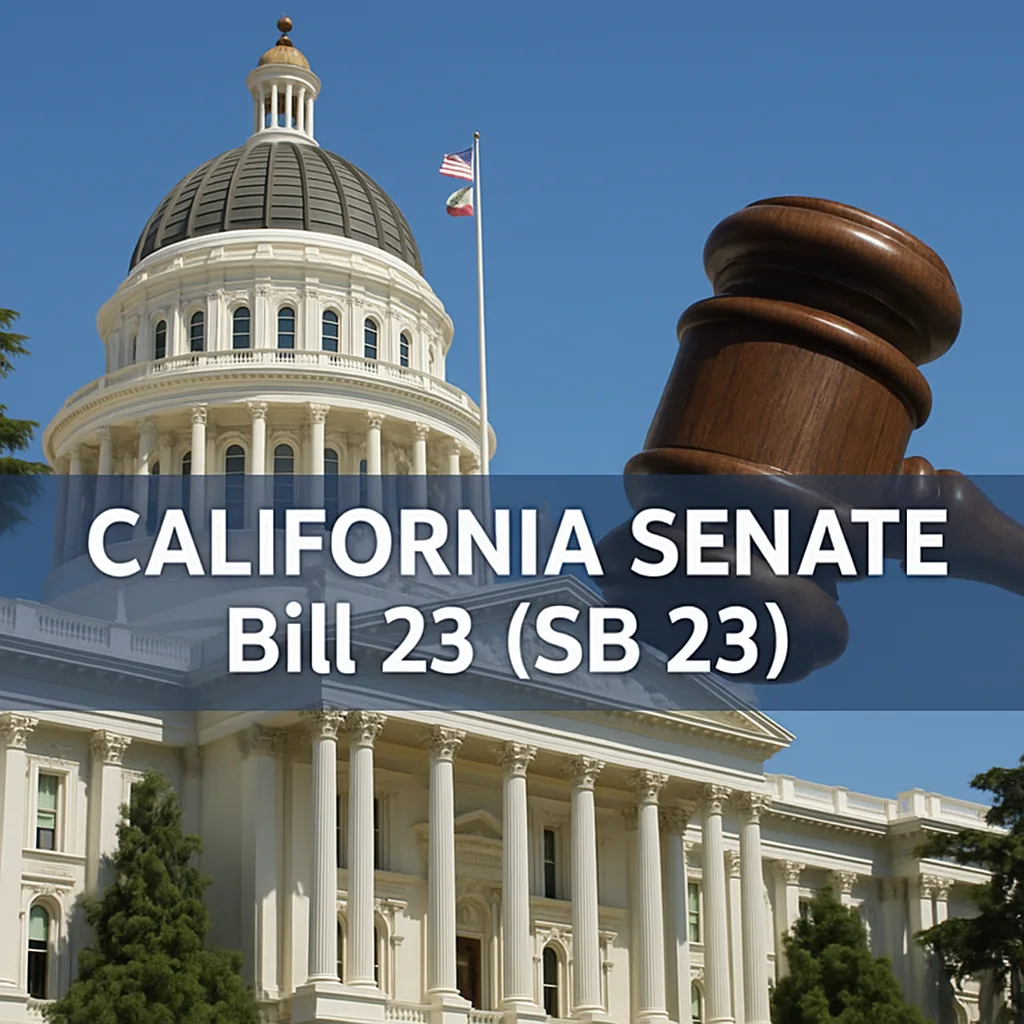
SB 23 (Valladares) would go much further. In its current form, SB 23 would:
- Provide a full property tax exemption on the principal residence of a veteran who is 100% disabled due to service-connected conditions (or paid at the 100% rate due to unemployability).
- Apply to property owned by the veteran, the veteran's spouse, or both jointly, as long as it's their primary home.
- Extend the same exemption to an unmarried surviving spouse if certain conditions are met (for example, if the veteran would have qualified or passed away from a service-connected cause).
- Run for property tax lien dates from January 1, 2025 through January 1, 2035, effectively creating a 10-year window of full relief.
- Require documentation from the U.S. Department of Veterans Affairs to verify disability status.
- Prohibit stacking this with other real property tax exemptions on the same home.
The State Board of Equalization's analysis notes that SB 23 would suspend the current basic and low-income Disabled Veterans' Exemption and replace it with this full exemption for the decade it's in effect. They estimate local governments could see an annual revenue loss of around $334 million statewide compared to current law.
In other words: instead of shaving some taxable value off the top, SB 23 would simply say, "If you are a 100% disabled veteran or qualifying surviving spouse, you do not pay property tax on your primary home during this period."
Why This Matters So Much in Real Life
Let's bring this down to a real-world scenario that I see every day in my work.
Imagine a 100% disabled veteran in California who bought a modest home years ago. Their mortgage payment may be manageable or even paid off but the property tax bill never goes away. In many counties, that bill can easily be several thousand dollars a year, especially as values and local assessments rise.
On a fixed income VA disability, Social Security, maybe a small pension that annual tax bill is not just "an expense." It can be:
- The difference between paying for medications or pushing prescriptions out.
- The difference between fixing a roof leak or letting the damage spread.
- The difference between staying in the community they fought to protect… or being forced to sell and move somewhere cheaper.
SB 23 is trying to address exactly that pressure. Supporters in the Legislature and veteran groups have explicitly said this measure is designed to help severely disabled veterans stay in their homes and reduce the risk of displacement and homelessness.
As one advocate told the Senate committee, this isn't just a "benefit" it's an investment in California's economy, because stable housing for disabled veterans ripples out into stable families, communities, and local spending.
When I think about my father-in-law, and the clients I've helped who roll into my office in wheelchairs, or who fight through chronic pain just to sit upright for a 45-minute call, it's hard not to see SB 23 as one small, very practical way to say:
You've already paid more than your share. We're not going to tax you just for the privilege of staying in the home you bled to protect.
Where SB 23 Stands Right Now (As of Late 2025)
Here's the reality check part, because I want you to have accurate, current information.
- Dec 2, 2024 - SB 23 is introduced in the California Senate by Senator Suzette Martinez Valladares (with multiple coauthors).
- March 12, 2025 - The Senate Revenue & Taxation Committee hears SB 23, branded the "Homes for Heroes Act." The committee votes 5-0 to pass the bill and re-refer it to the Senate Committee on Military & Veterans Affairs.
- March 28, 2025 - The bill is set for a subsequent hearing.
- April 28, 2025 - That hearing is canceled at the author's request. As of now, the bill remains in the committee process and has not yet been enacted into law.
Behind the scenes, there's also a related bill, SB 296 (Archuleta), that proposes a similar decade-long full property tax exemption for disabled veterans and surviving spouses for lien dates beginning in 2026. SB 296 has its own path and timeline, but it's a strong signal that there is bipartisan interest in expanded property-tax relief for disabled veterans in California.
So where are things now?
- SB 23 has momentum: it passed one key Senate committee unanimously, with strong testimony from veterans' organizations and county veteran service officers.
- It has not become law yet. Until it passes both houses of the Legislature and is signed by the Governor, it's still a proposal.
- For now, disabled veterans must continue to rely on the existing Disabled Veterans' Exemption the partial exemption that reduces assessed value but doesn't fully eliminate the tax bill.
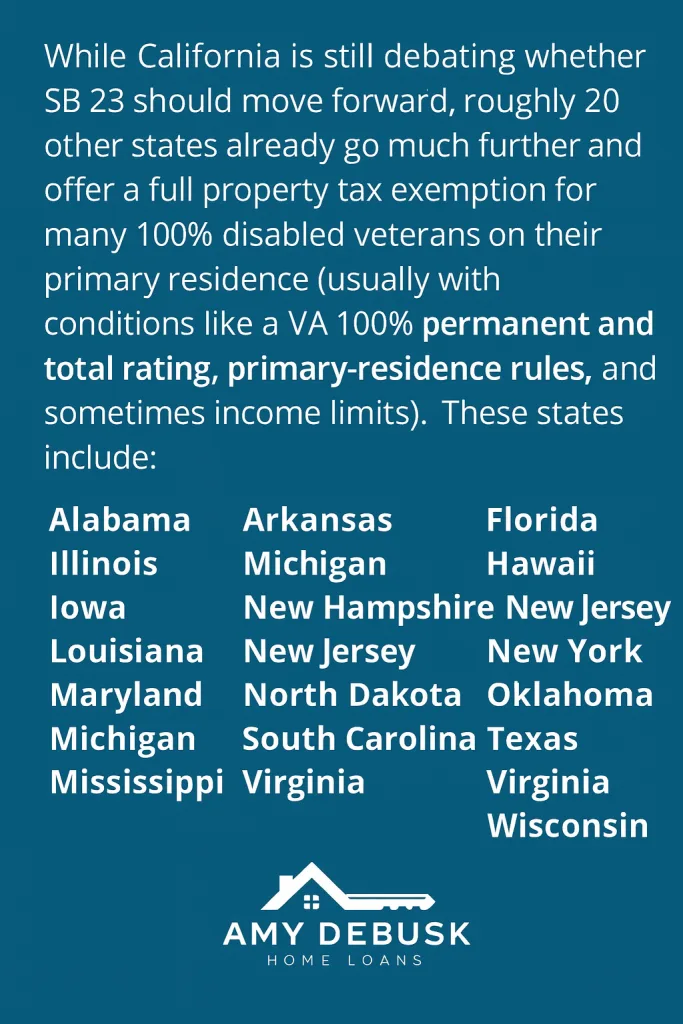
The Tough Trade-Off: Veterans' Stability vs. Local Revenue
One reason this bill is moving slower than many of us would like is the fiscal impact.
The State Board of Equalization's analysis estimates that giving a full exemption to all qualifying 100% disabled veterans and surviving spouses could mean around $334 million in annual local revenue loss, compared to the current partial exemption structure.California State Board of Equalization
Local governments rely heavily on property taxes to fund schools, fire departments, law enforcement, libraries, and basic services. SB 23, as currently written, also says the state will not reimburse local agencies for that lost revenue.Senate Rules 23+1
So the Legislature is trying to balance two truths:
We owe a profound debt to veterans who were permanently disabled in service to this country.
Cities, counties, and schools need stable funding to function.
Personally, I'm not neutral on the moral side of this. When someone comes home 100% disabled because they volunteered for the hardest job this country offers, I believe "we can't afford it" is not a serious answer in a state with California's resources.
But I also understand that lawmakers are wrestling with how to structure something this generous responsibly whether it's SB 23, SB 296, or some blended future solution.
What This Means If You're a Disabled Veteran or Surviving Spouse Today
Here's the practical bottom line if you're reading this as a veteran or family member:
SB 23 is not law yet. You are still under the current Disabled Veterans' Exemption system.
You may already be eligible for a basic or low-income exemption that can significantly reduce your property tax bill if:
Your home is your principal residence, and
You are rated 100% disabled (or paid at the 100% rate due to unemployability), or meet specific blindness/limb-loss criteria, or are an unmarried surviving spouse of a qualifying veteran.
For 2025, the exemption amounts are $175,298 (basic) and $262,950 (low-income) in assessed value, with the low-income level limited to a specific income cap.
If you're not sure whether you've claimed everything you're entitled to, that's a conversation worth having now, regardless of what happens with SB 23.
Frequently Asked Questions for California's Disabled Veteran Tax Exemption (SB-23)
❓ What is California SB 23?
It is a property tax exemption for disabled veterans that reduces the taxable value of their home.
❓ Who qualifies for the 100% Disabled Veteran Property Tax Exemption in California?
Disabled veterans with qualifying service-related disabilities and, in some cases, surviving spouses.
❓ How do I apply in Placer County?
Apply through the county assessor's office with required documentation.
❓ Does this work with a VA loan?
Yes. It works alongside VA loan benefits to reduce overall housing costs.
❓ Does this affect my mortgage payment?
It does not change your loan payment directly, but it reduces your property taxes, lowering your total monthly housing cost.

My Personal Why: Veterans, Homeownership, and Stability
When I help a disabled veteran close on a home-especially with a VA loan-it is never "just another loan."
I think about:
The nights they spent far from home so the rest of us could sleep safely.
The years of pain, medical appointments, and limitations most of us will never see.
The quiet pride of sitting at their own kitchen table, knowing the home is finally theirs.
That's why it hits me so hard when those same families sit at that same kitchen table years later, staring at a property-tax bill and wondering if this is what finally pushes them out.
SB 23 isn't perfect. No bill is. But the heart of it-the idea that 100% disabled veterans should not be taxed out of the homes they fought to defend is something I will always stand behind. To all of the Veterans, Thank you for our freedom!
If you prefer to watch and listen instead of just reading, I've created a full VA Home Loans Guide for Veterans & Active-Duty Military playlist on my YouTube channel.
Inside that playlist, I break down:
How to buy a home with $0 down using your VA benefits
VA loan perks most buyers don't realize they have
How CalVet loans help veterans buy homes in California
What SB 23 and other tax rules could mean for property taxes
Why VA loans don't require Section 1 clearance the way many buyers think
How one veteran saved thousands of dollars on property taxes
Strategies around Prop 19 and keeping more of your hard-earned money
You can watch the full playlist here:
All Mortgage Made Easy articles · Book a Complimentary Discovery Call