

If you're considering the California Dream For All program in Sacramento, Roseville, or Fair Oaks, the biggest question isn't just how it works… it's whether it actually makes sense for your situation.
I'm Amy DeBusk, a Branch Manager with over 25 years of experience, and I've worked with many buyers navigating California down payment assistance programs.
The Dream For All program can offer significant help, sometimes up to 20% of the purchase price, but it also comes with trade-offs, including limited availability and shared appreciation.
So the real question is:
Is it worth it for you in today's market?
Let's break that down clearly.
How the Dream For All Shared Appreciation Works
Dream For All provides down payment assistance as a silent second mortgage.
You own the home. The State of California does not co own your property.
When you sell, refinance, or transfer the home, you repay:
- The original assistance amount
- 5% of appreciation if you were below area median income
- 20% of appreciation if you were above area median income
That shared appreciation is the tradeoff for receiving upfront down payment funds.
Now let us look at how this plays out in actual neighborhoods like Roseville, Fair Oaks, Citrus Heights, and Rancho Cordova.
Roseville vs Citrus Heights: The Asset Class Question
When buyers compare Roseville and Citrus Heights, the conversation usually centers around price. But when Dream For All makes it possible to purchase at a higher price point, the smarter question becomes long term equity growth. If appreciation rates are similar, the higher value property can generate more total wealth over time.
Below is a simplified comparison assuming both homes appreciate at 6 percent annually over five years.
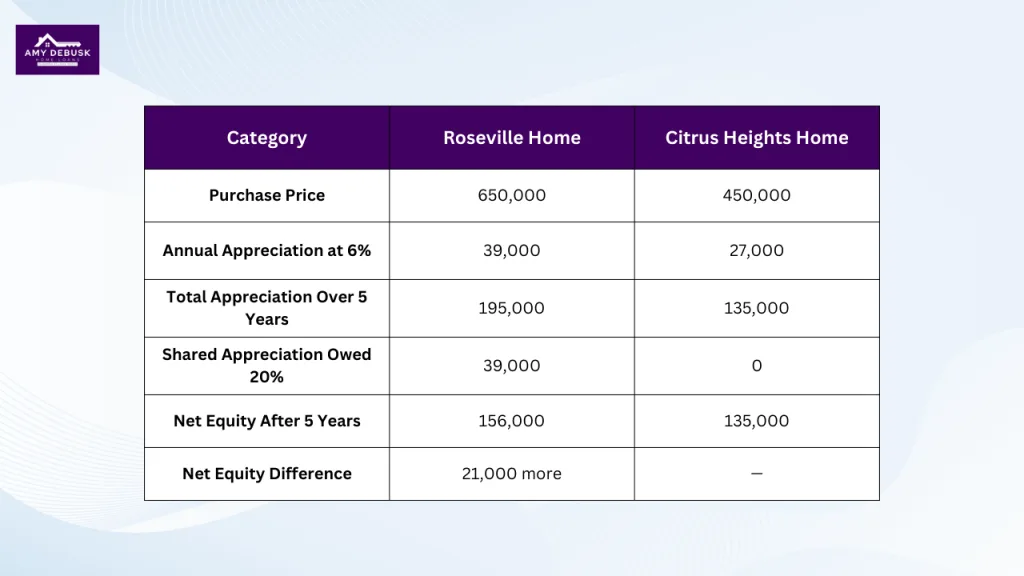
Even after sharing 20% of the appreciation, the Roseville property still produces approximately 21,000 more in net equity over five years. The takeaway is simple. When appreciation percentages are equal, the larger asset often builds more absolute equity, even when a portion is shared.
Is the Dream For All Program Available Right Now?
The Dream For All program is not continuously open.
In 2026, the program operated through a limited application window from late February through mid-March, followed by a lottery system where only selected applicants receive funding. (California Association of Realtors)
Because of this, buyers need to prepare in advance and understand that being eligible does not guarantee receiving the assistance.
This is one of the most important factors when deciding whether the program is worth pursuing.
When Dream For All Is Worth It
This program may be a strong fit if:
You need significant help with your down payment
You plan to stay in the home long term
You are comfortable sharing a portion of future appreciation
You are prepared ahead of the application window
When It May NOT Be Worth It
It may not be the best option if:
You need certainty and cannot rely on a lottery
You plan to sell or refinance in the short term
You want to keep 100% of your home's future equity
You qualify for other assistance programs available year-round
The right choice depends on your timeline and long-term goals.
What I'm Seeing in Sacramento and Placer County
In the Sacramento, Roseville, and Fair Oaks markets, many buyers are interested in Dream For All because of the larger down payment assistance.
However, because the program is limited and lottery-based, I often help buyers create backup strategies using other loan programs so they are not stuck waiting.
The buyers who succeed are the ones who prepare early and understand all of their options.
How to Prepare for the Next Dream For All Opening
If you're interested in using this program in the future, preparation is key.
Here's what I recommend:
Get pre-approved early with a lender familiar with the program
Review income and eligibility requirements
Understand how shared appreciation works
Have a backup loan strategy ready
Because the application window is short and competitive, preparation makes a significant difference.
It's also important to understand how Dream For All compares to other options that may be available right now, especially if your timeline is more immediate.
If you're weighing both approaches, this breakdown can help you decide which direction makes the most sense: Dream For All vs CalHFA Down Payment Assistance
Fair Oaks vs Rancho Cordova: 5 Year Equity Comparison
When buyers are choosing between Fair Oaks and Rancho Cordova, price is usually the first consideration. But when a shared appreciation program makes a higher purchase price possible, the real conversation shifts to asset performance and long term equity growth.
Let's compare two properties under the same assumptions:
- 6% annual appreciation
- 5 year hold period
- 20% shared appreciation on the higher priced home
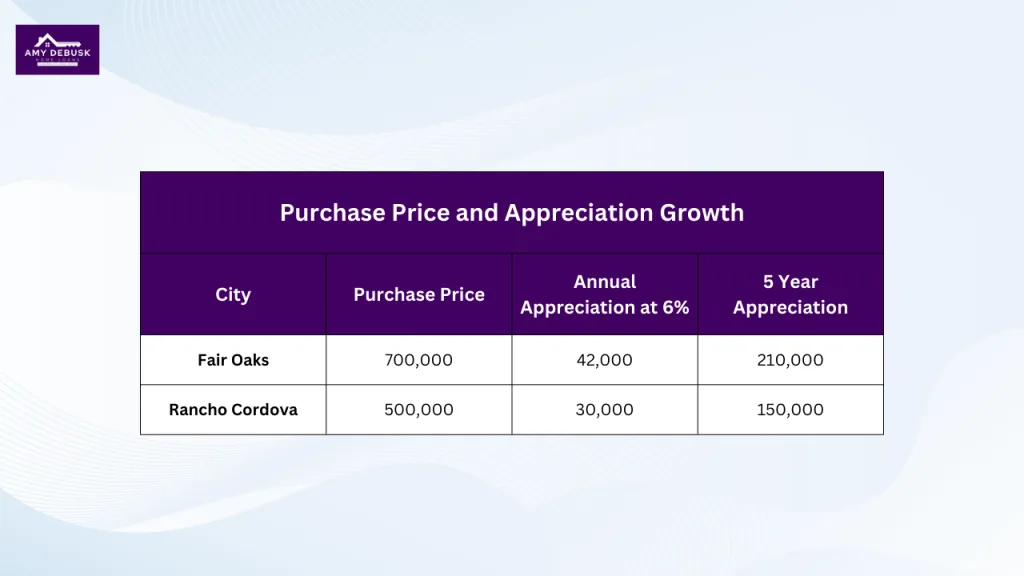
Over five years, the Fair Oaks home generates 60,000 more in total appreciation simply because it is appreciating on a larger base value.
Now let's factor in shared appreciation.
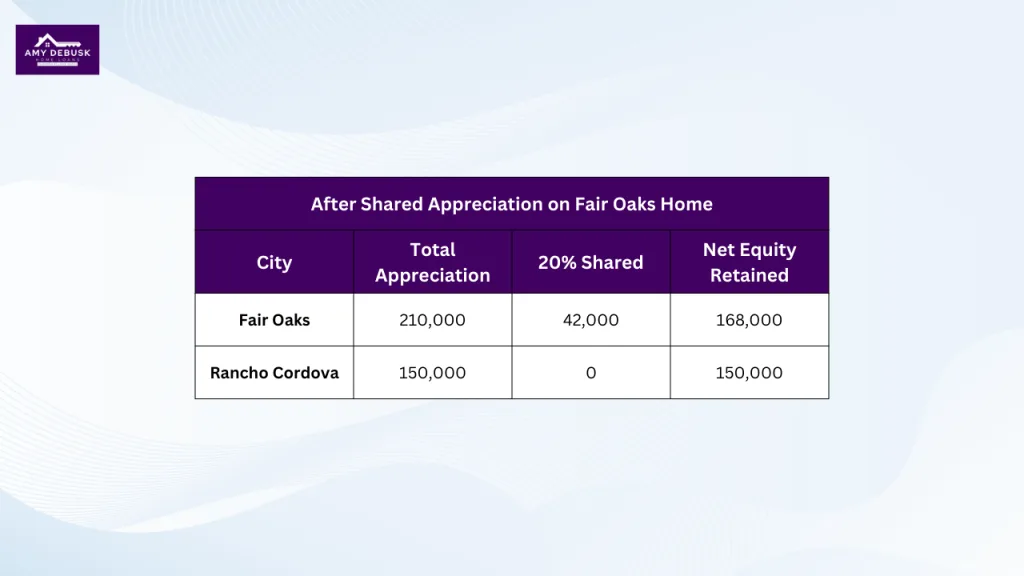
Even after sharing 42,000 of the appreciation, the Fair Oaks property still produces 168,000 in net equity compared to 150,000 in Rancho Cordova.
Key Takeaways
The difference in net equity after five years is 18,000 in favor of the higher priced Fair Oaks home.
Both properties appreciated at the same percentage. The advantage comes purely from owning a larger asset. When appreciation rates are equal, the higher value property builds more absolute dollars in equity.
This is the core asset class principle. Equity growth is driven by both rate and base value. A shared appreciation structure does reduce total gain, but it does not automatically eliminate the financial advantage of owning the higher priced property.
For buyers evaluating location options, this framework can completely change how they think about price versus long term wealth building.
What About Conventional Loans and PMI?
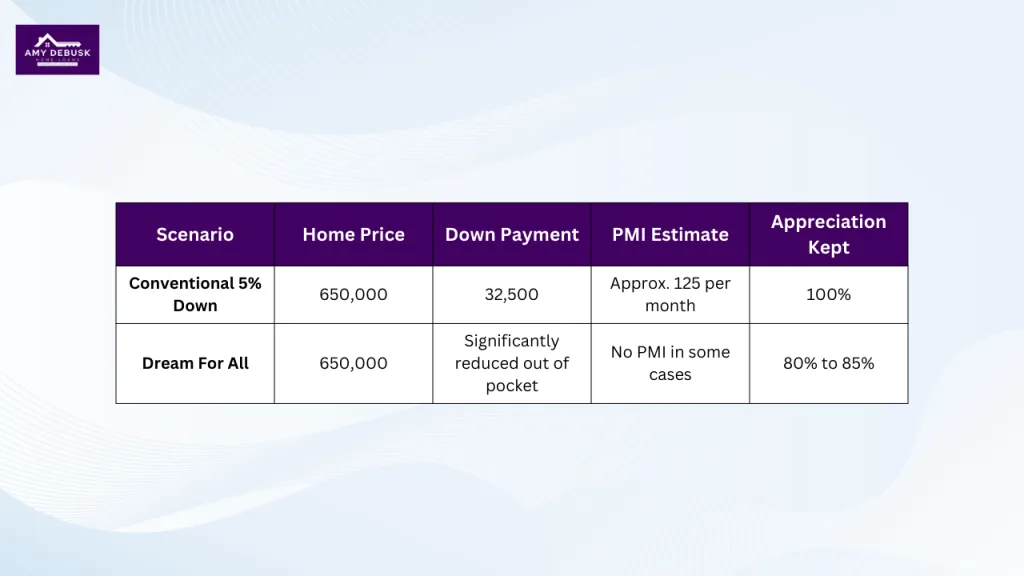
Many buyers compare Dream For All to a conventional loan with 5 percent down. On the surface, the biggest difference appears to be private mortgage insurance versus shared appreciation. But the real comparison goes deeper than that.
Let's look at a simplified example using the same 650,000 purchase price.
How the Costs Work
With a conventional loan at 5 percent down:
- You bring 32,500 to closing
- You pay PMI monthly until you reach 20% equity
- PMI can typically be removed once your loan balance drops below 80 percent of the home's value
With Dream For All:
- Out of pocket cash is often substantially reduced
- PMI may not apply depending on structure
- Instead of monthly PMI, you agree to share a portion of future appreciation
- Shared appreciation is only paid when you sell, refinance, or transfer the property
The Timing Difference
PMI increases your monthly payment immediately and affects cash flow until you reach 20% equity. Shared appreciation has no monthly cost and is only paid when you sell, refinance, or transfer the home. One impacts your budget now, the other impacts your equity later.
The Bigger Strategic Question
This is not just PMI versus shared appreciation. It is often a choice between a lower priced home with full appreciation and a higher-priced home with partial shared appreciation. If Dream For All allows access to a stronger market like Roseville or Fair Oaks, the higher value property can generate more total equity even after sharing a portion. The real decision is balancing short term payment with long term wealth growth.
Is the California Dream For All Program Worth It?
There is no universal answer.
It depends on:
- Your income level
- How long you plan to keep the home
- The neighborhoods you are comparing
- Your appreciation assumptions
- Your long term wealth strategy
When evaluated with real numbers instead of emotion, Dream For All can be a strategic tool for first time homebuyers in Roseville, Fair Oaks, Citrus Heights, Rancho Cordova, and throughout the greater Sacramento Valley.
If you would like to run personalized numbers for your situation, we can compare Dream For All and conventional financing side by side and determine which strategy builds the most long term equity.
All loans subject to approval. Equal Housing Lender.
All Mortgage Made Easy articles · Book a Complimentary Discovery Call