
If you have been searching for a home in Sacramento, Roseville, Rocklin, Citrus Heights, or anywhere in the greater Sacramento area, you may already be feeling what so many buyers are feeling right now. There is a real housing shortage, especially in the entry-level price points. Move-in-ready homes can feel expensive for what you are actually getting, and many of the homes that are priced well often need updates, repairs, or a complete refresh.
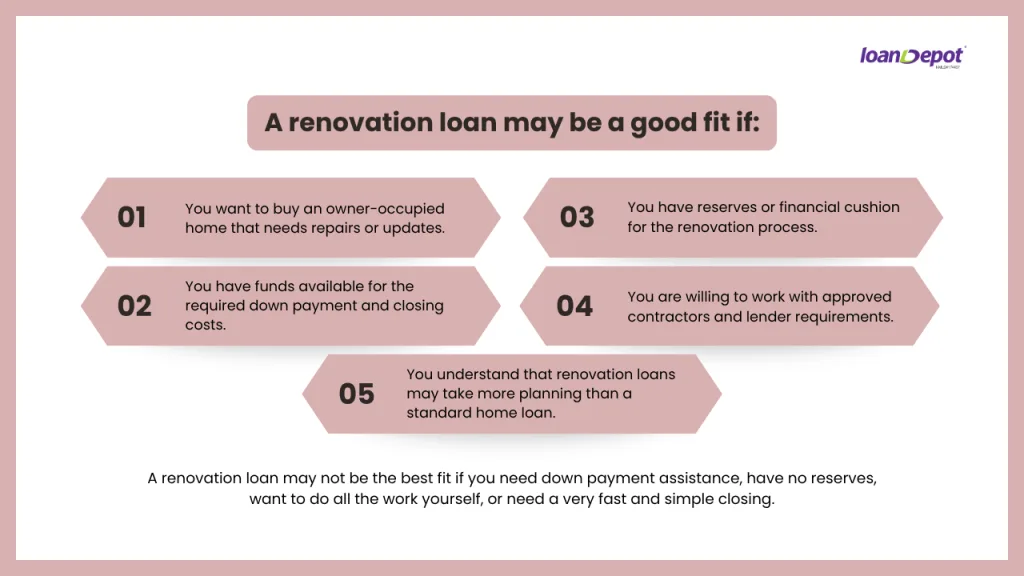
A renovation loan may be a good fit for a buyer who wants to purchase an owner-occupied fixer-upper and has money available for the required down payment, closing costs, and financial reserves. Renovation loans are powerful, but they are not usually paired with down payment assistance programs, so buyers need to be financially prepared before moving forward.
There are three main renovation loan options many buyers consider: FHA 203K, Choice Renovation, and VA Renovation. FHA renovation financing generally requires at least 3.5% down and a credit score over 640. Choice Renovation financing generally requires at least 5% down and a credit score over 680. For eligible veterans, VA renovation financing may allow 100% financing with a credit score starting at 600, depending on the full loan approval and program requirements.
It is also important to know that renovation loans are not designed for do-it-yourself projects. The work must typically be completed by an approved licensed contractor, and the lender will need to review the contractor, the scope of work, and the renovation budget. If you already have a contractor you trust, our team can help guide you through the process of getting your contractor approved with our company.
But here is the opportunity: sometimes the home with the outdated kitchen, old flooring, worn bathrooms, or needed repairs may be the home that creates the best path forward. Instead of only competing for fully remodeled homes, you may be able to buy a home that needs work and finance eligible improvements into the loan.
I'm Amy DeBusk, a Branch Manager and Mortgage Advisor with over 25 years of mortgage experience. I help buyers understand niche loan products, like renovation loans, in a simple and easy-to-understand way so they can make confident decisions about their home financing options.
In this guide, I'll walk you through how renovation loans work, the different options available, and how to decide whether a renovation loan may be the right fit for your situation.
What Is a Renovation Loan?
A renovation loan allows you to finance the cost of the home and the cost of eligible improvements into one mortgage. This can be especially helpful when you find a home in a great location or at a better price point, but it needs updates, repairs, or improvements before it feels like the right home.
A renovation loan may allow you to:
- Purchase a home and finance eligible renovations
- Refinance your current home and finance improvements
- Use the home's future value after improvements, also known as the After Repair Value
- Create a home that better fits your lifestyle, instead of waiting for the perfect home to appear
For many buyers in the Sacramento area, this can be a powerful strategy. Instead of competing only for fully remodeled homes, you may be able to consider homes that other buyers are overlooking because they need work.
This does not mean every fixer-upper is a good idea. The numbers, the condition of the home, the scope of work, the contractor, and the financing all matter. But with the right guidance, a renovation loan can help turn an "almost right" home into a home that truly works for you.
Instead of relying on cash, credit cards, or high-interest personal loans, eligible renovation costs may be built into the mortgage, creating one financing strategy for both the home and the improvements.
Most buyers at this stage also start looking at ways to reduce upfront costs, compare loan options, and understand what assistance programs may be available.
CHOICE Renovation Loan: A Conventional Renovation Option
The CHOICE Renovation Loan is a conventional renovation loan option that can help eligible buyers purchase a home that needs repairs or improvements and finance eligible renovation costs into the loan.
This can be a strong option for buyers who want to purchase a fixer-upper, customize a home after closing, or finance larger improvements while using a conventional loan structure.
The CHOICE Renovation Loan may work well for:
- Buying an owner-occupied fixer-upper and financing eligible improvements
- Renovating a primary home, second home, or investment property, depending on program guidelines
- Funding larger improvements such as kitchens, bathrooms, additions, flooring, energy-efficient upgrades, or full remodels
- Buyers who meet conventional loan requirements and want to avoid some of the extra costs associated with FHA financing
Real Client Story: Buying the Home They Were Renting With a CHOICE Renovation Loan
One of my favorite examples of a CHOICE Renovation Loan involved clients in Rocklin, California who were renting a home from their landlord. They loved the location, they already knew the property, and they had the opportunity to purchase the home they were living in.
The home needed updating throughout, and the estimated renovation budget was around $100,000. They were purchasing the home for approximately $475,000, and there was enough equity in the property to support the improvements they wanted to make.
Instead of looking for a different home or trying to compete for a fully remodeled property, they used a CHOICE Renovation Loan to purchase the home and finance the improvements into the loan.
For this family, the goal was not to add square footage. They wanted to improve the existing footprint of the home and make it more functional for their lifestyle. Their renovation plan included updating the kitchen, remodeling the bathrooms, replacing the roof, installing new flooring, and widening or extending hallway access to better accommodate a family member who used a wheelchair.
This is exactly where renovation financing can be so powerful. The home did not need to be perfect on day one. What mattered was that the property had potential, the renovation plan made sense, and the financing strategy helped turn the home into something that worked better for their family.
A CHOICE Renovation Loan can be a strong option for buyers who find a home with good bones, a good location, and room for improvement. It may allow eligible buyers to purchase the home and finance approved renovations into one loan, rather than relying on cash, credit cards, or separate high-interest financing.
This Rocklin story is a beautiful example of using the right loan strategy to create a home that fits the family, supports accessibility needs, and builds long-term value through thoughtful improvements.
Why the CHOICE Renovation Loan Can Be a Strong Strategy
One reason buyers may prefer the CHOICE Renovation Loan over an FHA 203K loan is that conventional renovation financing does not have the FHA upfront mortgage insurance premium. FHA loans typically include an upfront mortgage insurance premium of 1.75%, which is added to the loan amount unless paid in cash.
For some buyers, avoiding that upfront FHA mortgage insurance cost can create meaningful savings.
The CHOICE Renovation Loan typically requires:
- A minimum 5% down payment for eligible primary residence purchases
- A credit score around 660 or higher, depending on full loan approval and program requirements
- Approved contractor bids and project documentation
- The work to be completed by an approved licensed contractor
- The home and renovation plan to meet lender and program guidelines
CHOICE Renovation Loan vs. FHA 203K
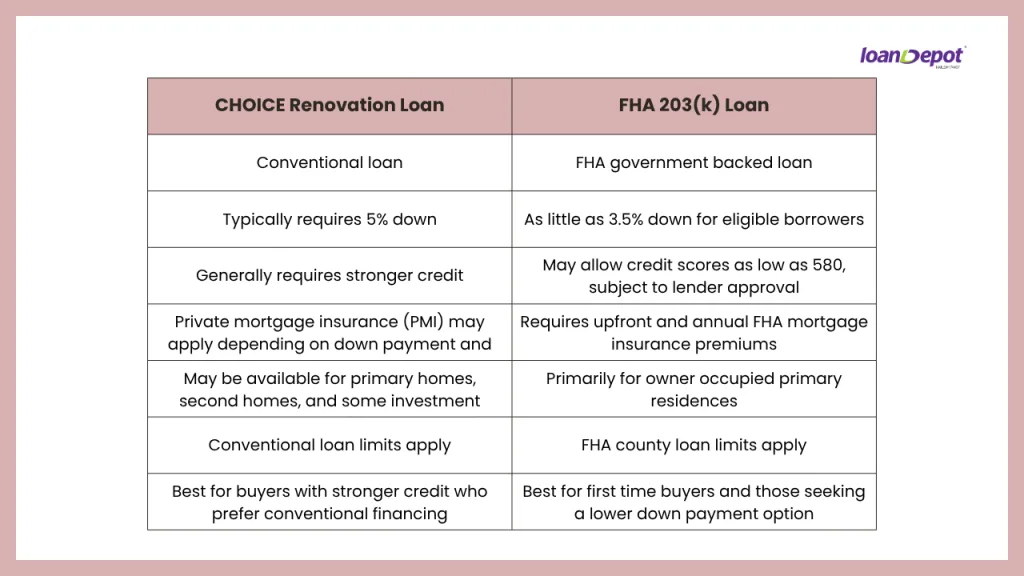
The CHOICE Renovation Loan may be a better fit for buyers with stronger credit, at least 5% down, and a desire to use conventional financing.
The FHA 203K loan may be a better fit for first-time buyers or buyers who need a lower down payment option. FHA renovation financing generally allows 3.5% down for eligible buyers and may allow lower credit scores, with some programs allowing credit scores down to 580, depending on full loan approval and lender requirements.
The tradeoff is that FHA financing includes mortgage insurance, including the upfront FHA mortgage insurance premium, while conventional financing may offer a different mortgage insurance structure depending on the buyer's down payment, credit profile, and loan terms.
Strategy: Choose the Program That Fits the Buyer
There is no one-size-fits-all renovation loan. The best option depends on the buyer's credit score, down payment, reserves, property type, renovation budget, contractor plan, and long-term goals.
For a buyer with 5% down and stronger credit, the CHOICE Renovation Loan may offer more flexibility and potential cost savings compared to FHA.
For a buyer with limited down payment funds or a credit profile that fits FHA better, the FHA 203K loan may be the better path.
The key is to compare both options side by side before making an offer on a fixer-upper.
Not Sure Which Renovation Loan Fits Your Situation?
Renovation loans are not one-size-fits-all. The right option depends on your credit score, down payment, reserves, property type, contractor plan, renovation budget, and long-term goals.
If you are looking at a home that needs work, or you already own a home and want to remodel, the smartest first step is to compare your options before you start the project or make an offer.
I can help you review FHA 203K, CHOICE Renovation, VA Renovation, HELOCs, fixed-rate second mortgages, and other financing strategies so you can understand what may work best for your situation.
Schedule a free consultation here: talkingwithamy.com
Can You Use a Renovation Loan on Multi-Family or Manufactured Homes?
Yes, renovation loans may be available for eligible 2 to 4 unit properties and certain manufactured homes, but the property must meet the loan program requirements.
For 2 to 4 unit properties, the home must be owner-occupied. This means you must live in one of the units as your primary residence. This can be a powerful strategy for buyers who want to purchase a duplex, triplex, or fourplex that needs repairs or updates.
Depending on the loan program, renovation financing may also be available for eligible manufactured homes. However, manufactured homes can have additional property requirements, and higher credit scores may be required depending on the loan program, lender guidelines, property type, and overall loan profile.
Both FHA 203K and conventional renovation options, such as CHOICE Renovation, may allow financing on eligible property types, subject to full underwriting, property approval, contractor approval, and renovation guidelines.
This is especially helpful in markets like Sacramento, Roseville, Citrus Heights, and surrounding areas where entry-level housing can be limited. A renovation loan may allow a buyer to consider homes that need work, including certain multi-family or manufactured home options, while still creating a path toward homeownership.
A buyer may be able to live in one unit of a 2 to 4 unit property, improve the property, and potentially use rental income from the additional units to help support the overall housing strategy. The key is making sure the loan program, property condition, renovation budget, contractor plan, manufactured home eligibility if applicable, and buyer qualification all line up before making an offer.
FHA 203K Renovation Loan
The FHA 203K loan is one of the most well-known renovation loan options, especially for first-time buyers and owner-occupied buyers who want a lower down payment option.
FHA 203K financing may allow an eligible buyer to purchase or refinance a home and include funds for eligible repairs or improvements in the mortgage. This can be a helpful strategy when the home needs work, but the buyer does not want to rely on cash, credit cards, or a separate personal loan to complete the repairs.
If you're purchasing your first home, you may also want to review our complete guide for first-time buyers to better understand loan options, down payment requirements, and the home buying process.
FHA 203K may be a good fit for buyers who:
- Want to buy an owner-occupied fixer-upper
- Need a lower down payment option
- Have less than 5% down
- Have a credit profile that fits FHA better than conventional financing
- Want to finance eligible repairs or improvements into the mortgage
- Are working with an approved licensed contractor
There are two main versions of the FHA 203K loan: the Limited 203K and the Standard 203K.
- The Limited 203K is generally used for smaller, non-structural updates and repairs. This may include items such as flooring, paint, appliance replacement, minor repairs, and other eligible improvements.
- The Standard 203K is used for more extensive renovation projects and may include larger repairs, structural work, additions, or major rehabilitation. Because the Standard 203K involves more moving parts, it typically requires more documentation, planning, contractor involvement, and oversight.
FHA 203K loans are designed to improve the safety, livability, and functionality of the home. They are not intended for luxury upgrades, non-permanent improvements, or do-it-yourself projects.
FHA financing generally allows a 3.5% down payment for eligible buyers, and FHA guidelines may allow lower credit scores than conventional renovation options. At Amy DeBusk Home Loans, we typically look for a credit score over 640 for FHA 203K financing to help create a stronger approval profile and smoother renovation loan process.
If you are trying to buy a home that needs work and you do not have 5% down or the credit profile needed for a conventional renovation loan, FHA 203K may be the better fit.
For a deeper breakdown, read our full guide: FHA 203K Loans Explained: How to Buy a Fixer-Upper Without Extra Loans.
VA Renovation Loan: 100% Financing for Eligible Veterans
The VA Renovation Loan can be a powerful option for eligible Veterans, active-duty service members, and qualifying borrowers who want to buy or refinance a home and include eligible renovation costs in the same loan.
One of the biggest benefits is that VA renovation financing may allow up to 100% financing for eligible borrowers, which means qualified buyers may be able to purchase a home that needs work without a required down payment.
This can be especially helpful when a Veteran finds a home in the right location, but the property needs updates, safety repairs, or functional improvements before it fully fits their needs.
A VA Renovation Loan may help eligible borrowers:
- Purchase a home and finance eligible repairs
- Refinance and include eligible improvements
- Improve the safety, livability, and functionality of the home
- Use approved licensed contractors instead of paying cash for renovations
- Create a home that better supports their lifestyle and long-term goals
Veterans who are still comparing traditional VA financing versus renovation financing may find it helpful to review our complete VA loan resource center.
Like other renovation loans, VA renovation financing is not designed for DIY projects. The work generally must be completed by an approved licensed contractor, and the lender will review the contractor, scope of work, project details, and renovation budget.
At Amy DeBusk Home Loans, we typically look for a credit score around 600 or higher for VA renovation financing, depending on the full loan profile, property, and program requirements.
If you are an eligible Veteran and want to understand how this works in more detail, read our full guide: VA Renovation Loan: Build the Home You Deserve Using Your VA Benefits.
Renovation Loan Starting Point
Before you make an offer on a fixer-upper or start planning a remodel, get clear on:
- Which renovation loan program fits your goals
- How much down payment may be required
- What credit score is needed
- Whether you have enough reserves
- What repairs or improvements may be eligible
- Whether the contractor can be approved
- How the renovation budget affects the loan
- What the home may be worth after improvements
We Help You Navigate Contractor Approval
Renovation loans are not DIY loans. The work generally must be completed by an approved licensed contractor, and the contractor, bid, scope of work, timeline, and project details must be reviewed as part of the loan process.
If you already have a contractor you want to use, our team can help guide you through the process of getting that contractor approved with our company. If you do not know where to start, we can help you understand what type of contractor documentation is typically needed for renovation financing. We can provide you with a list of approved contractors as well.
The goal is to make sure the project is structured correctly from the beginning so the renovation plan, loan program, contractor, and property all work together.
Final Thoughts: The Right Renovation Loan Can Change How You Look at Homes
In a competitive market like Sacramento, Roseville, Rocklin, Citrus Heights, and Placer County, it can feel discouraging when move-in-ready homes are priced higher than what many buyers are comfortable paying.
But sometimes, the opportunity is not in the perfect home. Sometimes, the opportunity is in the home with good bones, a great location, and the potential to become exactly what you need.
A renovation loan may be a smart option if you want to buy an owner-occupied fixer-upper, remodel your current home, or finance improvements without relying on cash, credit cards, or high-interest personal loans. It may also be a powerful strategy for buyers who have a down payment, reserves, and the patience to work through a more detailed loan process.
The key is choosing the right program. FHA 203K, CHOICE Renovation, and VA Renovation loans all work differently. Your credit score, down payment, property type, contractor, renovation budget, and long-term goals all matter.
That is why the best first step is not touring fixer-uppers or calling contractors. The best first step is understanding your financing options.
At Amy DeBusk Home Loans, we help make niche mortgage products simple and easy to understand. If you are wondering whether a renovation loan could help you buy, remodel, or create a home that better fits your life, we would be happy to walk you through your options.
Schedule a free consultation: talkingwithamy.com
❓FAQs about Renovation Loan for Sacramento Home Buyers and Homeowners
A renovation loan allows eligible buyers or homeowners to finance both the property and approved improvements into one mortgage strategy. This can be helpful when buying a fixer-upper, remodeling a current home, or purchasing a home that needs repairs before it fully fits your needs.
The right renovation loan depends on your credit score, down payment, property type, contractor plan, scope of work, renovation budget, and long-term goals.
A renovation loan may be a good fit for a buyer who wants to purchase an owner-occupied fixer-upper and has money available for the required down payment, closing costs, and reserves.
Renovation loans are not usually paired with down payment assistance programs, so buyers need to be financially prepared. These loans may be a strong option for buyers who want to improve a home, build value, and finance eligible repairs instead of paying for the entire renovation out of pocket.
Yes, eligible buyers may be able to buy a fixer-upper and finance approved repairs or improvements into the loan. This can make it possible to consider homes that need updates, repairs, or improvements, instead of only competing for move-in-ready homes.
This can be especially helpful in markets like Sacramento, Roseville, Rocklin, Citrus Heights, and Placer County, where entry-level homes can be limited and move-in-ready properties may be priced higher than many buyers expect.
Credit score requirements depend on the loan program and the full loan approval. At Amy DeBusk Home Loans, we typically look for a credit score over 640 for FHA 203K financing, around 660 or higher for CHOICE Renovation financing, and around 600 or higher for VA renovation financing.
Credit score is only one part of the approval. Income, assets, debts, reserves, property type, contractor approval, and the renovation plan also matter.
The required down payment depends on the renovation loan program. FHA 203K financing generally requires at least 3.5% down for eligible buyers. CHOICE Renovation financing generally requires at least 5% down for eligible primary residence purchases. VA renovation financing may allow 100% financing for eligible Veterans, active-duty service members, and qualifying borrowers.
Down payment, closing costs, reserves, and total cash needed should be reviewed before making an offer on a fixer-upper.
No, renovation loans are generally not designed for do-it-yourself projects. The work typically must be completed by an approved licensed contractor.
The contractor, bid, cost breakdown, scope of work, timeline, permits if required, and renovation budget must usually be reviewed as part of the loan process. If you already have a contractor you want to use, our team can help guide you through the process of getting that contractor approved with our company.
Renovation loans may be available for eligible 2 to 4 unit properties and certain manufactured homes, subject to loan program requirements, property approval, contractor approval, and full underwriting.
For 2 to 4 unit properties, the home must be owner-occupied, meaning you must live in one of the units as your primary residence. Manufactured homes may have additional property requirements, and higher credit scores may be required depending on the program and full loan profile.
It depends on whether you are buying a home or improving a home you already own. A renovation loan may be a better fit when you are purchasing a fixer-upper and want to include eligible repairs in the mortgage.
A HELOC or fixed-rate second mortgage may be a better fit if you already own the home, have enough equity, and want to finance improvements without refinancing your current first mortgage. The best option depends on your equity, current mortgage rate, credit profile, project size, payment goals, and long-term strategy.
All Mortgage Made Easy articles · Book a Complimentary Discovery Call