
By Amy DeBusk Home Loans
All loans subject to approval. Equal Housing Lender.
Self employed buyers in Sacramento and Roseville bring incredible value to this market. You are the creators, investors, innovators, and builders who keep our community thriving. You work hard. You reinvest in your business. You structure your finances to grow, adapt, and stay resilient through the seasons that come with entrepreneurship.
And yet, when it's time to buy a home, the tax system and the mortgage system often clash in a way that feels confusing and unfair.
Your accountant helps you reduce taxable income using legal business deductions. But then your lender looks at that same tax return and tells you the income is too low to qualify.
This leaves many self employed buyers facing two choices.
Option 1
Review a conventional loan using an accurate analysis of your tax returns and business cash flow.
Option 2
Review a bank statement loan using eligible deposits and the program’s expense and income calculations.
Both paths can lead to a mortgage.
Both paths can work.
But they do not lead to the same financial outcome.
Let's walk through this clearly so you can choose the path that protects your wealth.
Conventional qualifying income is not simply taxable income
Conventional underwriting analyzes documented business income and cash flow. Certain adjustments, such as eligible depreciation add-backs, may apply. A lower taxable-income figure does not by itself tell us what your qualifying income will be.
Start with an accurate income review. Tax returns must accurately report your income and deductions. Do not change a return simply to make a loan work; your tax professional should advise on any legitimate correction or planning decision. We can compare the mortgage options using the documentation that accurately reflects your business.
Bank statement loans use an alternative income review
An eligible bank statement program may review 12 or 24 months of statements instead of using tax returns for that income calculation. Eligible deposits, business expenses, ownership, transfers, and other non-income deposits need to be evaluated under the selected program.
Your total deposits are not automatically your qualifying income. Down payment, credit, business history, and property requirements vary. We should also protect the working capital you need to run your business.
Business history needs a program-specific review
A shorter self-employment history may be considered under some programs with additional conditions. It is not a universal 12-month rule. The available guidelines, your previous experience, and the evidence of business continuity need to be reviewed before relying on an exception.
Compare the actual offers and the full cost
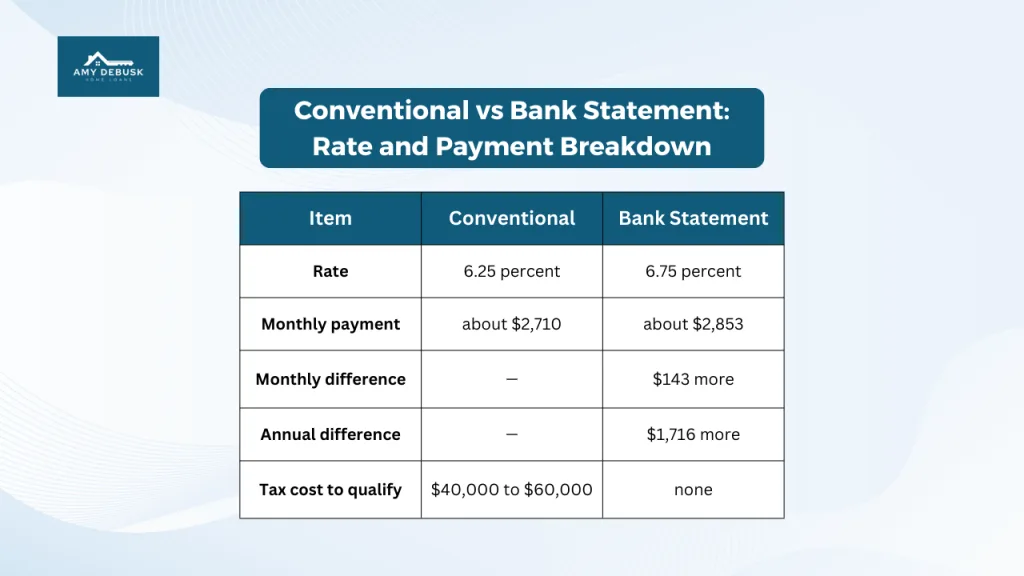
There is no fixed rate difference between a conventional and a bank statement loan. Compare the offers available for your situation, including rate, APR, fees, required funds, monthly payment, and how much cash remains after closing.
A tax estimate is also personal to the taxpayer and tax year. Your CPA can help evaluate lawful tax choices while we compare mortgage options. Neither loan type is automatically the better financial choice.

Sylvia’s story: finding a loan that fit her business and her plans
To show how this plays out in real life, I want to share a recent experience with a client of mine named Sylvia. She is self employed, single, disciplined, and incredibly smart with her money. She had saved more than $90,000 in the bank and was ready to buy her first home.
When we reviewed her tax returns, her taxable income was too low for a conventional loan because she had taken her legal write offs. Instead of guessing or making assumptions, we approached this strategically. I worked with her CPA to understand the tax implications of the approach being discussed and compare it with a bank statement option. Income reporting still needed to be accurate.
The CPA came back with the number.
To show $120,000 in taxable income, Sylvia would owe $42,000 in taxes.
This was a case-specific estimate from her CPA, not a general tax cost of conventional financing.
She had the money to do it, but the question became simple:
Why pay $42,000 to the IRS when that money could be used to build her future instead?
Sylvia and I made the clear, strategic choice to protect her write offs and use a Bank Statement Loan. She used her $90,000 for her down payment rather than handing nearly half of it to the IRS.
And this choice changed everything.
Sylvia purchased a beautiful farmhouse in Redding, California - a home with land, space, and room for the life she is creating. She moved in with her dog and her two goats, who were both pregnant at the time. It was the perfect property for the next chapter of her life.
And here is the part that matters most.
She found a financing path that supported her home plans and the way her business income was documented. Every borrower and property needs an individual review.
This is the power of choosing the loan program that aligns with your real financial life.
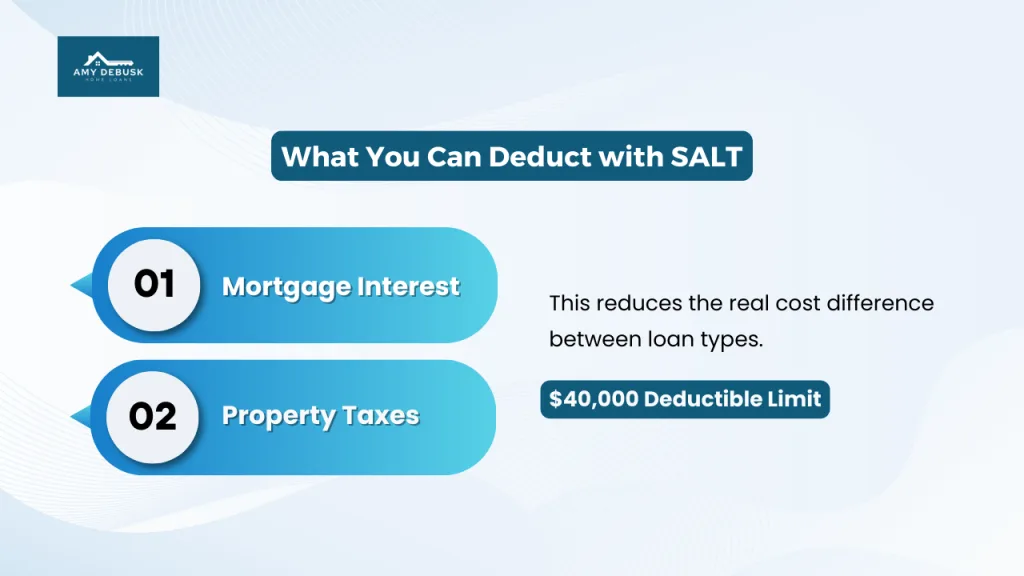
Mortgage interest and property-tax deductions are different
Mortgage interest and state and local taxes follow separate deduction rules. Eligibility, itemizing, income limits, loan use, and the tax year can affect the result. Ask your tax advisor how the rules apply to you instead of assuming a loan’s extra cost will be offset by a deduction.
The IRS homeowner tax information explains the categories and limitations.
Choose the loan that supports your business and home
Homeownership can support long-term goals, but appreciation and wealth-building are not guaranteed. The mortgage should fit your cash flow, reserves, and plans. We can compare a conventional loan and a bank statement loan without assuming one always wins.
You Are Closer to Homeownership Than You Think
Choosing between a conventional loan and a Bank Statement Loan is not about choosing a rate. It is about choosing the path that aligns with your tax plan, your business structure, and your long term wealth goals.
I help self-employed buyers across Sacramento, Roseville, and Placer County understand how their documented income may be evaluated under different mortgage options.
If you want to compare both loans using your real numbers, I will walk you through it step by step.
❓Self Employed Home Loans Conventional vs Bank Statement Loan FAQs
❓ 1. What is a Bank Statement Loan and who is it designed for?
A bank statement loan is an alternative-documentation option for eligible self-employed borrowers. The lender reviews eligible deposits, expenses, and other program requirements rather than treating every deposit as spendable income.
❓ 2. Do I need two full years of self-employment to qualify?
Some programs may consider a shorter business history under specific conditions. Prior experience does not automatically establish eligibility. I will review the current requirements and documentation for your situation.
❓ 3. What credit score is required for a Bank Statement Loan?
Credit requirements vary by program and transaction. I will confirm the current requirements alongside down payment, reserves, business history, and property eligibility.
❓ 4. Do I need a down payment, and are down payment assistance programs available?
The required down payment depends on the selected program and your qualifying picture. We can review eligible sources of funds and the cash you want to retain after closing.
❓ 5. How do lenders calculate my income using bank statements?
The lender reviews eligible deposits over the required statement period, excludes transfers and non-income items, and applies the applicable business expense and ownership calculations. The result is a program-specific qualifying income figure.
❓ 6. Is the interest rate higher on a Bank Statement Loan compared to a conventional loan?
There is no fixed rate difference. Compare current Loan Estimates and the full cost of the options available to you rather than rely on an old rate example or a general tax-savings claim.
❓ 7. How does choosing a Bank Statement Loan help me build generational wealth?
The goal is a sustainable home purchase that fits your business and household. A bank statement loan does not guarantee appreciation or greater wealth than a conventional loan. We can compare costs, cash retained, and long-term plans.
❓ 8. How do I get started with a Bank Statement Loan through Amy DeBusk Home Loans?
We begin with your goals and review the documentation needed to assess your options. Qualification and pre-approval require review. You can book a conversation with me before deciding to apply.
Your AI Powered Bank Statement Loan Assistant Is Here

For conventional income analysis, see the agency cash-flow analysis worksheet. Program-specific bank statement requirements are reviewed separately.
All Mortgage Made Easy articles · Book a Complimentary Discovery Call