

Why Asking the Right Questions Matters
Refinancing decisions are highly personal, and even small differences in structure can lead to very different outcomes. Two homeowners can refinance at the same interest rate and still see very different results.
Those differences often come down to
- Fees and closing costs
- Loan structure and term length
- The break even timeline
- Total interest paid over time
- How long the homeowner plans to stay in the home
The goal is not to refinance quickly or react to market noise. The goal is to refinance intentionally, with a clear understanding of how the decision impacts both short term cash flow and long term financial health.
Asking the right questions upfront creates clarity, prevents costly surprises, and helps ensure the refinance truly supports your bigger financial picture. The questions that follow are designed to do exactly that.
Question #1: What Is My Break-Even Point?
Your break-even point tells you how long it takes for your monthly savings to recover the cost of the refinance.
For example:
If your refinance costs $6,000 and you save $250 per month, your break-even point is about 24 months.
As a general guideline:
- A strong refinance typically breaks even within 24 months or less
- You should plan to stay in the home longer than that break-even period
If a lender cannot clearly explain your break-even point, that is a red flag.
Question #2: How Much Will I Actually Save Each Month?
Not just on the mortgage - overall.
Ask:
- What am I paying monthly today?
- What will my total monthly outflow be after refinancing?
This is especially important if you are:
- Consolidating debt
- Removing mortgage insurance
- Restructuring your loan
Monthly cash flow often matters more than the rate itself.
Question #3: Am I Paying Closing Costs Out of Pocket or Rolling Them Into the Loan?
Closing costs do not disappear. They are either:
- Paid out of pocket at closing, or
- Rolled into the new loan balance
Both options can make sense depending on your goals.
Ask:
- How does each option affect my payment?
- How does it affect my break-even point?
- How much interest will I pay long-term?
Understanding this upfront prevents surprises.
Question #4: Is This a Rate-and-Term Refinance or a Cash-Out Refinance?
This distinction matters.
- Rate-and-term refinance focuses on improving loan terms
- Cash-out refinance allows you to access home equity
If cash is involved, ask:
- How much equity can I access?
- How does this affect my payment and long-term costs?
Question #5: If I'm Using a Cash-Out Refinance, How Much Can I Actually Take Out?
Across most loan programs, the maximum loan-to-value for a cash-out refinance is 80% of the home's appraised value.
This means:
- Your total loan after refinancing generally cannot exceed 80% of the home's value
- At least 20% equity must remain in the home
Example:
If your home is worth $500,000, the maximum total loan amount would typically be $400,000.
This limit exists to protect homeowners and promote long-term stability.
Question #6: If I'm Consolidating Debt, How Much Will This Improve My Monthly Cash Flow?
When using a refinance for debt consolidation, the most important metric is monthly cash flow, not just the mortgage rate.
Ask:
- How much am I saving each month overall?
- Does this reduce financial stress?
- Am I improving my ability to save and plan?
A well-structured debt consolidation refinance replaces multiple high-interest payments with one manageable payment.
Question #7: Does This Refinance Depend on My Home Appraising for a Certain Amount?
Yes, for many refinance options, your home's value plays a critical role in whether the loan works and how it is structured.
This is especially true for:
• Cash-out refinances
• Refinances to remove mortgage insurance
• Conventional refinances
• Any refinance with a maximum loan-to-value requirement
That's why understanding how your home's value is being determined is so important.
What Is an AVM?
Before ordering a formal appraisal, many lenders begin with an AVM, which stands for Automated Valuation Model. An AVM is a computer generated estimate of your home's value that uses large sets of data to provide an early indication of where your property may land.
An AVM estimate is based on factors such as
- Recent comparable home sales in your area
- Property characteristics like size, location, and features
- Current market trends
- Public record data
An AVM should be viewed as a data driven snapshot, not a final determination of value. It is a starting point that helps guide early refinance conversations.
AVMs are commonly used to answer preliminary questions such as
- Whether there appears to be enough equity to refinance
- Whether a cash out refinance makes sense on paper
- Whether removing mortgage insurance may be realistic
While an AVM can be helpful early on, it does not replace an appraisal when one is required. Its role is to provide clarity at the beginning of the process so homeowners can make informed next steps with confidence.
Why You Should Ask If an AVM Was Run
One of the smartest questions you can ask your lender early in the refinance process is
"Have you run an AVM, and how are you determining my estimated value?"
This question opens the door to an important and transparent conversation. It allows your lender to walk you through how your home's value is being estimated and how that estimate supports your refinance goals.
Specifically, it helps clarify
- The value range currently being indicated
- Whether that value supports your specific refinance strategy
- Whether an appraisal waiver may be possible
- How conservative or aggressive the estimate appears to be
At Amy DeBusk Home Loans, this early step is used to set clear and realistic expectations before time, energy, and money are invested. It helps homeowners move forward with confidence and avoid surprises later in the process.
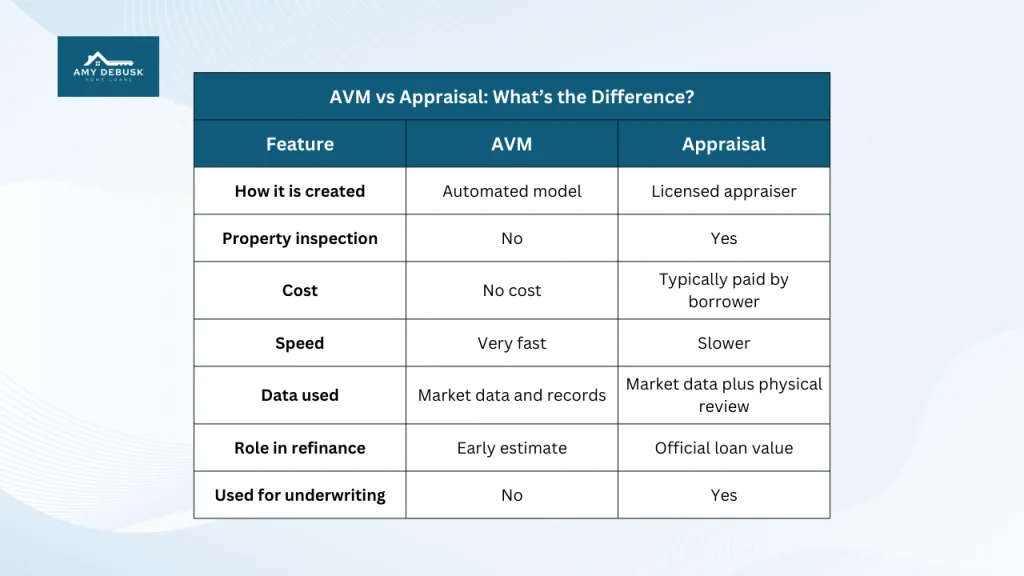
AVM vs Appraisal: What's the Difference?
Both AVMs and appraisals are used to estimate a home's value, but they serve very different purposes in the refinance process.
An AVM is an automated estimate generated by computer models using market data. It is fast, costs nothing, and provides an early snapshot of value, but it is not a final determination.
A formal appraisal is completed by a licensed appraiser and includes a review of the property and comparable sales. It is often required for many refinances and determines the official value used for underwriting and loan approval.
Why This Matters for Your Refinance Strategy
Your home's value plays a critical role in determining which refinance options are available and how your loan can be structured.
Home value directly affects
- How much equity may be accessed
- Whether mortgage insurance can potentially be removed
- Whether a cash out refinance is an option
- Whether the loan stays within required loan to value limits
For example, cash out refinances are commonly capped at eighty percent of the home's value. If an appraisal comes in lower than expected, the refinance structure may need to change to stay within program guidelines.
Understanding these factors early in the process helps set realistic expectations and prevents frustration later. When value is evaluated upfront, refinance decisions can be made with clarity rather than surprises.
The Right Way to Approach Value Conversations
Instead of asking, "What's my home worth?" a more productive question shifts the focus to strategy.
A better question to ask is "Based on current data, does my estimated value support the refinance strategy we're discussing?"
This reframes the conversation from guessing a number to evaluating options. It keeps the focus on whether the value works for your specific goal, whether that is lowering payments, removing mortgage insurance, or accessing equity.
Question #8: Do I Need an Appraisal for This Refinance?
Not always.
- FHA Streamline and VA IRRRL refinances typically do not require an appraisal
- Conventional, FHA Rate & Term, VA Cash-Out, and cash-out refinances usually do
Knowing this affects timing, cost, and expectations.
Question #9: What Credit Score Are You Using to Price My Loan?
Mortgage lenders do not use the credit score you see on Credit Karma.
They use:
- A FICO score, not a VantageScore
- The middle score from Experian, Equifax, and TransUnion
This middle FICO score determines your pricing tier.
Question #10: Is There an Opportunity for Me to Improve My Credit Score Before Refinancing?
Often, yes.
Small changes such as:
- Paying down credit card balances
- Reducing utilization
- Correcting reporting errors
can sometimes improve scores in 30-60 days, potentially resulting in better pricing.
Sometimes refinancing now still makes sense, strategy matters.
Question #11: How Long Will This Refinance Take?
Most refinances in California take 3 to 4 weeks from application to funding.
Streamline refinances may be faster. Full refinances that require appraisals and income documentation may take closer to four weeks.
Question #12: Why Should I Work With You Instead of a Bank or Online Lender?
A bank can only offer its own products.
At Amy DeBusk Home Loans, homeowners benefit from:
- In-house lending through American Pacific Mortgage
- Access to a broad network of banks and investors
- The flexibility to pivot if guidelines or pricing change
This means your refinance is matched to you, not forced into one box.
Question #13: Will Refinancing Hurt My Credit Score?
This is one of the most common concerns homeowners have, and it is an important question to ask.
Here is how it really works.
For Conventional loan refinances, we are able to start with a soft credit pull, which does not impact your credit score at all. This allows us to review your options, pricing, and eligibility without any credit hit.
For other loan types such as FHA, VA, Jumbo, or specialty loan programs, a hard credit inquiry is required in order to move forward. A hard pull may or may not cause a small, temporary change in your score, and when it does, it is typically minimal.
A few key points to keep in mind:
- A hard inquiry usually affects your score by only a few points, if at all
- Mortgage credit inquiries completed within a short time frame are generally grouped together
- Consistent, on-time payments after refinancing often support long-term credit health
The takeaway is this: A refinance is not harmful to your credit when done thoughtfully. In many cases, a well-structured refinance that improves cash flow, lowers monthly payments, reduces debt, or removes mortgage insurance can actually strengthen your overall financial picture over time.
What Credit Score Is Actually Used for a Mortgage Refinance?
Mortgage lenders rely on FICO scores when evaluating a refinance, not VantageScore or the scores commonly shown by many consumer credit apps.
When credit is pulled for a refinance, lenders review reports from all three major bureaus, Experian, Equifax, and TransUnion. Rather than using the highest or lowest score, the middle score is used for loan pricing and approval decisions.

Why This Question Matters So Much
Interest rates for mortgage refinances are typically tiered based on credit score ranges. This means even a small increase in your score can sometimes lead to meaningful improvements in loan terms.
A higher score may
- Improve your interest rate
- Reduce loan related fees
- Improve overall loan pricing
That's why this follow-up question is so important: "Is there an opportunity for me to raise my score to get a better rate?"
Can You Improve Your Score Before Refinancing?
In many cases, yes, and sometimes faster than expected. Strategic adjustments can often lead to measurable score improvements in a relatively short period of time.
Common strategies include
- Paying down credit card balances
- Adjusting credit utilization ratios
- Correcting reporting errors on credit reports
- Timing the credit pull strategically
In many situations, modest improvements can be made within thirty to sixty days, which may translate into significant long term savings over the life of the loan.
At Amy DeBusk Home Loans, this conversation is part of the refinance strategy. If improving your credit score could meaningfully improve your outcome, that guidance is provided upfront before a rate is locked or a loan is finalized.
Old-School Refinance Guidelines That Still Matter
While every refinance situation is different, there are still a few time tested guidelines that can help evaluate whether refinancing makes sense.
Helpful rules of thumb include
- Aiming to lower your interest rate by at least one percent when possible
- Exceptions may include consolidating debt or removing mortgage insurance
It is also important to try to recover refinance costs within twenty four months or less. This helps ensure the savings are substantial rather than marginal.
Most importantly, refinance with intention rather than emotion. A successful refinance supports long term goals and financial stability rather than reacting to short term market changes.
Smart Strategy After You Refinance
If refinancing lowers your required monthly payment, one of the smartest moves you can make is continuing to pay what you were paying before.
Set your automatic payment to your previous payment amount and confirm that any extra funds are applied directly toward principal.
This simple adjustment can
- Shorten your loan term significantly
- Save tens of thousands of dollars in interest over time
- Help you build equity faster without changing your budget
Because the payment was already part of your routine, this strategy allows you to maximize the benefit of refinancing while accelerating progress toward long term financial goals.
Final Thoughts
Refinancing is not about chasing the lowest rate. It is about understanding your numbers, asking thoughtful questions, and choosing a strategy that supports your long term goals.
For homeowners in Roseville, Sacramento, and surrounding Northern California communities, Amy DeBusk Home Loans provides guidance rooted in clarity, education, and experience.
❓Refinance Guide for Homeowners: Frequently Asked Questions
❓ How do I know if refinancing makes sense for me right now?
Refinancing makes sense when it improves your financial picture. This could mean lowering your monthly payment, reducing long-term interest, removing mortgage insurance, or improving cash flow. The key metric to review is your break-even point, which shows how long it takes to recover refinance costs through monthly savings.
❓ How long does a refinance take in California?
Most refinances take 3 to 4 weeks from application to funding. Streamline refinances are often faster, while full refinances that require appraisals and income documentation may take closer to four weeks.
❓ Do I need an appraisal to refinance?
Not always. FHA Streamline and VA IRRRL refinances typically do not require an appraisal. Conventional, FHA Rate & Term, VA Cash-Out, and cash-out refinances usually do.
❓ What is an AVM and why does it matter?
An AVM, or Automated Valuation Model, is a data-driven estimate of your home's value based on recent sales and market trends. It helps determine whether your refinance strategy is realistic before ordering a formal appraisal.
❓ How much equity can I access with a cash-out refinance?
In most cases, the maximum cash-out is 80% of your home's value, meaning at least 20% equity must remain in the property. This protects homeowners from overleveraging.
❓ What credit score is used to price my refinance?
Mortgage lenders use the middle FICO score from the three credit bureaus. This is different from the scores shown on Credit Karma or other free apps.
❓ Can I improve my credit score before refinancing?
Often, yes. Paying down credit cards, adjusting utilization, correcting reporting errors, or timing the credit pull strategically can sometimes improve scores in 30-60 days, which may result in better pricing.
❓ Can refinancing help me consolidate debt?
Yes, when done intentionally. A cash-out refinance can consolidate high-interest debt into one lower monthly payment. The focus should be on monthly cash flow improvement, not just rate.
❓ Will refinancing hurt my credit?
Refinancing may cause a small, temporary dip due to a credit inquiry, but this impact is typically short-lived. Over time, improved cash flow and consistent payments can support credit health.
❓ Why work with a mortgage broker instead of a bank?
A broker can compare multiple lenders and loan programs. At Amy DeBusk Home Loans, you benefit from both in-house lending through American Pacific Mortgage and access to a broad network of banks, giving you more options and flexibility.
Helpful Resources for Homeowners
Visit Our Refinance Hub
Our Refinance Hub was created to give homeowners a clear, pressure free place to explore refinancing. Inside, you will find detailed explanations of refinance options, practical strategies, and educational resources designed to help you understand how refinancing fits into your broader financial picture.
Whether you are looking to lower your monthly payment, reduce long term interest, remove mortgage insurance, or access home equity, the Refinance Hub allows you to learn at your own pace and build confidence before taking the next step. It is a starting point for informed decisions, not a sales pitch.
This resource is ideal for homeowners who want clarity first and action second.
Try Our Free Refinance GPT App
Our free Refinance GPT App is designed to help homeowners evaluate refinance decisions with clarity and confidence. It can help you calculate your break even point, explore different refinance scenarios, and determine whether refinancing makes sense for your goals.
You can ask questions like
- When will I break even
- Should I refinance now
- How much could I save over the long term

All Mortgage Made Easy articles · Book a Complimentary Discovery Call