

Refinancing in Roseville & Sacramento, California
Refinancing your home can be one of the most powerful financial decisions you make as a homeowner - when it's done with clarity and intention.
For many homeowners in Roseville, Sacramento, and surrounding Northern California communities, refinancing feels confusing, overwhelming, or risky. Online advice is often conflicting. Headlines focus only on interest rates. And too many lenders push one solution without fully explaining why it may or may not be right for you.
This guide is designed to change that.
Think of this as your complete refinance roadmap, written to help you understand your options, ask better questions, and make decisions that truly support your long-term goals.
As I often say:
Education removes fear. Understanding builds confidence.
What Does Refinancing Really Mean?
Refinancing is the process of replacing your existing mortgage with a new home loan. The purpose is not simply to change loans, but to realign your mortgage with your current financial goals.
A refinanced loan may offer
- A lower or more stable interest rate
- A shorter or longer loan term
- A different loan program that better fits your needs
- A new monthly payment amount
- The ability to access a portion of your home equity
Homeowners refinance for many reasons, including
- Lowering monthly payments to improve cash flow
- Reducing the total interest paid over time
- Eliminating mortgage insurance after building sufficient equity
- Consolidating higher-interest debt into a single payment
- Using equity for renovations, education, or major life expenses
- Creating greater financial stability and predictability
Refinancing looks different for every homeowner. Even in the same market, the right decision depends on income, goals, equity, and long-term plans.
Refinancing is a strategy, not a reflex.
It should support your broader financial picture and long-term goals, rather than reacting to headlines or short-term market changes.
How Long Does a Refinance Take?
Most refinances are completed within three to four weeks from application to funding. The exact timeline depends on several factors.
Timing can vary based on
- Loan type
- Whether an appraisal is required
- The amount of documentation needed
- How quickly is the requested information provided
Some refinance options move faster than others. Streamline refinances typically close sooner because they require less documentation and may not need an appraisal. Full refinances that include an appraisal and income verification usually take closer to the four week timeframe.
A smooth and timely refinance often comes down to preparation and communication. Providing documents quickly and working with an experienced loan team can help keep the process moving forward without unnecessary delays.
FHA Refinance Options
FHA refinances are popular because they offer flexibility, but not all FHA refinances work the same way. Choosing the right option depends on your goal and whether you want simplicity or flexibility.
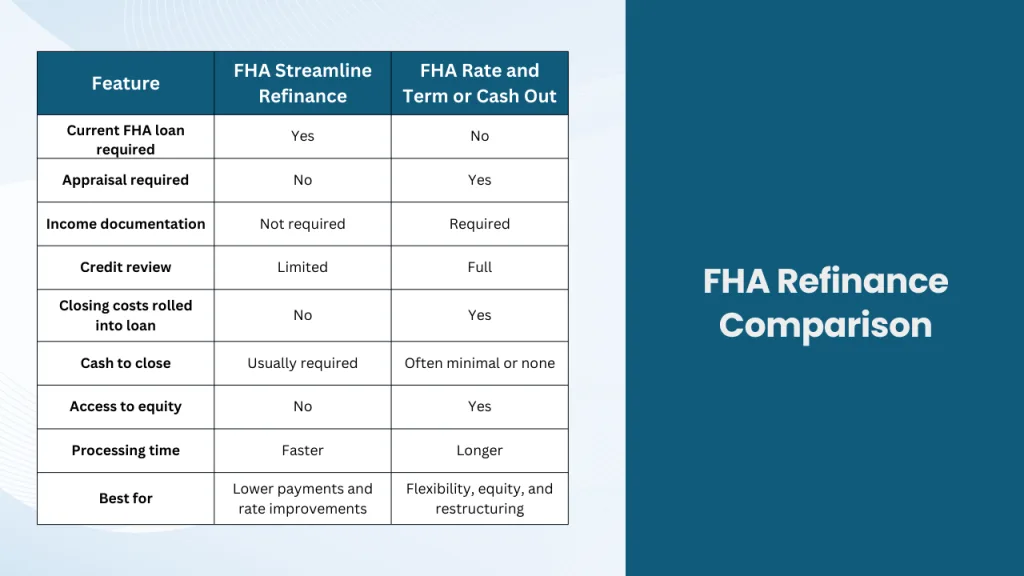
FHA Streamline Refinance
Simple, Fast, Minimal Paperwork
This option is available only if you currently have an FHA loan. It is designed to make refinancing easier when the primary goal is improving your existing loan terms.
Best suited for homeowners who want
- Lower interest rates
- Reduced monthly payments
- Improved loan stability
Key features include
- No appraisal required
- No income documentation required
- Limited credit review
- Faster overall processing
Important tradeoffs to consider
- Closing costs cannot be rolled into the loan
- Most borrowers bring some cash to closing
Net Tangible Benefit Explained
To qualify, FHA requires a net tangible benefit, meaning the refinance must clearly help you financially.
This is most commonly shown by:
- At least a 5% reduction in principal and interest payment, or
- A meaningful improvement in loan structure, such as moving from adjustable to fixed
FHA Rate & Term or FHA Cash-Out Refinance
More Flexible, Full Underwriting
These options offer more flexibility but require a more complete approval process. They are ideal for homeowners who want to restructure their loan or access equity.
Best suited for homeowners who wan
- To roll closing costs into the new loan
- To access home equity
- To consolidate higher interest debt
- To move into an FHA loan from another loan type
Key features include
- An appraisal is required
- Full income documentation is required
- Closing costs can be included in the loan
- Little to no money due at closing, depending on available equity
VA Refinance Options
VA refinance programs are among the strongest mortgage tools available to eligible veterans and service members. When used correctly, they can significantly improve loan terms, monthly cash flow, and overall financial stability.
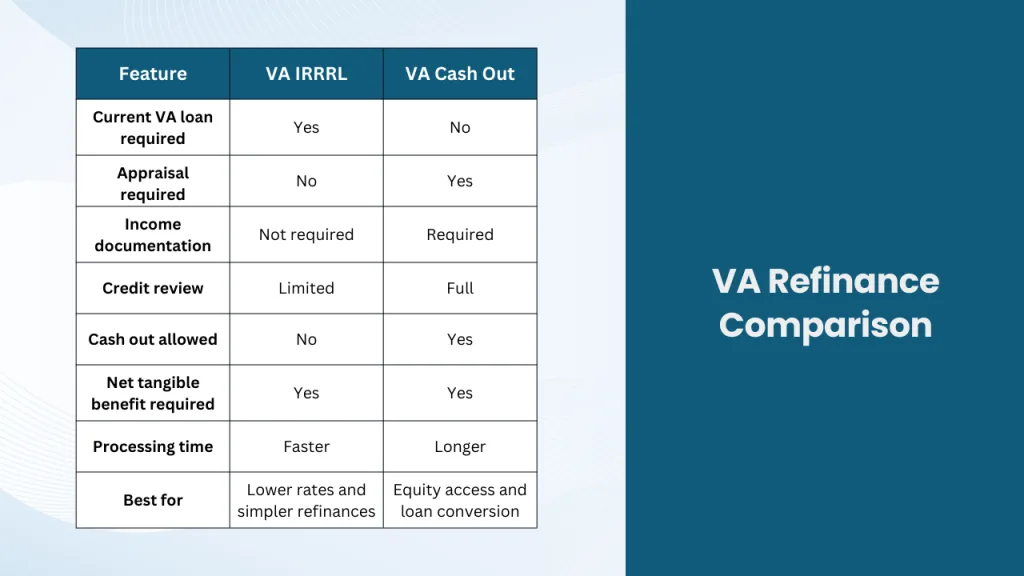
VA IRRRL (Interest Rate Reduction Refinance Loan)
The Simplest Refinance Available
This refinance option is available only to homeowners who currently have a VA loan. It is designed to make improving an existing VA mortgage as easy as possible.
Best suited for homeowners who want
- Lower interest rates
- Reduced monthly payments
Key features include
- No appraisal required
- No income documentation required
- No pest inspection or clearance required
- Limited credit review
- Faster overall timeline
Important notes to consider
- Cash out is not allowed, with very limited exceptions
- A net tangible benefit is required to show the refinance clearly improves your loan
VA Cash-Out Refinance
Equity Access and Flexibility
This option offers more flexibility and allows eligible borrowers to access home equity or convert an existing non VA loan into a VA loan.
Best suited for homeowners who want
- To access home equity
- To consolidate higher interest debt
- To refinance a conventional or FHA loan into a VA loan
Key features include
- An appraisal is required
- Full income documentation is required
- Full underwriting is required
Conventional Refinance Options
Conventional refinances are often a strong choice for homeowners with solid credit profiles and sufficient home equity. They offer flexibility, competitive pricing, and long term savings potential when structured correctly.
Conventional refinances work especially well for homeowners who want
- To remove private mortgage insurance once enough equity is reached
- Flexible loan terms that can be adjusted to fit current financial goals
- Lower long term interest costs through competitive conventional rates
Important considerations include
- Income and debt to income ratios play a significant role in approval
- An appraisal is typically required to confirm current home value
Because conventional loans have different guidelines than government backed options, understanding how they work is key. If you want a deeper breakdown of eligibility, credit requirements, and loan structures, be sure to read our previous blog titled The Ultimate Guide to Conventional Home Loans. It provides helpful context that can make deciding on a conventional refinance much clearer.
CalVet Refinance Options
CalVet refinance options are available only to homeowners who currently have a CalVet loan. These programs are more limited than other refinance types, but they can still be valuable in the right situation.
CalVet refinances are best suited for homeowners who want
- A rate and term refinance to improve their existing loan
Important limitations to understand
- Cash out is not available with CalVet refinances
- Options are more limited compared to FHA, VA, and conventional refinance programs
Because CalVet loans follow unique guidelines, it is important to understand how they differ from other loan types. For a deeper look at eligibility, benefits, and how CalVet loans work in California, be sure to read our previous blog titled The Ultimate Sacramento & Roseville CA Veteran's Guide to CalVet Home Loans.
Using a Cash-Out Refinance for Debt Consolidation
For many homeowners, refinancing is not about chasing the lowest possible interest rate. The real objective is creating breathing room in the monthly budget and regaining control of cash flow.
A cash-out refinance can be used to consolidate high-interest debt such as:
- Credit cards
- Personal loans
- Auto loans
- Other installment debt
By rolling multiple balances into a single mortgage, homeowners often replace several high interest payments with one lower, more manageable monthly payment. This can simplify finances and make budgeting far less stressful.
Why Cash Flow Matters More Than Rate in Debt Consolidation
When a cash-out refinance is used for debt consolidation, the most important measure of success is the impact on monthly cash flow, not just the new mortgage rate.
The right questions to consider include
- How much am I saving each month across all payments
- Does this reduce financial stress and pressure
- Am I creating more room to save, plan, and respond to unexpected expenses
In many situations, homeowners may
- Increase their overall mortgage balance
- Extend repayment over a longer period of time
However, if the outcome is
- Significant monthly savings
- Fewer payments to track and manage
- Greater flexibility in the household budget
Then, a cash-out refinance can be a thoughtful and responsible financial strategy. When structured correctly, it is not about taking on more debt. It is about reorganizing debt in a way that supports stability, clarity, and long-term financial health.
Important Limit to Know
This example shows how cash out refinance limits work across most loan programs. In this scenario, even though the home is worth five hundred thousand dollars, the total new loan amount is typically capped at four hundred thousand dollars. The remaining one hundred thousand dollars stays in the home as equity.
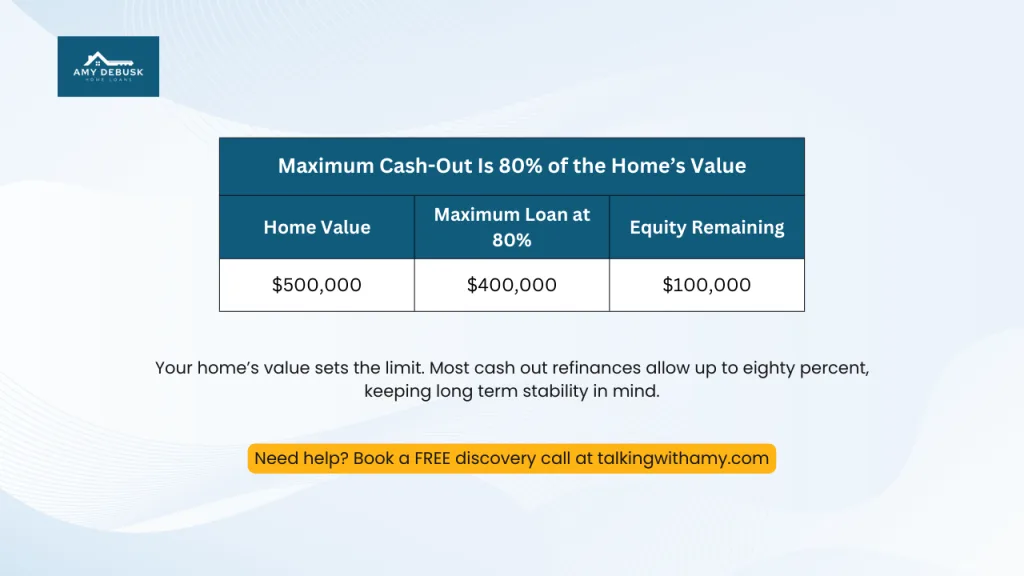
Across most loan programs, the maximum loan to value allowed for a cash out refinance is eighty percent of the home's appraised value. This applies to many conventional, FHA, and VA cash out refinances, with some program specific nuances.
In simple terms, this means
- The total new loan amount generally cannot exceed eighty percent of the home's value
- A portion of equity must remain in the home after the refinance
This limit exists to support responsible borrowing and long term financial stability. It helps protect homeowners from becoming overleveraged and encourages thoughtful use of home equity.
Because of this guideline, not all debt can always be consolidated, and that is completely normal. The goal is not to take the maximum amount available, but to take the right amount that improves monthly cash flow and supports long term financial health.
When Debt Consolidation Refinancing Works Best
Debt consolidation through refinancing is most effective when it is used with purpose and planning, not as a short term fix.
This strategy works best when
- The refinance creates a meaningful improvement in monthly cash flow
- High interest debt is eliminated first, especially revolving balances
- There is a clear and realistic plan to avoid rebuilding debt
Debt consolidation is not about hiding debt or pushing it down the road. It is about restructuring obligations in a smarter way that supports stability, clarity, and long term financial health.
When done correctly, this approach can reduce stress, simplify finances, and give homeowners the breathing room needed to move forward with confidence.
If you are considering using a refinance to consolidate debt, a free discovery call can help you determine whether it is the right move for your situation. Visit talkingwithamy.com to schedule your free discovery call and explore your options with no pressure and no obligation.
Old-School Refinance Guidelines That Still Matter
While every refinance scenario is unique, there are still a few time-tested guidelines that can help determine whether refinancing makes sense.
General rules that are still helpful
- Aim to lower your interest rate by at least one percent when possible
- Exceptions may include debt consolidation or removing mortgage insurance
Try to recover refinance costs within twenty-four months or less. This helps ensure the savings are meaningful rather than marginal.
Refinance with intention, not emotion. The decision should support your financial goals and long term plans rather than reacting to market headlines or pressure.
These guidelines are not rigid rules, but they provide a solid framework for evaluating whether a refinance is truly beneficial.
How to Maximize Long-Term Savings After You Refinance
One of the most effective strategies homeowners often overlook is continuing to pay the same amount they were paying before refinancing.
Here is how it works
- You refinance into a lower required monthly payment
- You set up automatic payments at your previous payment amount
- You confirm the extra funds are applied directly toward principal
This approach can create powerful long term benefits
- It can significantly shorten your loan term
- It can save tens of thousands of dollars in interest over time
- It helps build equity faster without changing your lifestyle
Because the payment is already part of your budget, this strategy allows you to capture the benefit of a lower rate while accelerating progress toward owning your home outright.
Final Thoughts
Refinancing is not about chasing the lowest rate.
It's about creating alignment between your home, your finances, and your future.
If you're a homeowner in Roseville or Sacramento, Amy DeBusk Home Loans offers the strength of an in-house lender through American Pacific Mortgage combined with the flexibility of a mortgage broker - ensuring you get the loan that fits you.
Education removes fear. Understanding builds confidence.
❓Refinance Guide for Homeowners: Frequently Asked Questions
❓ How do I know if refinancing my home is actually worth it?
Refinancing is worth considering when the new loan improves your financial picture, not just your interest rate. The most important metric to evaluate is your break-even point, which tells you how long it takes for your monthly savings to recover the cost of the refinance.
As a general guideline, a refinance makes sense when:
• You can recover the costs within 24 months or less
• You plan to stay in the home beyond that break-even period
• The refinance improves cash flow, stability, or long-term interest savings
This is why reviewing numbers with a knowledgeable lender matters.
❓ How long does a refinance usually take from start to finish?
Most refinances take 3-4 weeks from application to funding, depending on the loan type.
- Streamline refinances (FHA Streamline or VA IRRRL) are often on the faster end
- Full refinances that require appraisals and income documentation may take slightly longer
Preparation and communication are the biggest factors in keeping a refinance on track.
❓ Do I need an appraisal to refinance my home?
Not always.
- FHA Streamline and VA IRRRL refinances typically do not require an appraisal
- FHA Rate & Term, FHA Cash-Out, VA Cash-Out, and Conventional refinances usually do require an appraisal
This distinction matters because appraisals affect both timing and loan structure.
❓ Can I refinance without providing income documentation?
Yes, in some cases.
- FHA Streamline and VA IRRRL refinances generally do not require income documentation
- Full refinances usually require verification of income and debts
This is why Streamline and IRRRL programs are often ideal for homeowners who want simplicity.
❓ What does "net tangible benefit" mean in a refinance?
A net tangible benefit means the refinance must clearly help the homeowner financially.
For FHA and VA Streamline refinances, this is commonly shown by:
• At least a 5% reduction in principal and interest payment, or
• A meaningful improvement in loan stability, such as moving from an adjustable rate to a fixed rate
This requirement exists to protect homeowners from refinancing that doesn't truly benefit them.
❓ Should I wait for interest rates to drop before refinancing?
Not necessarily.
Waiting for the "perfect" rate can sometimes cost more than it saves. What matters most is whether the refinance improves your situation now and fits your long-term plan.
Factors to consider include:
• How long you plan to keep the home
• Current monthly savings
• Long-term interest paid
• Your break-even timeline
Refinancing is a strategic decision, not a market-timing game.
❓ Is refinancing a good way to consolidate debt?
It can be a very effective strategy when done intentionally.
Refinancing to consolidate debt works best when:
• You replace high-interest debt with lower-interest mortgage debt
• You improve monthly cash flow
• You have a plan to avoid re-accumulating debt
This strategy should always be reviewed carefully with a lender.
❓ Can refinancing help me remove mortgage insurance?
Yes.
Many homeowners refinance to:
• Remove FHA mortgage insurance when transitioning to a conventional loan
• Eliminate PMI once sufficient equity is reached
Removing mortgage insurance can significantly reduce monthly payments and long-term costs.
❓ Why does working with a mortgage broker matter when refinancing?
A broker is not limited to one lender or one set of guidelines.
At Amy DeBusk Home Loans, homeowners benefit from:
• In-house lending through American Pacific Mortgage
• Access to a broad network of banks and investors
• The ability to compare options and pivot if needed
This flexibility helps ensure you get the right loan, not just an available one.
❓ What is the smartest way to save money after refinancing?
One of the most effective strategies is to keep paying your old payment amount even after refinancing.
Here's how it works:
• Refinance into a lower payment
• Set auto-pay to your previous payment amount
• Ensure the extra funds are applied directly to principal
This shortens your loan term and can save tens of thousands of dollars in interest over time.
Try Our Free Refinance GPT App
Our Refinance GPT App helps homeowners:
• Calculate their break-even point
• Explore whether refinancing makes sense
• Understand long-term savings strategies
Ask it questions like:
• When will I break even on a refinance?
• Does refinancing make sense for me?

Explore Your Options in Our Refinance Hub
We have built a dedicated Refinance Hub where homeowners can explore refinance options with clarity and confidence. It is designed to help you learn at your own pace and understand what refinancing can truly do for your financial picture.
All Mortgage Made Easy articles · Book a Complimentary Discovery Call