

The BRRRR strategy is often described as a simple formula: Buy, Rehab, Rent, Refinance, Repeat.
In practice, it is anything but simple.
Most BRRRR deals do not fail because investors misunderstand the concept. They fail because the scope of work does not create real value, or because the investor attempts to execute the strategy without the right team in place.
This article breaks down what actually determines success in a BRRRR strategy, especially when the refinance is completed using a no-seasoning DSCR loan. If you plan to scale, recycle capital, and build a long-term portfolio, understanding this phase is critical.
For a full overview of investor loan strategies, visit our Real Estate Invesotr Loan Hub.
Why the Scope of Work Is the Foundation of a Successful BRRRR Strategy
In a BRRRR strategy, the scope of work is not just a rehab checklist. It is the bridge between purchase price and refinance value.
The refinance decision is not based on how much money you spent.
It only cares whether the finished property justifies a higher value in the eyes of the market and the appraiser.
A strong scope of work determines:
- Whether the property supports the projected After Repair Value (ARV)
- Whether rent aligns with DSCR requirements
- Whether the refinance closes smoothly
- Whether capital can be recycled efficiently
The scope of work must be designed with the refinance already in mind, not added together after the rehab is complete.
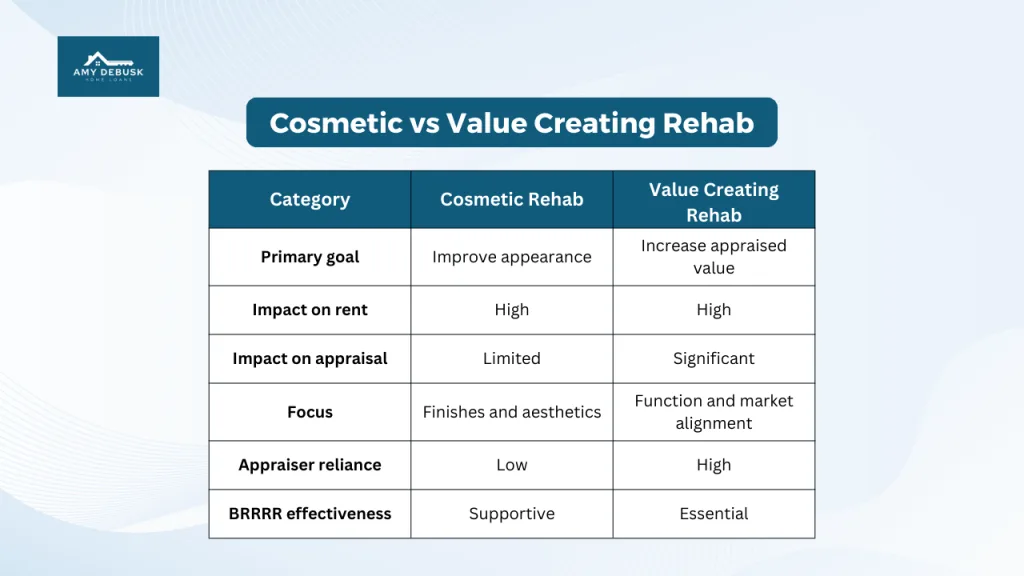
The Difference Between Cosmetic Rehab and Value-Creating Rehab
Many investors assume that updating finishes automatically creates equity. That is rarely true.
Cosmetic Improvements
Cosmetic improvements improve rentability and tenant appeal, but on their own they do not usually justify large increases in appraised value. These include:
- New flooring
- Paint
- Fixtures
- Lighting
- Cabinet and countertop updates
- Curb appeal improvements
Cosmetic upgrades help a property compete for tenants, but they must be paired with deeper improvements to materially impact value.
Functional Improvements
Functional improvements are what appraisers rely on to justify higher values. These improvements change how the property functions in the market. Examples include:
- Adding or improving bathrooms where the market supports it
- Improving layout and flow
- Adding legal living space
- Addressing outdated or inefficient systems
- Bringing the property up to the standard of renovated comparable sales
A BRRRR rehab must focus on functional alignment with the neighborhood, not just appearance.
Why This Matters for BRRRR Investors
A successful BRRRR rehab is not about making a property look nice. It is about making it appraise like the best comparable properties in the area.
Cosmetic upgrades support rent and presentation. Functional improvements support valuation. Both matter, but they serve different purposes.
Why Over-Improving Is Just as Dangerous as Under-Improving
One of the most overlooked risks in BRRRR strategies is over-improving a property.
Appraisers value properties relative to the neighborhood. If finishes or upgrades exceed what buyers or renters are paying for in that area, the additional cost may not be reflected in the appraisal.
The strongest BRRRR rehabs:
- Match the top tier of renovated properties in the area
- Avoid unnecessary luxury upgrades
- Focus on durability, not trends
- Are easy for an appraiser to defend using nearby sales
Equity is created by market alignment, not excess spending.
Why Execution Matters More Than Budget Size
Even the best scope of work can fail if execution is poor.
Execution affects:
- Rehab timeline
- Budget control
- Quality of workmanship
- Inspection outcomes
- Appraisal confidence
- Lender comfort
Experienced investors prioritize reliable execution over the lowest bid. Delays, rework, or substandard finishes can erode value and extend carrying costs, which directly impacts the refinance.
BRRRR strategies reward predictability, not shortcuts.
Understanding the Cost of Private Money in a BRRRR Strategy
Private money is a short-term execution tool used to fund acquisition and rehab quickly. It is not designed to be inexpensive. It is designed to be fast and flexible.
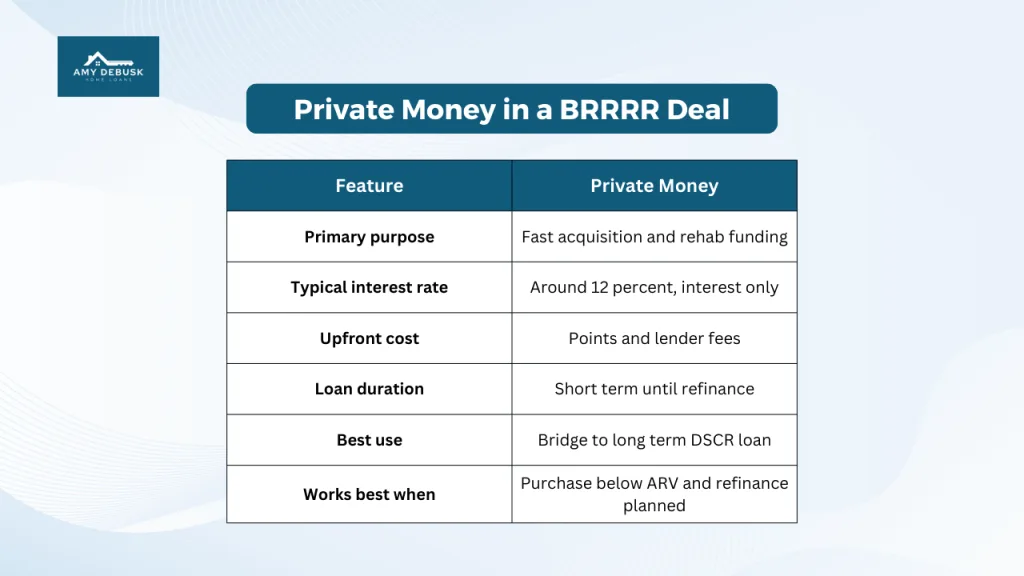
In today's market, standard private money terms typically include:
- 5 points (5 percent of the loan amount)
- 12.00 percent interest, interest-only
- Interest charged only on the funded amount
- Short-term duration until the takeout loan is completed
It is customary for private money lenders to require points and lender fees to be paid upfront at closing.
This cost structure only works when:
- The purchase price is meaningfully below ARV
- The scope of work creates real, appraisable value
- The refinance is planned before acquisition
- The long-term DSCR takeout loan is aligned early
Private money should function as a bridge, not a burden. Experienced investors account for these costs before submitting an offer, not after the rehab is complete.
Explore Our BRRRR and DSCR Video Playlist
Why Planning the Refinance Comes Before the Rehab
One of the most common BRRRR mistakes is planning the refinance after the rehab is complete.
Successful investors reverse this order.
Before acquiring a property, they confirm:
- Projected ARV using realistic comparable sales
- Expected rent using conservative assumptions
- DSCR viability at the anticipated loan amount
- Exit leverage that supports payoff of private money
When the refinance is planned first, the rehab becomes intentional rather than reactive.
The Role of the Dream Team in BRRRR Success
BRRRR strategies succeed when they are executed by a coordinated team, not a solo investor attempting to manage every role.
A BRRRR-Savvy Real Estate Agent
This agent understands:
- Buying below market value
- Identifying properties with true value-add potential
- Estimating realistic ARV
- Structuring offers that support rehab timelines
Not every agent understands BRRRR mechanics.
A Private Money Lender Who Understands the Exit
The right private lender:
- Prices risk appropriately
- Understands short-term execution
- Aligns with the refinance timeline
- Does not introduce unnecessary friction
Private money should support the strategy, not complicate it.
A DSCR Takeout Loan Specialist
This role is critical.
A true DSCR specialist:
- Reviews deals before purchase
- Evaluates rent and ARV conservatively
- Understands no-seasoning refinance requirements
- Coordinates timing with rehab completion
- Navigates appraisal and underwriting efficiently
At Amy DeBusk Home Loans, the focus is not just on offering DSCR loans, but on helping investors plan the refinance before capital is deployed.
A Reliable Rehab Team
Your rehab team should:
- Understand rental-grade renovations
- Deliver consistent quality
- Communicate clearly
- Stay on schedule
Cheap rehabs often result in delays, rework, and appraisal issues.
A Professional Property Manager
Property management impacts:
- Rent accuracy
- Vacancy
- Long-term cash flow
- DSCR stability
Strong management supports both underwriting and portfolio performance.
Legal, Insurance, and Title Professionals
Experienced attorneys, insurance providers, and title companies ensure:
- Proper LLC structure
- Correct vesting
- Smooth closings
- Compliance with lender requirements
These details matter more as portfolios grow.
A strong BRRRR strategy depends on alignment across the entire team. If you want help coordinating the refinance piece so it integrates smoothly with your agent, lender, and rehab timeline, you can start the conversation at talkingwithamy.com.
How No Seasoning DSCR Loans Fit Into the Strategy
No seasoning DSCR loans are designed to support investors who execute BRRRR deals with a defined refinance exit. Once the rehab is complete and rent is stabilized or clearly defensible, these loans allow investors to transition quickly from short term funding into long term financing.
Rather than waiting months to meet traditional seasoning requirements, a no-seasoning DSCR refinance enables the investor to refinance based on the after-repair value and move forward without unnecessary delays.
With the right structure, investors can:
- Refinance based on the after-repair value
- Avoid extended seasoning periods
- Pay off private or bridge financing
- Transition into long-term debt
- Hold the property in an LLC with personal credit guarantors
This efficiency is what makes the BRRRR strategy repeatable.
Typical Eligibility Requirements
No seasoning DSCR loans are not designed for speculative or first-time investors. They are built for borrowers with experience and stable execution.
- Minimum 680 FICO score
- Prior homeownership experience, including a primary residence
- Non owner occupied rental property
- Rental income that supports DSCR guidelines
If you want to confirm whether a deal meets no seasoning DSCR requirements before moving forward, you can review the scenario at talkingwithamy.com.
Why Some BRRRR Deals Fail at the Finish Line
Most BRRRR deals do not fail because financing disappears. They fail because the refinance was not planned early enough.
Common reasons include:
- Inflated after repair value assumptions
- Overly optimistic rent projections
- Cosmetic rehabs that do not justify appraised value
- Poor execution timelines that increase holding costs
- Refinance planning that begins after the rehab
Each of these issues tends to surface at the finish line, when the refinance must work exactly as modeled.
Successful BRRRR investors take the opposite approach. They plan the exit before closing on the purchase, validate ARV and rent conservatively, design rehabs that support appraisal, and align financing timelines from the start. That discipline is what makes BRRRR repeatable rather than risky.
For a deeper breakdown of how refinance planning fits into a successful BRRRR execution, you may also want to read our previous blog, How the BRRRR Strategy Works With No Seasoning DSCR Loans.
Final Thoughts
The BRRRR strategy works when it is treated as a system, not a shortcut.
Real value is created through:
- Thoughtful scope of work
- Market-aligned rehab
- Strong execution
- Proper team coordination
- Early refinance planning
No-seasoning DSCR loans are powerful tools, but they reward discipline and preparation. When the strategy is executed correctly, investors can recycle capital efficiently while building long-term wealth through rental real estate.
Next Step
If you are actively evaluating a BRRRR deal and want to confirm whether the scope, rent, and refinance will work before you commit capital, a focused strategy conversation is the right next move.
Schedule a BRRRR strategy call with Amy DeBusk Home Loans to review your deal structure, rehab plan, and refinance options.
All loans subject to approval. Equal Housing Lender.
❓BRRRR Strategy Scope of Work and Appraisable Value FAQs
❓ What is the difference between private money and hard money?
Private money usually comes from individuals or small groups lending their own capital. Hard money typically comes from institutional lenders with standardized programs. Private money is relationship driven and flexible, while hard money is rule driven and more rigid.
❓ Is private money cheaper than hard money?
Not always. Rates can be similar, but private money often offers more flexibility on deal structure, faster decision making, and fewer underwriting layers. Hard money lenders may also charge additional fees and impose stricter timelines that affect execution.
❓ Why do BRRRR investors prefer private money?
Experienced BRRRR investors often choose private money because speed matters more than rate, rehab timelines are flexible, exit strategies are customized, and lenders understand the refinance plan.
❓ Are points and interest negotiable?
Sometimes, but experienced investors underwrite conservatively and assume standard terms such as five points and twelve percent interest. Deals that only work with discounted terms are often too tight.
❓ Why do private money lenders require points paid upfront?
Points compensate the lender for short term risk, opportunity cost, and speed of execution. Paying points upfront is standard in private money transactions.
❓ How long do investors typically keep private money loans?
Most BRRRR investors aim to refinance within three to six months. The goal is to complete rehab, stabilize the property, and transition into a long term DSCR loan efficiently.
❓ Can private money be used for both purchase and rehab?
Yes. Many private money loans fund the acquisition, rehab costs, and in some cases interest reserves. This reduces the need to tie up personal capital.
❓ What happens if the DSCR refinance is delayed?
Delays increase carrying costs. This is why conservative timelines, strong project management, and planning the refinance before purchase are critical. Experienced investors build buffer time into their projections.
Private money usually comes from individuals or small groups lending their own capital. Hard money typically comes from institutional lenders with standardized programs. Private money is relationship driven and flexible, while hard money is rule driven and more rigid.
Not always. Rates can be similar, but private money often offers more flexibility on deal structure, faster decision making, and fewer underwriting layers. Hard money lenders may also charge additional fees and impose stricter timelines that affect execution.
Experienced BRRRR investors often choose private money because speed matters more than rate, rehab timelines are flexible, exit strategies are customized, and lenders understand the refinance plan.
Sometimes, but experienced investors underwrite conservatively and assume standard terms such as five points and twelve percent interest. Deals that only work with discounted terms are often too tight.
Points compensate the lender for short term risk, opportunity cost, and speed of execution. Paying points upfront is standard in private money transactions.
Most BRRRR investors aim to refinance within three to six months. The goal is to complete rehab, stabilize the property, and transition into a long term DSCR loan efficiently.
Yes. Many private money loans fund the acquisition, rehab costs, and in some cases interest reserves. This reduces the need to tie up personal capital.
Delays increase carrying costs. This is why conservative timelines, strong project management, and planning the refinance before purchase are critical. Experienced investors build buffer time into their projections.
All Mortgage Made Easy articles · Book a Complimentary Discovery Call