

The BRRRR strategy has become one of the most powerful ways for experienced real estate investors to scale quickly. But while many investors understand the concept, far fewer execute it successfully.
The difference is not effort or ambition. It is planning the refinance before the purchase.
This guide explains how experienced investors use ARV-based, no-seasoning DSCR loans to execute BRRRR strategies efficiently, recycle capital faster, and avoid the common mistakes that derail refinances.
This is not theoretical lending. This reflects how these loans are actually underwritten and closed.
For a full overview of investor loan strategies, visit our Real Estate Investor Loan Hub. 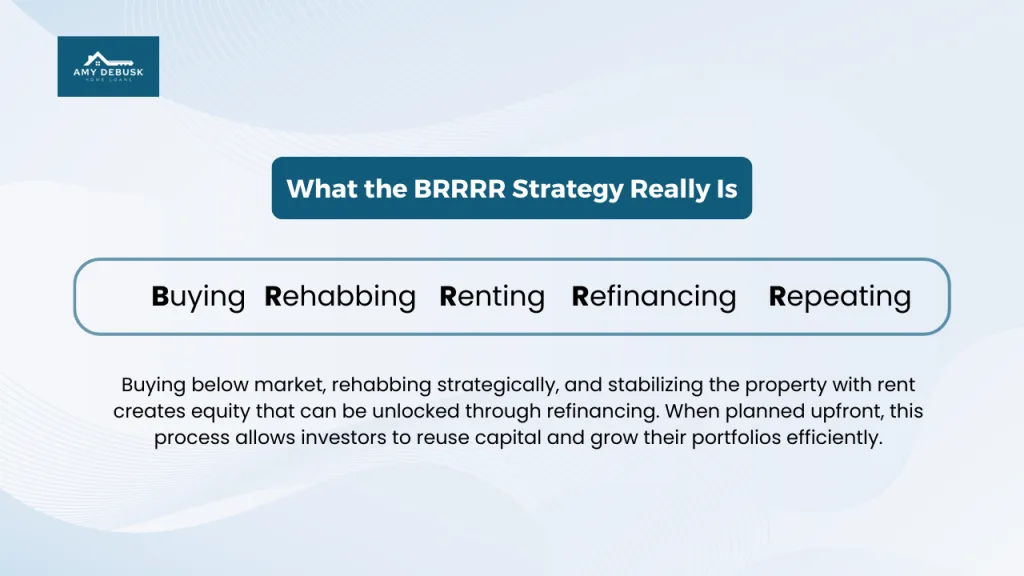
Where many BRRRR deals fail is not in the rehab. It is in the refinance.
The strategy only works when the refinance is planned upfront. Loan type, seasoning requirements, valuation method, and exit timelines should be considered before the purchase is ever made. Waiting until after the rehab to see what happens often results in lower valuations, delayed timelines, or refinance options that do not support the original strategy.
When executed with intention, BRRRR is not speculative. It is a structured approach to long-term portfolio growth built around equity creation and capital efficiency.
Why No-Seasoning DSCR Loans Matter for BRRRR
In traditional lending, cash-out refinances require a seasoning period, often 6 to 12 months, before a lender will use current market value.
A no-seasoning DSCR loan removes that waiting period.
With this structure:
- You do not wait months after purchase
- The refinance is based on After Repair Value (ARV)
- Equity created through rehab can be accessed immediately
- The refinance process begins once rehab is complete
This is what allows BRRRR investors to recycle capital efficiently instead of letting it sit idle.
Who This BRRRR Strategy Is Designed For
This strategy is designed for experienced real estate investors, not beginners.
You may be a good fit if:
- You already own real estate
- You own or have owned a primary residence
- You are purchasing non-owner-occupied investment property
- You are using cash or private money for purchase and rehab
- You plan to hold the property as a long-term rental
Traditional income documentation is not required. Ownership experience matters.
Who This Strategy Is NOT For
This strategy is not available for:
- First-time home buyers
- Owner-occupied purchases
- Borrowers with no real estate ownership history
- Short-term flips with no rental exit
- Properties that cannot meet minimum value requirements
If you have never owned real estate, this loan program will not be approved.
Minimum Property and Deal Requirements
For a no-seasoning DSCR refinance to work, the deal must meet clear baseline requirements. These guidelines exist to ensure the refinance is supported by real value and sustainable income, not short-term speculation.
This strategy is designed for scalable investing, where properties can be refinanced efficiently and repeated across a portfolio.
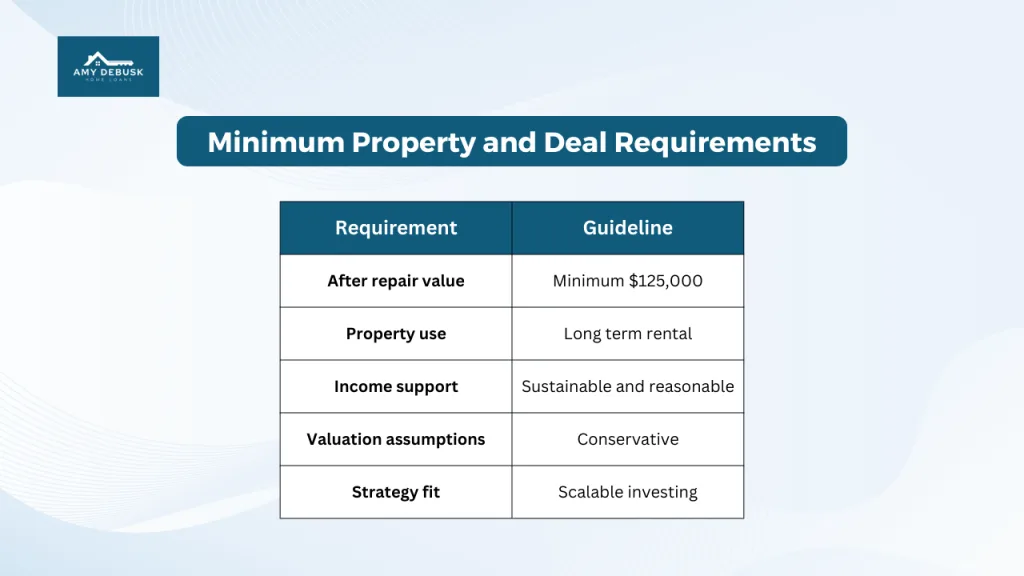
Underwriters focus on durability. Deals that rely on best-case scenarios or temporary income spikes are less likely to align with program guidelines.
Why These Requirements Matter
No seasoning refinances remove the waiting period between purchase and refinance. Because of that, lenders place greater emphasis on asset quality, valuation support, and realistic income.
When these requirements are met, investors can refinance efficiently and redeploy capital without delays that slow portfolio growth.
Understanding DSCR and Rent Requirements
DSCR stands for Debt Service Coverage Ratio. It measures whether rental income supports the mortgage payment.
For this program:
- Minimum rent-to-mortgage ratio is 1.10
- Rent must be at least 110 percent of the monthly mortgage payment
If rent does not support the payment:
- Loan amount may be reduced
- Additional reserves may be required
- The refinance may not be approved
Rent must be defensible and supported by real market data.
How Expected Rent Is Determined
Expected rent must be supported by:
- Comparable leased properties
- Market rent data
- Appraisal-supported rent surveys
- Lease agreements when the property is rented
Online estimates alone are not sufficient. Deals that barely qualify on rent leave no margin for error.
Stress Testing the Deal Before You Buy
Underwriters stress test deals. Smart investors do too.
Before submitting an offer:
- Reduce projected rent slightly
- Increase projected payment slightly
- Confirm DSCR still meets the 1.10 requirement
If the deal does not survive stress testing, it is not BRRRR-ready.
Why the Scope of Work Matters
In a no-seasoning DSCR refinance, value is based on what functionally changed, not simply how much money was spent.
Cosmetic updates help rentability.
Functional improvements justify higher appraised values.
Examples include:
- Increasing bathroom count where the market supports it
- Improving layout and usability
- Bringing the property up to neighborhood renovation standards
Rehab must be intentional and aligned with comparable sales.
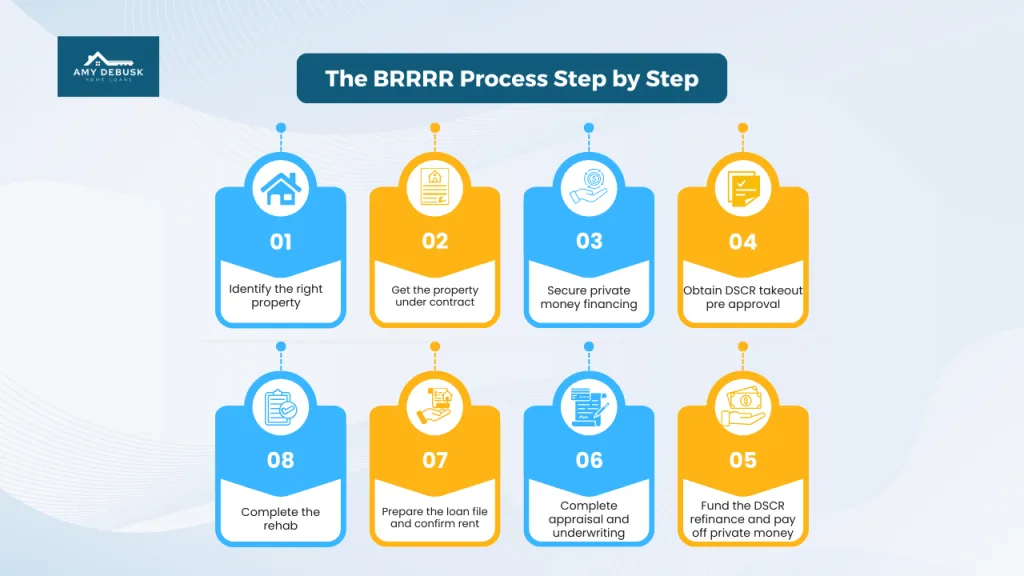
The BRRRR Process Step by Step
This process reflects how experienced investors actually run BRRRR deals to keep them predictable, fundable, and repeatable.
Step 1: Identify the Right Property
Before submitting an offer, evaluate:
- Purchase price
- Rehab scope
- Estimated ARV
- Expected rent
- Refinance leverage
If the refinance does not cleanly pay off private money, the deal is not ready.
Step 2: Get the Property Under Contract
Once under contract:
- Purchase price is locked
- Rehab timelines are confirmed
- Private money is finalized
Private lenders often ask about the refinance exit at this stage.
Step 3: Secure the Private Money Loan
Private money typically:
- Funds purchase and rehab
- Requires closing costs upfront
- Charges fees commonly ranging from 3 to 6 percent
Many private lenders require confirmation of a takeout loan.
This approach helps reduce surprises during the refinance stage and keeps timelines realistic. When each step is planned in advance, investors are better positioned to recycle capital efficiently and move on to the next opportunity without delays.
Step 4: DSCR Takeout Pre-Approval
Before or shortly after closing with private money, a DSCR takeout pre-approval can be issued.
At this stage we:
- Collect documents
- Run credit
- Review real estate owned
- Analyze projected rent and ARV
This confirms the refinance exit and supports your private lender.
Step 5 and 6: Rehab and Loan Start
Rehab must be:
- Fully completed
- Consistent with neighborhood standards
- Supportive of rent and ARV
Once rehab is complete:
- Final documents are collected
- Rent is confirmed
- Application is prepared for appraisal
Step 7 and 8: Appraisal, Underwriting, and Funding
The appraisal is based on:
- Completed condition
- Renovated comparable sales
- Market rent analysis
From appraisal receipt to funding:
- Typical timeline is approximately 3 weeks
- Private money is paid off
- Long-term DSCR loan is recorded
- Property is titled in the LLC name
- Owners act as personal credit guarantors
Minimum credit score: 680. Credit is reviewed for all guarantors.
If you want help planning the refinance exit before you buy, you can start the conversation at talkingwithamy.com.
Cash-Out Leverage and Timing
Maximum cash-out leverage:
- 75 percent of ARV if the property is rented
- 70 percent of ARV if the property is not rented
Typical timeline from appraisal order to funding is approximately 35 days.
Common Reasons No-Seasoning BRRRR Deals Fail
Most failures are avoidable.
Common reasons include:
- ARV assumptions not supported by comps
- Rent projections too aggressive
- Rehab scope insufficient to justify value
- Property value below minimum threshold
- Exit strategy planned after purchase
Successful investors plan the refinance first.
Final Perspective
A no-seasoning DSCR loan is a powerful tool when used with discipline.
It rewards:
- Experience
- Conservative assumptions
- Intentional value creation
- Proper exit planning
When rent, ARV, rehab, and leverage align, this strategy allows investors to recycle capital efficiently while building long-term wealth.
Next Step
If you are serious about executing a BRRRR strategy the right way, the next step is a focused conversation.
Book a free BRRRR strategy call with Amy DeBusk Home Loans to review your deal, timeline, and refinance options.
All loans subject to approval. Equal Housing Lender.
❓ BRRRR Strategy With No Seasoning DSCR Loans FAQs
❓ What makes a property eligible for a No Seasoning DSCR refinance in a BRRRR strategy?
The property must support long term rental use and meet minimum value and rent requirements. The refinance is based on After Repair Value, not the original purchase price, and must be supported by renovated comparable sales. The rehab scope must clearly justify the new value. Properties bought near retail value or with cosmetic only rehabs often do not qualify.
❓ Do I need to wait six or twelve months before refinancing with a DSCR loan?
No. A No Seasoning DSCR loan allows refinancing as soon as the rehab is complete, as long as rent, value, and documentation requirements are met. This is what allows investors to recycle capital quickly and scale with BRRRR.
❓ How much rent does the property need to qualify for a DSCR refinance?
Most No Seasoning DSCR programs require rent equal to at least 110 percent of the proposed mortgage payment, also known as a 1.10 DSCR. Rent must be supported by market data, comparable rentals, or lease agreements.
❓ Can I use a No Seasoning DSCR loan if the property is not yet rented?
In many cases, yes. Some lenders allow qualification based on market rent projections. However, leverage may be lower and reserve requirements higher. Leasing the property before refinance often results in better terms.
❓ What credit score and experience are required for a BRRRR DSCR loan?
Most programs require a minimum 680 FICO score. Borrowers must currently own or have previously owned a primary residence. These loans are not available to first time home buyers.
❓ How much cash can I pull out in a BRRRR refinance using a DSCR loan?
Cash out is based on a percentage of After Repair Value.
Up to 75 percent of ARV if the property is rented
Up to 70 percent of ARV if the property is not yet rented
❓ Why do some BRRRR deals fail to qualify for the refinance?
Most failures are due to planning issues, not lender issues. Common causes include unsupported ARV, overly aggressive rent projections, rehab scopes that do not justify value, or planning the exit strategy after purchase.
❓ Is the property titled in my name or my LLC after the DSCR refinance?
DSCR loans typically allow the property to be titled in an LLC, with the borrower acting as a personal guarantor. Conventional loans do not allow LLC ownership.
The property must support long term rental use and meet minimum value and rent requirements. The refinance is based on After Repair Value, not the original purchase price, and must be supported by renovated comparable sales. The rehab scope must clearly justify the new value. Properties bought near retail value or with cosmetic only rehabs often do not qualify.
No. A No Seasoning DSCR loan allows refinancing as soon as the rehab is complete, as long as rent, value, and documentation requirements are met. This is what allows investors to recycle capital quickly and scale with BRRRR.
Most No Seasoning DSCR programs require rent equal to at least 110 percent of the proposed mortgage payment, also known as a 1.10 DSCR. Rent must be supported by market data, comparable rentals, or lease agreements.
In many cases, yes. Some lenders allow qualification based on market rent projections. However, leverage may be lower and reserve requirements higher. Leasing the property before refinance often results in better terms.
Most programs require a minimum 680 FICO score. Borrowers must currently own or have previously owned a primary residence. These loans are not available to first time home buyers.
Cash out is based on a percentage of After Repair Value.
Up to 75 percent of ARV if the property is rented
Up to 70 percent of ARV if the property is not yet rented
Most failures are due to planning issues, not lender issues. Common causes include unsupported ARV, overly aggressive rent projections, rehab scopes that do not justify value, or planning the exit strategy after purchase.
DSCR loans typically allow the property to be titled in an LLC, with the borrower acting as a personal guarantor. Conventional loans do not allow LLC ownership.
All Mortgage Made Easy articles · Book a Complimentary Discovery Call