
The Core Difference Between DSCR and Conventional Loans
At its core, the difference between DSCR and conventional loans comes down to how qualification works and how investors scale over time.
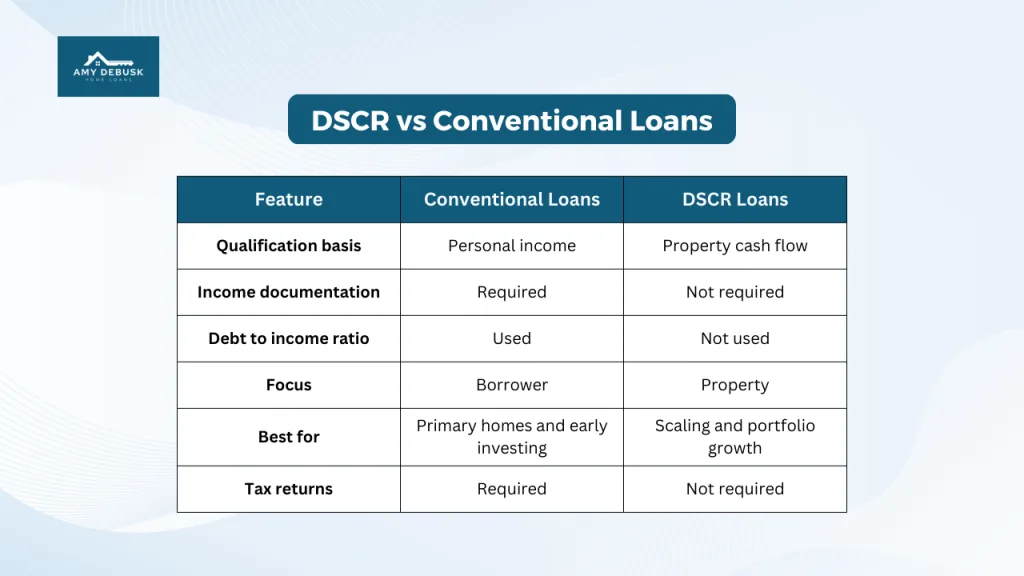
DSCR loans qualify borrowers based on the performance of the property rather than personal income. Approval focuses on rental income, the DSCR ratio, equity position, credit strength, and overall investor profile. Personal tax returns and debt-to-income ratios are typically not required, which allows investors to expand without personal income becoming a limiting factor.
Conventional loans qualify borrowers based on personal income and documentation. Approval is driven by tax returns, employment history, debt to income ratios, and personal credit. This structure works well for primary residences and early investment purchases, but it can become restrictive as portfolios grow or income becomes more complex.
Both loan types are legitimate and widely used. They are not competing solutions, but complementary tools. Conventional loans are often ideal for owner-occupied properties and early investment stages, while DSCR loans are designed to support portfolio growth, scalability, and asset-based qualification.
For a deeper look at how DSCR loans use rental income for qualification, you may also want to read our recent blog on DSCR Loans Using Rental Income in 2026.
Conventional Loans for Investment Properties
A conventional investment property loan is a fully documented mortgage underwritten using your personal financial profile.
To qualify, lenders typically require:
- Two years of personal tax returns
- Verification of employment or business income
- Debt-to-income (DTI) calculations
- Personal assets and reserves
The loan must be titled in your personal name, and you are personally responsible for repayment.
Key Benefits of Conventional Loans
- Interest rates are typically 0.25% to 0.50% lower than DSCR loans
- No prepayment penalties
- Straightforward option for investors with high, documentable income
Limitations of Conventional Loans
- Full income documentation required
- Must be held in your personal name
- Maximum of 10 financed properties per borrower
- Scaling becomes increasingly difficult as you approach the limit
For investors planning to own a small number of rental properties, conventional loans can be effective. For investors planning to scale, these limits often become restrictive.
If you want to compare conventional loans with other investor options, start the conversation at talkingwithamy.com.
DSCR Loans for Real Estate Investors
A DSCR loan (Debt Service Coverage Ratio loan) is designed specifically for rental property investors and qualifies based on property income, not personal income.
Instead of reviewing tax returns or DTI, the lender evaluates whether the rental income supports the mortgage payment.
DSCR loans are commonly used by:
- Experienced real estate investors
- Self-employed borrowers with write-offs
- BRRRR strategy investors
- Portfolio investors scaling beyond conventional limits
To explore whether a DSCR loan fits your investment strategy, you can start the conversation at talkingwithamy.com.
Interest Rates and Prepayment Tradeoffs
Rates are often the first thing investors compare, but understanding why the rate differs is more important than the number itself.
Conventional Loan Rates
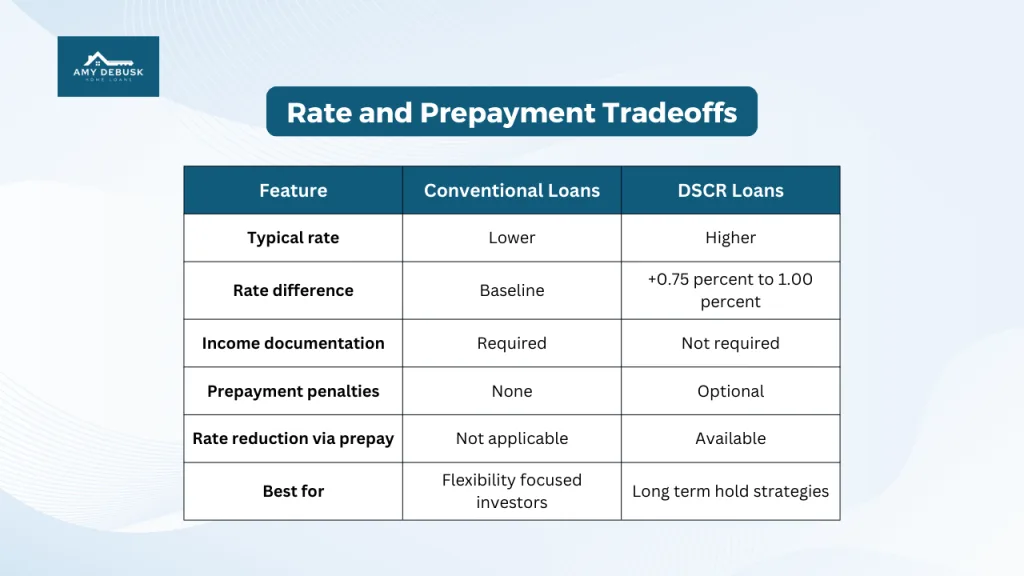
- Typically 0.25% to 0.50% lower than DSCR loans
- No prepayment penalties
- Best for investors prioritizing flexibility and lower cost of capital
DSCR Loan Rates
- Typically 0.75% to 1.00% higher than conventional loans
- Reflect flexibility, simplified qualification, and scalability
- Can be reduced by selecting a 3-5 year prepayment penalty
Many investors intentionally accept a prepayment period on a DSCR loan to secure a lower rate, especially when planning to hold the property long term.
Prepayment penalties are not inherently negative. They are a pricing tool that allows investors to trade flexibility for better pricing.
Portfolio Limits: Why DSCR Loans Scale Better
One of the most significant differences between DSCR and conventional loans is how many properties you can finance.
Conventional Loan Property Limits
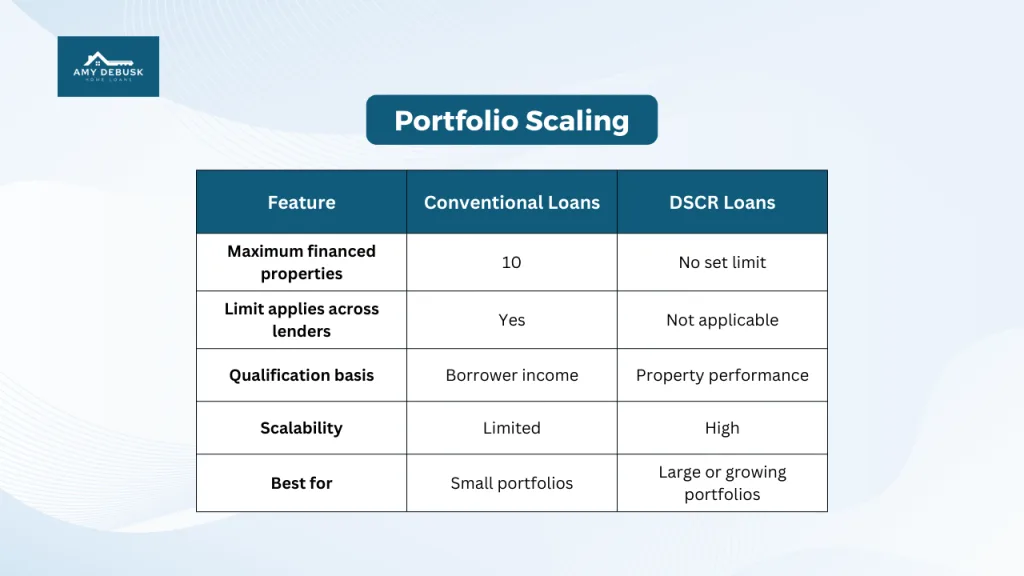
- Maximum of 10 financed properties
- Properties financed across all lenders count toward the limit
- Increased scrutiny as you approach the cap
Once you reach the limit, conventional financing is no longer an option, regardless of your income or assets.
DSCR Loans and Unlimited Scaling
DSCR loans do not impose a maximum number of financed properties.
Because qualification is based on:
- Property cash flow
- Credit profile
- Overall risk assessment
Investors can continue acquiring properties without being capped by an arbitrary limit.
For investors planning to build large portfolios, DSCR loans are the more scalable long-term solution.
Buying Investment Property in an LLC: A Key DSCR Advantage
Another major difference is how title can be held.
DSCR Loans and LLC Ownership
With a DSCR loan:
- Properties can be titled in the name of an LLC
- You act as a personal guarantor using your credit
- Personal income is not used for qualification
This structure aligns with treating real estate as a business.
Benefits of Buying Investment Property in an LLC
- Separation of personal and investment assets
- Improved liability management
- Cleaner accounting and portfolio organization
- Easier scalability and future planning
While legal and tax advice should always be obtained separately, many investors prefer LLC ownership as portfolios grow.
Conventional Loans and Title Restrictions
Conventional loans:
- Must be titled in your personal name
- Do not allow LLC ownership
- Require full personal income documentation
For investors focused on asset protection and long-term scaling, this limitation is often decisive.
DSCR vs Conventional Loans At a Glance
This comparison highlights the structural differences between DSCR and conventional loans and shows how each supports different investment strategies.
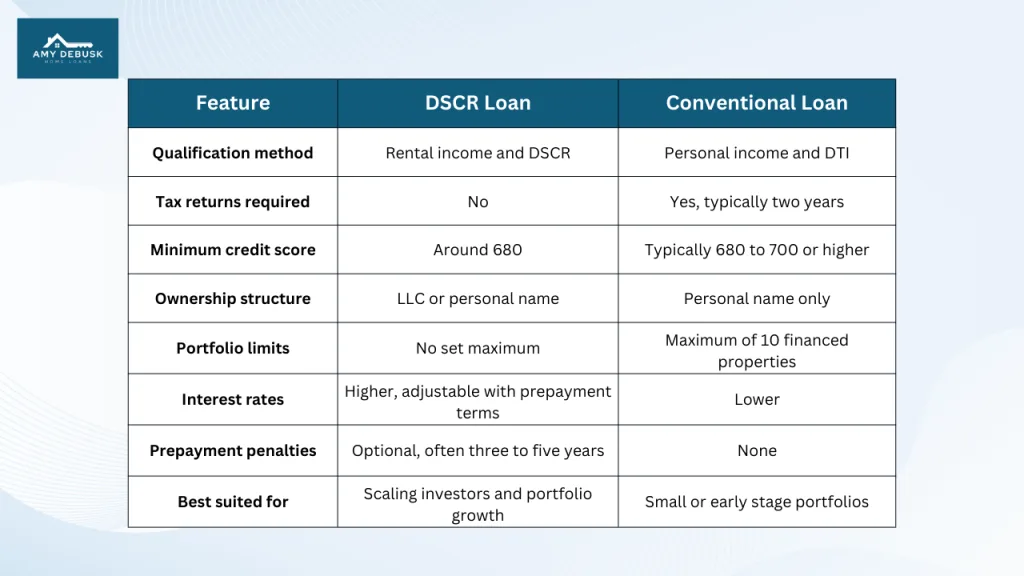
Neither option is better in every scenario. The right choice depends on how you plan to invest, how quickly you want to scale, and whether personal income or property performance should drive qualification. Many investors use both loan types at different stages to support long-term growth.
For a deeper look at how DSCR loans use rental income for qualification, you may also want to read our recent blog on DSCR Loans Using Rental Income in 2026.
❓ DSCR Loans vs Conventional Loans for Real Estate Investors FAQs
❓ Is there a limit to how many DSCR loans I can have?
No. DSCR loans do not have a set limit on the number of financed properties, making them ideal for scaling a real estate portfolio.
❓ Can I purchase investment property in an LLC using a DSCR loan?
Yes. DSCR loans typically allow properties to be titled in an LLC, with the borrower acting as a personal guarantor.
❓ Can a conventional loan be held in an LLC?
No. Conventional loans must be held in an individual's personal name.
❓ Why are DSCR loan interest rates higher than conventional loans?
DSCR loans offer simplified qualification, portfolio scalability, and LLC ownership. The higher rate reflects this added flexibility.
❓ How can investors lower DSCR loan interest rates?
Choosing a 3 to 5 year prepayment penalty often results in significantly better pricing.
❓ Are DSCR loans good for BRRRR strategies?
Yes. DSCR loans are commonly used for BRRRR refinances due to flexible qualification and scalability.
❓ Who should avoid DSCR loans?
First time home buyers and owner occupants. DSCR loans are intended for experienced real estate investors only.
Which Loan Is Right for You?
- If you want the lowest rate and plan to own a few properties, a conventional loan may work well.
- If you plan to scale, hold property in an LLC, and build a true portfolio, DSCR loans are often the better strategic choice.
Many experienced investors use both loan types at different stages. The key is knowing when to use which tool.
To see how investors structure these decisions in real scenarios, explore our Investor Education Video Playlist.
Next Steps
Choosing between DSCR and conventional financing is a strategic decision that can impact your portfolio for years. A clear plan matters.
Schedule a strategy call with Amy DeBusk Home Loans to determine which loan structure aligns with your investment goals.
All loans subject to approval. Equal Housing Lender.
All Mortgage Made Easy articles · Book a Complimentary Discovery Call