

What Is a DSCR Loan?
DSCR stands for Debt Service Coverage Ratio. A DSCR loan is an investment property mortgage where qualification is based on the income produced by the property, not your personal income.
Instead of reviewing W-2s, tax returns, or pay stubs, the lender evaluates whether the rental income from the property is sufficient to support the monthly mortgage payment.
This makes DSCR loans especially valuable for:
- Real estate investors
- Business owners and self-employed borrowers
- Investors with significant tax write-offs
- Portfolio investors scaling multiple properties
DSCR loans are strictly for non-owner-occupied investment properties. They are not available for primary residences and are not designed for first-time home buyers.
How DSCR Is Calculated
DSCR is calculated using a simple formula:
Gross Monthly Rental Income ÷ Monthly Mortgage Payment (PITIA)
PITIA includes:
- Principal
- Interest
- Property taxes
- Insurance
- HOA dues, if applicable
Example
- Monthly rental income: $2,500
- Monthly mortgage payment: $2,000
DSCR = 1.25
A DSCR of 1.0 means the rental income fully covers the mortgage payment.
2026 DSCR Lending Updates Investors Should Know
One of the biggest misconceptions about DSCR loans is that the property must always be cash-flow positive to qualify. That is no longer universally true.
In 2026, DSCR lending has expanded significantly for experienced investors with strong overall profiles.
Lower DSCR Options for Experienced Investors
Depending on credit score, equity position, and loan size, some DSCR programs allow lower DSCR ratios, even when rental income does not fully cover the mortgage payment.
In certain scenarios, investors may qualify when rental income covers approximately half of the mortgage payment, provided the overall loan profile meets lender guidelines.
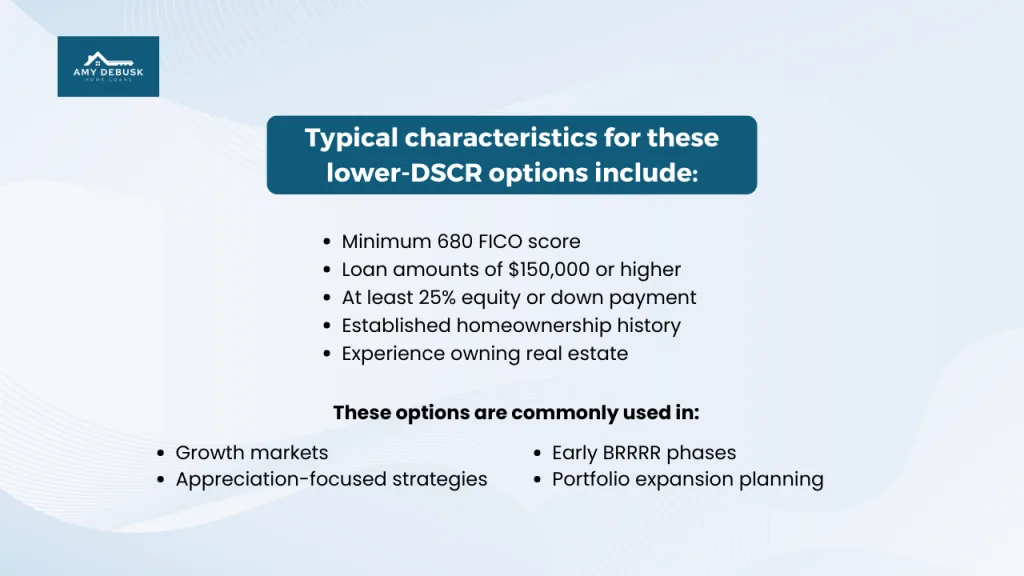
Lower DSCR programs are designed to support experienced investors who understand how to balance short term cash flow with long term growth. When credit strength, equity position, and experience are aligned, these options allow investors to move strategically in competitive or appreciating markets without being limited by early income performance alone.
Who DSCR Loans Are Designed For
DSCR loans are designed for experienced investors, not entry-level buyers.
To qualify, borrowers must:
- Own a home currently or previously as a primary residence
- Be purchasing or refinancing a non-owner-occupied investment property
- Meet minimum credit and equity requirements
DSCR loans are not available to:
- First-time home buyers
- Borrowers purchasing primary residences
- Owner-occupied buyers
This structure helps keep DSCR programs focused on true investment use.
Key DSCR Loan Features in 2026
While guidelines vary by lender, many DSCR loan programs offer:
- Up to 80 percent LTV on purchases
- Up to 75 percent LTV on cash-out refinances
- Loan amounts up to $2.5 million
- Minimum 680 FICO score
- No personal income or employment verification
- Qualification based on rental income or market rents
- Optional interest-only structures in certain cases
DSCR loans are commonly used for:
- Long-term rental properties
- Portfolio loans
- BRRRR refinances
- Scaling rental portfolios efficiently
DSCR Loans and Portfolio Scalability
DSCR loans do not have a maximum number of financed properties.
Because qualification is based on:
- Property cash flow
- Credit profile
- Overall risk assessment
Investors can continue to acquire properties without being capped by an arbitrary property count.
This is one of the primary reasons DSCR loans are favored by investors who plan to:
- Scale beyond a handful of properties
- Build long-term rental portfolios
- Use repeatable acquisition strategies
- Grow without conventional lending constraints
If your long-term goal includes owning more than 10 rental properties, DSCR loans are typically the more scalable solution.
Buying Investment Property in an LLC: Why DSCR Loans Support This Strategy
Another major advantage of DSCR loans is the ability to purchase or hold investment property in the name of an LLC.
DSCR Loans and LLC Ownership
With a DSCR loan:
- The property can be titled in an LLC
- You act as a personal guarantor using your credit
- Your personal income is not used to qualify
This structure aligns more closely with how investors operate real estate as a business.
Benefits of Buying Investment Property in an LLC
Holding investment property in an LLC can offer meaningful advantages for real estate investors, particularly as portfolios expand and strategies evolve.
Here are the key benefits:
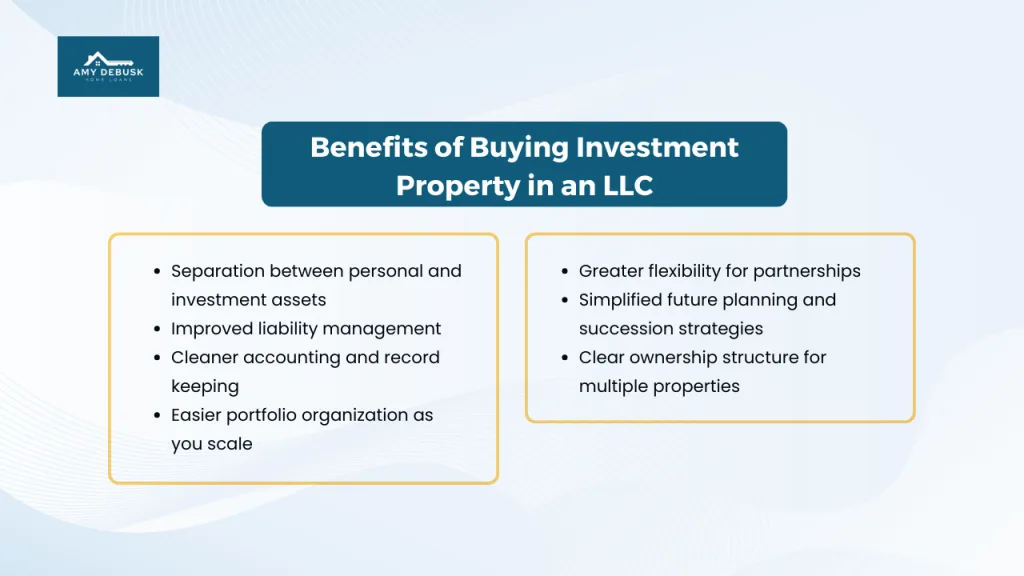
When paired with proper legal and tax guidance, LLC ownership can support long term portfolio growth, operational clarity, and strategic planning as investment activity increases.
Why Investors Use DSCR Loans to Scale
DSCR loans are popular among investors because they remove many of the limitations found in traditional financing.
Benefits include:
- No debt-to-income calculation
- No tax returns required
- Portfolio-friendly underwriting
- Faster approvals compared to conventional loans
- Cash-out options to redeploy capital
This makes DSCR loans especially effective for investors who want to grow beyond one or two properties without hitting conventional lending caps.
To see how investors use DSCR loans in real scenarios, explore our Investor Financing Video Playlist.
DSCR Loans and the BRRRR Strategy
DSCR loans play a critical role in the BRRRR strategy (Buy, Rehab, Rent, Refinance, Repeat).
In many cases, investors use DSCR loans to:
- Refinance quickly after stabilization
- Avoid seasoning requirements
- Pull equity out to fund the next acquisition
We break this down in detail inside our BRRRR education series, which you can access through our Investor Hub.
Prepayment Penalties What Investors Should Understand
Many DSCR loans include prepayment penalties, particularly during the early years of the loan. These terms are not hidden fees. They are part of how lenders price risk and offer more competitive interest rates.
Understanding how prepayment penalties work helps investors align loan structure with their exit or refinance strategy.
Common Prepayment Penalty Structures
Prepayment terms vary by lender and program, but the most common structures include the following.
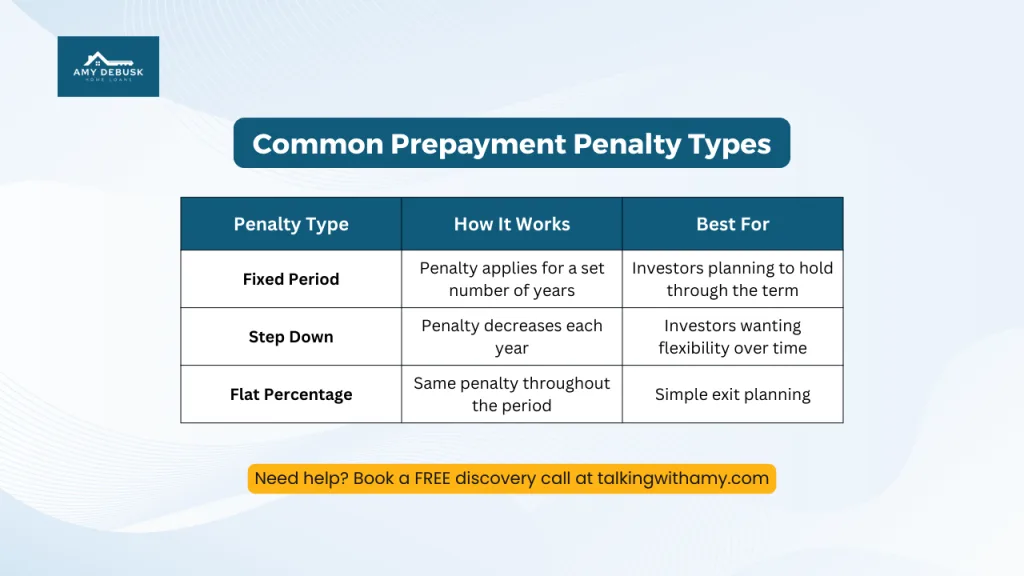
Fixed Prepayment Periods
These penalties apply for a set number of years, typically ranging from one to five years.
A three-year prepayment period is often the most appealing balance between interest rate savings and flexibility, which is why it is commonly chosen by investors.
Step Down Prepayment Penalties
Step-down penalties decrease over time.
A common example looks like this:
- Year 1: 3 percent of the remaining loan balance
- Year 2: 2 percent of the remaining loan balance
- Year 3: 1 percent of the remaining loan balance
This structure rewards longer holds while still allowing earlier exits at a declining cost.
Flat Percentage Penalties
Some loans use a flat percentage penalty during the prepayment period.
This means the penalty remains the same regardless of when the loan is paid off within that window.
The right prepayment structure depends on how long you plan to hold the property and whether a refinance or sale is part of your long term strategy. When prepayment terms are aligned with your investment timeline, they can support stronger pricing upfront while still preserving flexibility down the road.
❓ DSCR Loans Using Rental Income in 2026 FAQs
❓ What is the minimum credit score for a DSCR loan?
Most DSCR loan programs require a minimum 680 FICO score. Higher scores typically qualify for better rates and terms.
❓ Can first time home buyers use DSCR loans?
No. DSCR loans are designed for experienced investors. Borrowers must currently own or have previously owned a primary residence.
❓ Do DSCR loans require tax returns or W2s?
No. DSCR loans do not require personal tax returns, W2s, or pay stubs.
❓ Can I use a DSCR loan for a primary residence?
No. DSCR loans are only for non owner occupied investment properties.
❓ How is rental income calculated for a DSCR loan?
Rental income is based on either existing lease agreements or market rent estimates, depending on lender guidelines.
❓ Are DSCR loans available for short term rentals?
Yes, in some cases. Approval depends on documentation, rental history, and lender requirements.
❓ Can I do a cash out refinance with a DSCR loan?
Yes. Many DSCR programs allow cash out refinances up to 75 percent loan to value.
❓ Are DSCR loans good for building a real estate portfolio?
Yes. DSCR loans are one of the most scalable financing options for real estate investors.
Is a DSCR Loan Right for Your Investment Strategy?
DSCR loans are not one-size-fits-all. They work best when aligned with a clear investment plan, property type, and long-term portfolio goals.
If you are an experienced investor looking to qualify based on rental income and scale strategically, DSCR loans may be a strong fit.
To explore how DSCR loans fit into your overall investing strategy, visit our Real Estate Investor Loan Hub or watch our investor education videos.
Next Steps
If you are considering a DSCR loan for your next investment property, a strategic conversation matters. Every investor scenario is different, and the best loan structure depends on your goals and experience.
Schedule a strategy call with Amy DeBusk Home Loans to explore DSCR loan options aligned with your portfolio plan.
All loans subject to approval. Equal Housing Lender.
All Mortgage Made Easy articles · Book a Complimentary Discovery Call