
Real estate investing in 2026 is no longer about chasing appreciation or copying what worked in the past. Today's successful investors are strategic, well-capitalized, and intentional about how they buy, finance, and hold property.
This guide is designed to give you a clear, realistic understanding of how real estate investing works today, what strategies investors are actually using, and how financing, structure, and location decisions impact long-term success.
Whether you are planning your first investment property or actively scaling a portfolio, this guide will help you think like an investor, not just a buyer.
Why Real Estate Investing Still Works in 2026
Real estate continues to be one of the most effective wealth-building tools available, even in changing markets. Its strength does not come from speculation or timing the market. It comes from structure.
When executed intentionally, real estate allows investors to combine:
- Leverage to control assets with less upfront capital
- Cash flow that supports holding through market cycles
- Appreciation driven by long-term demand and improvements
- Long-term debt paydown that builds equity over time
In 2026, successful investors are not relying on rapid price increases or short-term momentum. They are underwriting deals conservatively, prioritizing sustainable performance, and structuring ownership and financing to work across different market environments.
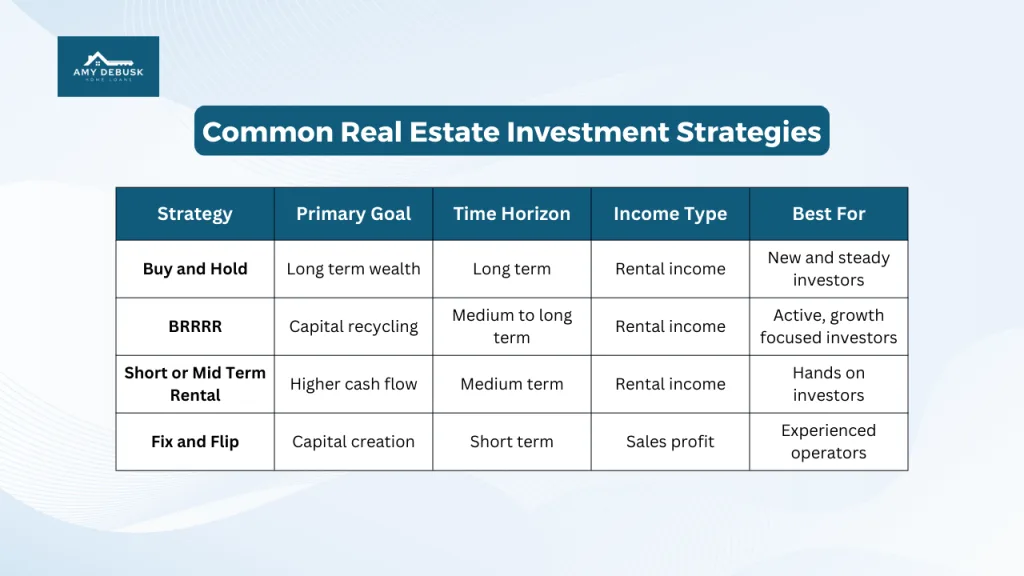
The Main Ways Investors Build Wealth With Real Estate
There is no single path to success. Investors choose strategies based on experience level, capital, risk tolerance, and time horizon.
Buy and Hold Investing
Buy-and-hold investors purchase rental properties and hold them long term. This strategy focuses on:
- Monthly rental incom
- Gradual appreciation
- Loan amortization over time
This is one of the most common entry points into investing and forms the foundation of many portfolios.
The BRRRR Strategy
BRRRR stands for Buy, Rehab, Rent, Refinance, Repeat. This strategy allows investors to:
- Purchase properties below market value
- Create equity through renovation
- Refinance based on the new value
- Recycle capital into the next deal
BRRRR strategies rely heavily on private money for acquisition and DSCR loans for long-term financing. Planning the refinance before the purchase is essential.
Short-Term and Mid-Term Rentals
Some investors focus on furnished rentals or short-term stays. These strategies can generate higher income but require:
- Strong market research
- Active or professional management
- Financing that supports the rental model
Not all loan options allow short-term rental income, making lender strategy critical.
Fix and Flip
Flipping properties involves buying, renovating, and selling for profit. While not a long-term rental strategy, flips are often used to:
- Build capital
- Gain experience
- Fund future rental investments
This strategy requires strict cost control and disciplined timelines.
How Financing Shapes Your Investment Strategy
Financing is not just about approval. It directly affects:
- Cash flow
- Risk exposure
- Portfolio scalability
- Ownership structure
In 2026, investors choose loans based on strategy, not just interest rate.
Conventional Loans for Investors
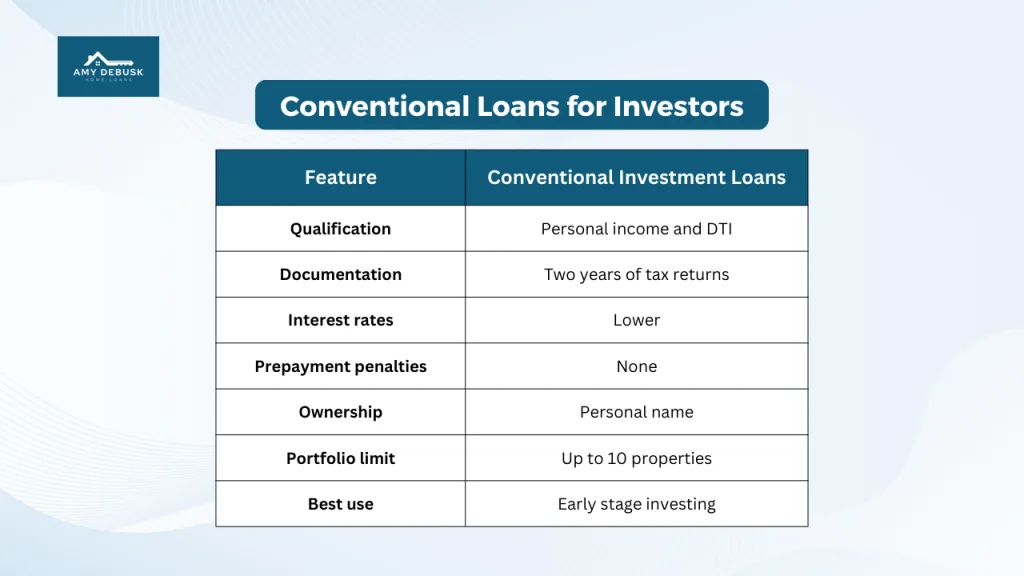
Conventional investment loans are fully documented mortgages that qualify borrowers based on personal income, assets, and debt-to-income ratios. Because underwriting relies on tax returns and employment or business income, these loans often offer lower interest rates and more flexible terms, including no prepayment penalties.
At the same time, conventional loans come with structural limits that affect scalability. Borrowers are typically required to provide two years of tax returns, hold the loan in their personal name, and remain under a maximum of 10 financed properties across all lenders. As investors approach that limit, underwriting becomes more restrictive and growth can slow.
Conventional loans tend to work best early in an investor's journey or for those planning to own a small number of rental properties. They provide an accessible entry point, but they are not designed for long-term portfolio expansion.
DSCR Loans: A Core Tool for Investors in 2026
DSCR loans qualify investors based on property cash flow, not personal income.
Key advantages include:
- No tax returns or W-2s required
- LLC ownership allowed
- No cap on the number of financed properties
- Portfolio-friendly underwriting
DSCR loans are commonly used for long-term rentals, BRRRR refinances, and portfolio growth. Rates are typically higher than conventional loans, but many investors accept this tradeoff for flexibility and scale.
For a side by side breakdow, read the blog DSCR Loans vs Conventional Loans for Real Estate Investors.
How Much Capital Do You Need to Get Started?
One of the most common questions investors ask is how much money is required to purchase an investment property.
For most long-term rental purchases using DSCR or conventional investment loans, investors should plan for:
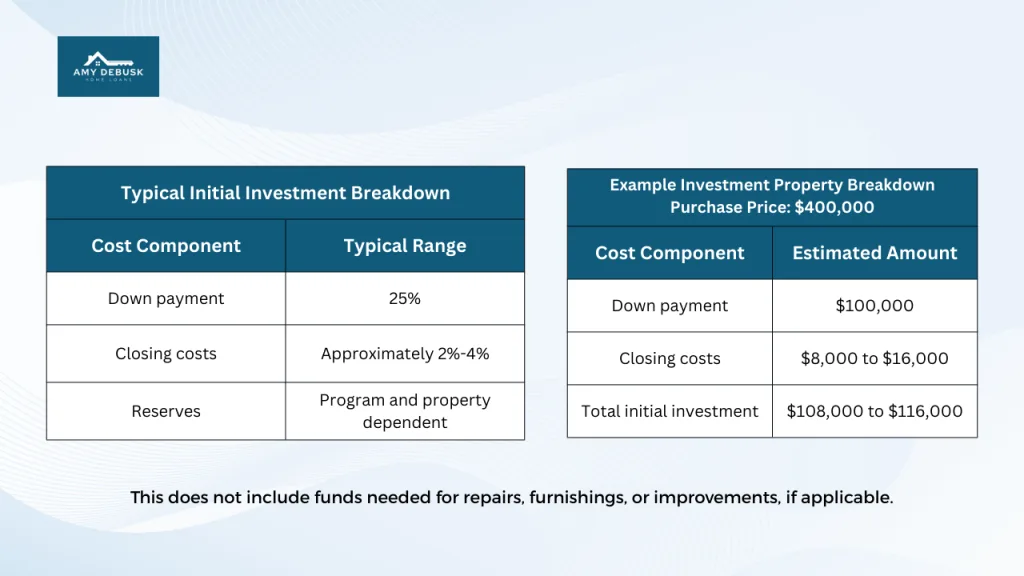
For BRRRR strategies, capital requirements are different because acquisition and rehab are often funded with private money, followed by a refinance into a long-term DSCR loan.
Understanding Risk vs Reward in Real Estate Investing
Every investment involves tradeoffs. Successful investors are not avoiding risk. They are structuring deals to manage it intelligently.
How an LLC Helps Mitigate Risk
Holding investment property in an LLC can:
- Separate personal and investment assets
- Improve liability management
- Organize portfolios as they grow
DSCR loans typically allow properties to be titled in an LLC, with the investor acting as a personal guarantor using credit only. This structure becomes increasingly important as portfolios scale.
Legal and tax professionals should always be consulted for proper setup.
Why State Landlord Laws Matter
Location matters beyond price and rent. State and local landlord-tenant laws impact:
- Eviction timelines
- Rent control rules
- Operational complexity
- Cash flow stability
The same property can perform very differently depending on the legal environment.
State-by-State Landlord Friendliness Overview
Landlord-Friendly States
Examples include Tennessee, Texas, Florida, Georgia, Alabama, Ohio, and North Carolina. These states often offer:
- Faster eviction processes
- Fewer rent restrictions
- More predictable operations
They are attractive for cash-flow-focused investors.
Balanced States
Examples include Arizona, Nevada, Colorado, Washington, Virginia, and Pennsylvania. These states offer:
- Moderate protections for both parties
- Growing markets
- Mixed cash flow and appreciation opportunities
Tenant-Friendly States
Examples include California, Oregon, New York, New Jersey, and Illinois. These markets often have:
- Strong tenant protections
- More complex compliance
- Higher property values and appreciation potential
Investors in these states often focus on long-term equity growth rather than short-term cash flow.
Matching Strategy to Risk Tolerance
There is no universally "best" market.
- Cash-flow-focused investors often choose landlord-friendly states
- Equity-focused investors may prefer higher-cost, tenant-friendly markets
- Many experienced investors diversify across multiple states
Understanding the rules before investing allows you to price risk appropriately.
Common Mistakes Investors Make
Many real estate investors run into challenges not because the opportunity was bad, but because key details were overlooked early in the process. Most setbacks can be traced back to planning assumptions rather than market conditions.
Common mistakes include:
- Overestimating rent by relying on optimistic projections instead of verified market data
- Underestimating rehab scope, timelines, or carrying costs
- Choosing a loan structure that does not align with the investment strategy
- Ignoring legal, ownership, or entity structure considerations
- Waiting too long to plan the financing and refinance exit
Each of these issues can compound as a deal progresses, increasing costs and limiting flexibility.
Avoiding these mistakes early helps protect capital, reduce stress, and keep investment strategies repeatable. Careful underwriting, conservative assumptions, and early financing alignment are what separate scalable investors from stalled ones.
How Investors Scale Over Time
Most successful investors follow a progression:
- Start with a primary residence or first rental
- Use conventional loans early
- Transition into DSCR loans as portfolios grow
- Build teams around lending, management, and rehab
Scaling is intentional, not accidental.
Final Thoughts
Real estate investing in 2026 continues to reward preparation, structure, and patience. Success is not defined by owning the most properties or moving the fastest. It is defined by building a portfolio that performs consistently, holds up across market cycles, and supports long term financial goals.
Investors who scale effectively understand that strategy comes before acquisition. Financing is not an afterthought. Risk is modeled conservatively. Capital is deployed intentionally. When these elements are aligned, growth becomes repeatable rather than stressful.
The strongest portfolios are built step by step, with clear exits, realistic assumptions, and financing structures that support the plan rather than restrict it. That discipline is what separates investors who struggle to sustain momentum from those who continue to expand with confidence.
❓Real Estate Investing in 2026 FAQs
❓ How much money do I realistically need to start investing in real estate?
For most long term rental investments, investors should plan for a 25 percent down payment plus closing costs. Closing costs typically range from 2 to 4 percent of the purchase price, and lenders may also require reserves depending on the loan program.
For example, on a $400,000 investment property, an investor may need approximately $108,000 to $116,000 to get started. BRRRR strategies work differently and often use private money for acquisition and rehab, followed by a refinance into a long term DSCR loan.
❓ What is the difference between investing with a conventional loan and a DSCR loan?
Conventional loans are based on personal income, tax returns, and debt to income ratios. They offer lower interest rates but limit investors to 10 financed properties and require ownership in the borrower's personal name.
DSCR loans qualify based on property cash flow rather than personal income. They allow LLC ownership, have no limit on financed properties, and are designed for investors planning to scale.
❓ Can I invest in real estate if I am self employed or have large tax write offs?
Yes. This is one of the most common reasons investors use DSCR loans. Qualification is based on rental income rather than personal income, so tax returns, W2s, and pay stubs are not required if the property cash flow supports the loan.
❓ Is it better to invest locally or out of state?
There is no single right answer. Local investing offers familiarity and easier oversight. Out of state investing can offer better cash flow or lower entry costs, especially in landlord friendly states.
Many experienced investors diversify by holding cash flow properties in landlord friendly states and appreciation focused properties in higher cost markets. The right choice depends on risk tolerance, management strategy, and long term goals.
❓ Why do landlord tenant laws matter when choosing where to invest?
Landlord tenant laws affect eviction timelines, rent control rules, lease enforcement, and overall risk. These factors directly impact cash flow stability.
Some states are more landlord friendly, while others offer stronger tenant protections but higher appreciation potential. Understanding these differences helps investors align markets with their strategy.
❓ Should I hold my investment property in an LLC?
Many experienced investors choose LLC ownership to separate personal and investment assets and organize portfolios more effectively. DSCR loans typically allow LLC ownership, while conventional loans do not.
LLC structures should always be set up with guidance from legal and tax professionals.
❓ What are the biggest mistakes new real estate investors make?
Common mistakes include overestimating rent, underestimating expenses or rehab costs, choosing the wrong loan type, ignoring landlord laws, and planning financing too late. Successful investors plan conservatively and align financing early.
❓ How do investors scale from one property to a portfolio?
Most investors scale intentionally by starting with an initial rental or primary residence, using conventional loans when appropriate, transitioning to DSCR loans as portfolios grow, and building a strong team around lending, management, and rehab.
Scaling is a strategy, not an accident.
For most long term rental investments, investors should plan for a 25 percent down payment plus closing costs. Closing costs typically range from 2 to 4 percent of the purchase price, and lenders may also require reserves depending on the loan program.
For example, on a $400,000 investment property, an investor may need approximately $108,000 to $116,000 to get started. BRRRR strategies work differently and often use private money for acquisition and rehab, followed by a refinance into a long term DSCR loan.
Conventional loans are based on personal income, tax returns, and debt to income ratios. They offer lower interest rates but limit investors to 10 financed properties and require ownership in the borrower's personal name.
DSCR loans qualify based on property cash flow rather than personal income. They allow LLC ownership, have no limit on financed properties, and are designed for investors planning to scale.
Yes. This is one of the most common reasons investors use DSCR loans. Qualification is based on rental income rather than personal income, so tax returns, W2s, and pay stubs are not required if the property cash flow supports the loan.
There is no single right answer. Local investing offers familiarity and easier oversight. Out of state investing can offer better cash flow or lower entry costs, especially in landlord friendly states.
Many experienced investors diversify by holding cash flow properties in landlord friendly states and appreciation focused properties in higher cost markets. The right choice depends on risk tolerance, management strategy, and long term goals.
Landlord tenant laws affect eviction timelines, rent control rules, lease enforcement, and overall risk. These factors directly impact cash flow stability.
Some states are more landlord friendly, while others offer stronger tenant protections but higher appreciation potential. Understanding these differences helps investors align markets with their strategy.
Many experienced investors choose LLC ownership to separate personal and investment assets and organize portfolios more effectively. DSCR loans typically allow LLC ownership, while conventional loans do not.
LLC structures should always be set up with guidance from legal and tax professionals.
Common mistakes include overestimating rent, underestimating expenses or rehab costs, choosing the wrong loan type, ignoring landlord laws, and planning financing too late. Successful investors plan conservatively and align financing early.
Most investors scale intentionally by starting with an initial rental or primary residence, using conventional loans when appropriate, transitioning to DSCR loans as portfolios grow, and building a strong team around lending, management, and rehab.
Scaling is a strategy, not an accident.
Watch: Real Estate Investing Education for Investors
We have created a dedicated YouTube playlist for real estate investors covering topics such as:
- DSCR loans and investor financing
- BRRRR strategies and execution
- Cash flow analysis and scaling
- Conventional vs investor loan comparisons
- Real-world investing scenarios
Watch our Real Estate Investor Video Playlist
These videos are designed to support what you are learning in this guide and help you see how successful investors structure real deals.
Explore the Real Estate Investor Loan Hub
This guide is part of our larger Real Estate Investor Loan Hub, where we bring everything together in one place.
Inside the Investor Hub, you'll find:
- In-depth investor blogs and strategy guides
- BRRRR and DSCR education
- Downloadable resources and planning tools
- Curated video playlists
- Investor-focused FAQs and updates
Visit the Real Estate Investor Loan Hub
Next Step
If you are planning your first investment property or preparing to scale an existing portfolio, aligning your financing with your strategy is critical.
Schedule a strategy call with Amy DeBusk Home Loans to review your investment goals and loan options.
All loans subject to approval. Equal Housing Lender.
All Mortgage Made Easy articles · Book a Complimentary Discovery Call