
Bridge Loan, Buy Before You Sell Program, HELOC, or Contingency?
By Amy DeBusk | Amy DeBusk Home Loans | TalkingWithAmy.com
Yes, You Can Buy Your Next Home Before Your Current One Sells
Here's the honest version most articles won't give you: buying before you sell isn't one product, and it isn't only about financing. It's a handful of different paths, a lot of preparation, and one very human question underneath all of it: how do you leave a home you've lived in for decades without losing your mind in the process?
You have more options than you probably realize. You can write a contingent offer. You can use a HELOC on your current home to fund a down payment. You can use a Buy Before You Sell program. You can use a bridge loan. Each one solves the puzzle differently, and each one asks something different of you, in cost, in timing, or in how much of your own equity you're willing to put to work early.
This guide walks through all of it: the financing options, two real client stories, what it actually feels like to prepare a longtime home for sale, and a clear-eyed way to compare your choices so you can pick the one that fits your life, not just your loan application. Whether you're a move-up buyer chasing more space or a couple downsizing into your next chapter, the goal is the same: buying your next home without your current one holding you hostage.
If you're looking for additional planning tools, calculators, buyer checklists, and educational guides, visit our Homebuyer Resources before deciding which strategy is right for your move.
Why Families Want to Buy Before They Sell
Almost nobody comes to me asking about bridge financing on day one. They come to me because they're stuck.
Most of my clients who explore this are move-up buyers in the truest sense, people selling one home to buy another that actually fits the life they're living now, not the one they were living twenty or thirty years ago when they bought their current place. That's not just a mortgage payment, that's three decades of belongings, memories, and a garage nobody has fully sorted through since the Clinton administration. The idea of packing, listing, showing, negotiating, and moving all at once, while also trying to buy a new home under a contingency deadline, is genuinely overwhelming.
What these families are really asking for is time. Time to prepare their home properly instead of rushing it onto the market. Time to move their things once instead of twice. Time to not be showing a house with moving boxes already stacked in the hallway.
Time, it turns out, is a luxury you can buy. That's exactly what these programs do. But like any luxury, it costs something, in fees, in interest, or in giving up some control over your final sale price. Neither option is free, and neither is automatically the right call. My job is to make sure you understand exactly what you're trading before you sign anything.

The Real Weight of Moving After 20 or 30 Years
I want to spend a minute here, because almost nobody talks about this part, and it matters more than any interest rate.
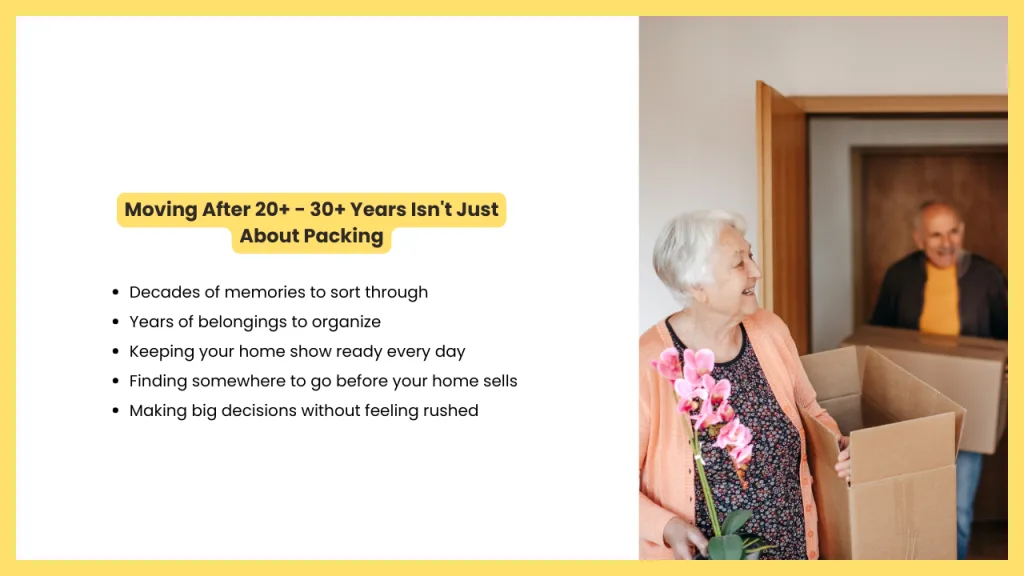
If you've lived in your home for two or three decades, you have accumulated far more than you think you have. Every closet, every garage shelf, every drawer in the kitchen has quietly filled up, year after year, without you noticing it happening. And it isn't just stuff. It's layers of history. Kids' report cards. A parent's handwriting on a recipe card. Furniture that came from someone who isn't here anymore. Sorting through all of that isn't a weekend project. It's an emotional excavation, and it deserves to be treated like one, not squeezed into three frantic weekends before a listing photographer shows up.
On top of the sorting, there's the day-to-day reality of selling a home while you're still living in it. Keeping a house "showing ready" every single day, dishes done, beds made, floors clean, on the off chance a buyer wants to walk through at 4pm on a Tuesday, is exhausting in a way that's hard to describe until you've lived it.
And here's the part that surprises people: a home almost always sells faster, and often for more, when it's staged and vacant, not lived in. Buyers need to picture their own life in a space, and that's genuinely harder to do around someone else's furniture, photos, and daily clutter. Which means that to sell your home at its best price, you often need to move most of your belongings out before it ever hits the market, which brings you right back to the original problem: you have to be mostly moved out before you've sold, which usually means you needed somewhere to go, which is the entire reason you're reading this guide in the first place.
This is exactly why the financing conversation and the moving conversation can't really be separated. The right loan doesn't just solve a numbers problem. It buys you the breathing room to handle the emotional and physical side of this well, instead of in a panic.
Get Clear on Your Why, and the How Will Follow
Before we get into loan programs, I want to ask you the question I ask every client who walks into my office overwhelmed by this decision: why are you actually moving?
Are you moving closer to your kids or grandkids? Are you finally getting the single-story home your knees have been asking for? Are you downsizing so more of your equity works for you instead of sitting in unused square footage? Are you making space for a parent to move in with you? The reason matters, because it becomes your compass every time this process feels overwhelming, and it will, at least once.
This is the whole idea behind Mortgage Made Easy. It was never about having every loan program memorized. It's about helping you get clear on what you're actually trying to build, and then finding the financing path that serves that goal, instead of a goal built around whatever loan happens to be easiest for me to sell you.
If you need help getting that clarity before you even talk numbers, is a good place to start.
Know Your Numbers Before You Decide
Every option in this guide gets easier to evaluate once you actually know your numbers instead of estimating them. Before you decide between a contingent offer, a HELOC, a Buy Before You Sell program, or a bridge loan, get these three things in hand.
1. A Real Market Analysis on Your Current Home
Ask a trusted local agent for a current market analysis (a CMA), not a Zestimate, not a guess from a neighbor who sold two years ago. You want a real, current number on what your home would likely sell for today, along with an honest estimate of what you'd actually net after commissions, closing costs, and any repairs a buyer will probably ask for. It's also worth understanding how current housing conditions may affect both your sale and your next purchase.
2. A Pre-Approval That Reflects Your Real Situation
Get pre-approved before you fall in love with a house. A real pre-approval, one that accounts for whichever path you're leaning toward, contingent, HELOC, Buy Before You Sell, or bridge, tells you what you can actually afford under that specific structure, since the number can change significantly depending on which option you use.
3. A Side-by-Side Comparison of Your Actual Options
Once you know your net proceeds and your true buying power, you can compare your options against real numbers instead of guesses. That's exactly what the rest of this guide will help you do.
Your Four Real Options
There isn't one right way to buy before you sell. Selling one home to buy another is one of the most common moves in real estate, and there are four common paths through it, each trading cost, speed, and control differently.
Option 1: A Contingent Offer
This is the traditional route: you make an offer on your new home contingent on the sale of your current one. It's the lowest-cost option by far, since there's no bridge financing involved at all.
| 💰 Contingent Offer, at a Glance Pros: No extra financing costs, no bridge loan fees, no interest accruing on a second loan.Cons: Sellers in a competitive market often prefer offers without a home-sale contingency, so your offer may be weaker than a non-contingent one. You're also dependent on your current home selling on a timeline that matches your purchase. Helpful strategy: Many buyers list their current home first, before making an offer on the next one. That way you know your real budget, and you speed up the chain instead of guessing. Worth knowing: If you sell first and need extra time before your next home closes, a rent-back agreement lets you sell your house, then pay rent to the new buyers for a period of time while you finish closing on your next home. It's a simple, often overlooked way to avoid a rushed move. |
Option 2: A HELOC on Your Current Home
A Home Equity Line of Credit lets you borrow against the equity in your current home while you still own it, and use those funds toward your next down payment. It's a popular option because it can be less expensive than a full bridge loan or Buy Before You Sell program.
Asking the right questions before accessing your home equity can help you avoid unnecessary costs.
| 💰 HELOC for Your Down Payment, at a Glance How it works: You open a line of credit secured by your current home's equity and draw what you need for your new down payment and closing costs. Pros: Often lower cost than a bridge loan, flexible, and you only draw what you actually need. The real limitation: A HELOC doesn't remove your current mortgage from your debt-to-income calculation. In most cases, you still have to qualify to carry both your existing mortgage and your new one at the same time, plus the new HELOC payment. This is where a lot of people run into trouble, not because the equity isn't there, but because their income simply doesn't support three payments at once. Best for: Homeowners with strong income relative to their debt, who mainly need help bridging the down payment, not the full monthly payment picture. |
Option 3: Our Buy Before You Sell Program
This program is typically the lower-cost option between the two dedicated bridge-style products. It's designed to let you make a strong, non-contingent offer without carrying two mortgage payments while your old home is on the market.
| 💰 Buy Before You Sell, at a Glance Best for: Homeowners who want a lower-cost path than a bridge loan and are comfortable with a firm timeline to sell. Cost: Generally lower than a bridge loan, typically structured as discount points and closing costs rather than a high accruing interest rate. Qualifying: Whether the payment on your departing home counts against you when qualifying for the new loan depends on the specific investor and program structure. Some exclude it entirely because of the program's built-in purchase guarantee. Others don't. Not all Buy Before You Sell programs are alike, so this has to be confirmed for your exact situation before you rely on it. The catch: Most of these programs give you a limited window, often around four months, to sell your home on the open market. If it hasn't sold by the deadline, the program itself purchases your home from you, and the price is based on what the market will bear at that time, not necessarily what you hoped to get. Whatever you owe the program comes out of those proceeds first. |
Option 4: Our Bridge Loan Program
A bridge loan is the more expensive option, but it buys something the others can't: real time, and full control over your eventual sale price, without your income having to support two full mortgage payments the way a HELOC-plus-contingent approach often does.
| 💰 Bridge Loan, at a Glance Best for: Homeowners who need more breathing room, have significant equity, or are in a time-sensitive situation like a purchase that's about to fall through. Cost: Higher than a Buy Before You Sell program or a HELOC. Expect meaningful fees plus an interest rate that typically accrues onto the loan rather than being paid monthly. Timeline: Bridge loans commonly give you six months to a full year to sell, often with a reserve account structured so you make no payments during that window. The advantage: There's no forced sale and no program stepping in to buy your home. You control the listing, the negotiations, and the final price, on your own timeline, within the loan term. |
| 💡 A Detail Most People Don't Know When you close on a new mortgage, your first payment typically isn't due for about two months. If you close in June, for example, your first payment is usually due in August. That built-in gap gives you a little natural breathing room in almost any scenario, contingent, HELOC, Buy Before You Sell, or bridge, and it's worth factoring into your timeline when you're deciding how much cushion you actually need. |
| ✅ Real Story #1: The Program They Almost Used Pleasant Hill, CA → Roseville, CA | Buy Before You Sell Program, Considered and Declined |
Not every story in this guide ends with a closing. This one is just as important, because it shows what it looks like when a client makes an informed decision to walk away from a product after really understanding the tradeoffs.
A couple selling their home in Pleasant Hill for $1,100,000 wanted to buy a home here in Roseville for $875,000. They had plenty of equity to work with, and on paper, a Buy Before You Sell program looked like a clean solution: make a non-contingent offer on the Roseville home, move on their own schedule, and sell the Pleasant Hill home without the pressure of a double closing.
Then we ran the actual numbers. The program was going to cost them $41,000 in discount points and closing costs.
I told them plainly: "This program will get you moved faster, but I want you to understand exactly what you're paying for that speed, and what happens if your home takes longer than four months to sell." Once they saw the number next to the four-month clock, and understood that if the home didn't sell in that window, the program's investor would purchase it at market value rather than the price they wanted, they had real pause.
They decided to pull back. Instead, they're preparing the Pleasant Hill home properly for the open market, and plan to buy their next home the traditional way, on a standard sale contingency. That $41,000 stays in their pocket, and they'll know exactly what they're netting from their sale before they commit to anything, instead of being at the mercy of a program's timeline.
| 💜 Amy's Mortgage Made Easy Insight This wasn't a program failure. This was the program working exactly as designed, and my clients deciding the tradeoff wasn't right for them. That's the whole point of walking through real numbers before you commit: sometimes the right answer is the simpler, cheaper path, even if it takes a little longer. Mortgage Made Easy doesn't mean the flashiest tool. It means the one that actually fits your life. |

| ✅ Real Story #2: The Bridge Loan That Saved the Deal Alameda, CA → Rio Linda, CA | Bridge Loan | Elderly Couple Keeps Their Contract on 4 Acres |
This is the story that shows exactly why a bridge loan exists, and why some families choose to pay more for it.
An elderly couple was under contract to buy a home on four beautiful acres in Rio Linda, purchase price $890,000, on a contingent offer based on the sale of their home in Alameda. Their Alameda home was worth $1,500,000, and they only owed $180,000 on it. The equity was there. The problem was time. Their Alameda home wasn't selling fast enough, and they were about to lose the Rio Linda property entirely.
I told them, "You have more than enough equity here to solve this. The question isn't whether we can save this deal, it's how much time you need to do it right." That's when we moved to a bridge loan.
We structured a bridge loan large enough to pay off their existing $180,000 first mortgage on the Alameda home and pay all cash for the Rio Linda property. No new-purchase financing contingency, no risk of losing the home they'd fallen in love with, partly because of its potential to be subdivided down the road.
The cost reflected the extra time and flexibility they were buying: $35,000 in fees and an 8.00% interest rate, accruing onto the back of the loan rather than billed monthly. A reserve account was built into the loan so they wouldn't owe a single payment for up to 12 months, giving them a full year to sell the Alameda home on their own terms, at their own price, with no one else's deadline attached.
They kept the home in Rio Linda. They didn't have to accept a rushed price on Alameda. And they got to spend their time actually enjoying their new property instead of panicking about a financing contingency.
| "I finally slept through the night after we decided to pay the extra fees and do the bridge loan." |
She called to tell me that a few weeks after closing. That sentence is the whole reason this loan exists.
| 💜 Amy's Mortgage Made Easy Insight A bridge loan costs more, there's no getting around that. But when a purchase is genuinely at risk, or when someone needs more than a few months to sell on their own terms, that cost buys something real: control. This couple didn't need the cheapest option. They needed the one that actually worked for their situation, and their timeline. That's the distinction I walk through with every client before we pick a path. |
Getting Your Home Ready to Sell: A Real Checklist
Whichever financing path you choose, the work of actually preparing a longtime home for sale is real, and it goes so much faster with a plan and the right people around you.
Start With Professional Help, Not a Solo Sprint
The single most important decision in this whole process, outside of financing, is who you hire to represent you. A premier, experienced listing agent (and, on the purchase side, a strong buyer's agent) is worth their weight in gold here. The right agent doesn't just list your home, they help you sequence the entire move: what to fix, what to skip, when to list, how to negotiate, and how to keep both transactions moving in sync. Don't try to navigate this alone.
Order Your Pre-Listing Inspections Early
Get ahead of surprises instead of reacting to them. A pest inspection, a roof inspection, and a general home inspection, done before you list, let you fix or disclose issues on your own terms instead of renegotiating under pressure after a buyer's inspector finds them first. This is especially important in an older home, where thirty years of wear can hide things you've simply stopped noticing.
Line Up Storage Before You Need It
Since homes typically show and sell better staged and lived-in-light, you'll likely need to move a meaningful portion of your belongings out before your home ever hits the market. Research storage companies and get pricing early, whether that's a traditional storage unit or a portable container service that can later move with you. Booking this ahead of time removes one major scramble later.
Get Moving Quotes Before You're in a Rush
Moving companies book up, especially during peak season. Get a few quotes early, even if your exact date isn't locked in yet, so you're choosing a mover based on reputation and price, not just who happens to be available on short notice.
Consider Professional Staging
Staged homes consistently show better in photos and in person, and often sell faster and for a stronger price than vacant or heavily personalized homes. Ask your listing agent for staging recommendations, many have trusted stagers they work with regularly, and some offer staging as part of their listing services.
Give Yourself Permission to Grieve a Little
This one doesn't show up on anyone else's checklist, but it belongs here. If you've raised a family in this home, or built a life in it over decades, it is completely normal to feel a real sense of loss in the middle of all the logistics. That doesn't mean you're making the wrong decision. It means you lived a full life in that house. Give yourself room to feel that alongside the practical planning.
Comparing Your Options, Pros and Cons
Here's all four paths, side by side, stripped down to what actually matters when you're deciding.
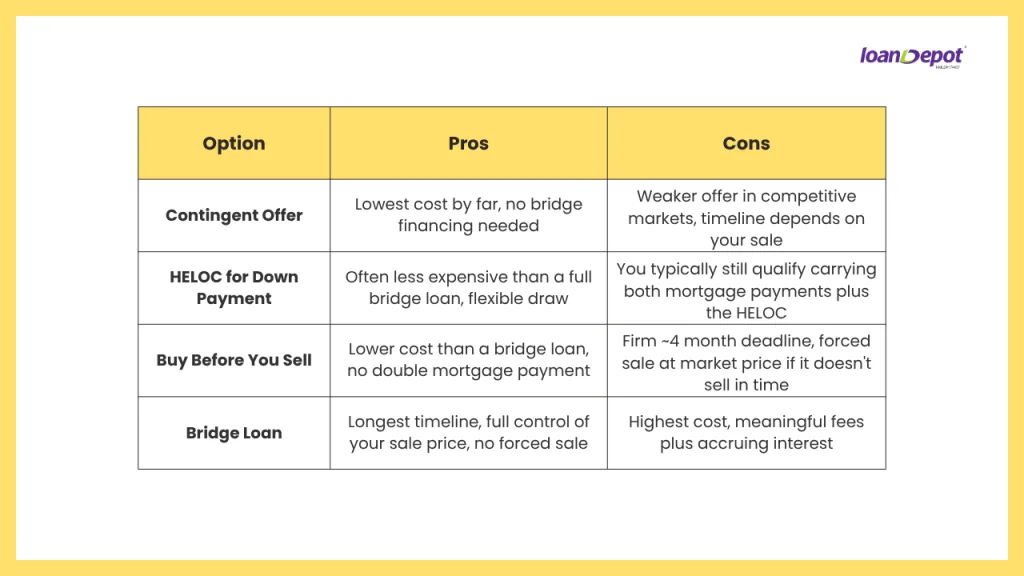
A note on qualifying, because it comes up in almost every conversation I have about this: different investors have different rules. Depending on the specific loan product and program, you may or may not have to qualify as if you're carrying both payments. There are several investors offering Buy Before You Sell style programs, and they are not all alike. This is one of the first questions I answer for every client before we choose a direction, because it can change what you actually qualify to buy.
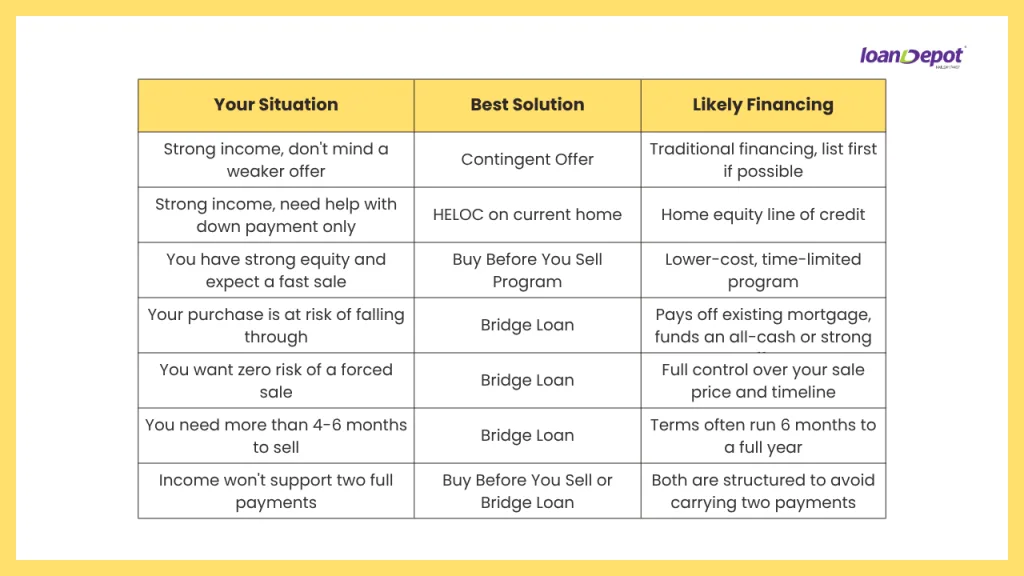
Which One Fits Your Situation?
Every move is different, which means there isn't a single solution that works for everyone. The best strategy depends on your equity, income, timeline, and overall goals.
❓FAQs about How to Buy Your Next Home Before Selling Your Current Home in California
Not directly, since that equity is illiquid until your home actually closes. What you can do is tap into it early through a HELOC or a bridge loan, both let you access your current equity ahead of your sale to fund your new down payment. Which one makes sense depends on whether your income can comfortably support carrying both mortgage payments in the meantime.
The two most common ways are a contingent offer, where your purchase is tied to the sale of your current home so you're never carrying both loans at the same time, or a rent-back agreement, where you sell your current home first and then pay rent to the new owners for an agreed period while you finish closing on your next home. Our Buy Before You Sell program and bridge loan are also both structured specifically so you're not carrying two full payments during the transition.
A bridge loan is a temporary, short-term loan that bridges the financial gap between buying your new home and selling your current one. It uses the equity in your current property to pay off your existing mortgage and fund your new purchase, often as an all-cash or non-contingent offer, while you take the time you need to sell on your own terms.
This takes real strategy, and it's exactly where a strong agent earns their fee. Many buyers list their current home first, before making an offer on the next one, so they know their real budget and timeline going in. From there, your agent and loan officer coordinate the chain so both closings land as close together as possible, and a rent-back agreement can add flexibility if the dates don't line up perfectly.
It depends heavily on your debt-to-income ratio, your reserves, and your credit profile. Lenders want to see that you can comfortably carry both payments if your current home takes longer than expected to sell. This is exactly why many people turn to a Buy Before You Sell program or a bridge loan instead, both are structured so you're generally not required to qualify while carrying two full mortgage payments at once.
It can be, especially if your income comfortably supports carrying your current mortgage, your new mortgage, and the HELOC payment all at once. The tradeoff is that a HELOC doesn't remove your existing mortgage from your qualifying picture the way a Buy Before You Sell program or bridge loan often can, so it works best for buyers with strong income relative to their debt, not those who are already stretched thin.
The program itself purchases your home from you, typically at whatever price the market will bear at that time. Whatever you owe the program is paid out of those proceeds first. This is the tradeoff for the lower cost, and it's the part that makes some homeowners uncomfortable, since the eventual price isn't guaranteed to match what they hoped to net.
Generally, yes. A bridge loan typically involves higher fees and an interest rate that accrues over the loan term, whereas a Buy Before You Sell program is usually structured around discount points and closing costs. The tradeoff is that a bridge loan buys you more time and keeps you in full control of your eventual sale price.
Typically about two months after you close, not the first of the following month. If you close in June, for example, your first payment is usually due in August. It's a small detail, but it builds in a little natural breathing room no matter which path you choose.
Start with your numbers, not a loan program. Get a real market analysis on your current home so you know what you'd likely net, and get pre-approved so you know your true buying power. Once you have both of those, we can sit down and compare a contingent offer, a HELOC, our Buy Before You Sell program, and our bridge loan side by side, using your actual numbers instead of guesses.
| Not sure which path is right for your move? Every family's equity, timeline, and comfort with risk is different. I'll walk through your actual numbers with you, all four options, side by side, so you know exactly what you're choosing and why, before you commit to anything. Schedule your Buy Before You Sell Strategy Session at TalkingWithAmy.com Amy DeBusk | Amy DeBusk Home Loans | 26 Years of Mortgage Made Easy |
All Mortgage Made Easy articles · Book a Complimentary Discovery Call