

Most buyers don't realize there's a way to combine home financing, down payment assistance, and solar energy into one strategy.
The FHA HOPER Loan is not a traditional FHA mortgage. It's a unique program designed to make homeownership more affordable by pairing FHA financing with solar energy and financial incentives.
I'm Amy DeBusk, a Branch Manager with over 25 years of experience, and I help buyers in Sacramento, Roseville, and across California explore financing strategies like this when traditional options don't quite fit.
The goal isn't just to buy a home, it's to make homeownership more affordable long after closing.
For buyers in Sacramento, Roseville, and throughout California, using an FHA loan with solar panels can be a powerful way to reduce both upfront costs and long-term monthly expenses.
What Is the FHA HOPER Loan
Before exploring the benefits, it helps to understand what makes this program different from a traditional FHA mortgage. The FHA HOPER Loan was designed to support affordable homeownership while encouraging energy-efficient improvements.
The FHA HOPER Loan, which stands for Home Ownership Promotion Education and Research, allows eligible borrowers to finance a home and add a fully owned solar energy system to one FHA loan. It also offers financial assistance that can significantly reduce upfront costs. Some buyers also compare this with other assistance options available in California.
This program is especially helpful for buyers in high-cost states like California, where housing and electricity costs often go hand in hand.
If you are new to FHA financing, our Ultimate Guide to FHA Loans is a great place to start and explains how FHA loans work from qualification to closing.
What Makes the FHA HOPER Loan Different
The FHA HOPER Loan combines several advantages into one program:
- FHA financing with low down payment options
- Up to $13,000 in financial assistance for eligible buyers
- The ability to finance a fully owned solar system into the loan
- Potential eligibility for federal solar tax credits
Unlike traditional FHA loans, this program focuses on both upfront affordability and long-term cost savings through energy efficiency.
How the FHA HOPER Loan Supports Affordable Homeownership
Homeownership is not just about qualifying for a mortgage. It is also about managing monthly expenses long after closing. The FHA HOPER Loan focuses on affordability, both upfront and over time.
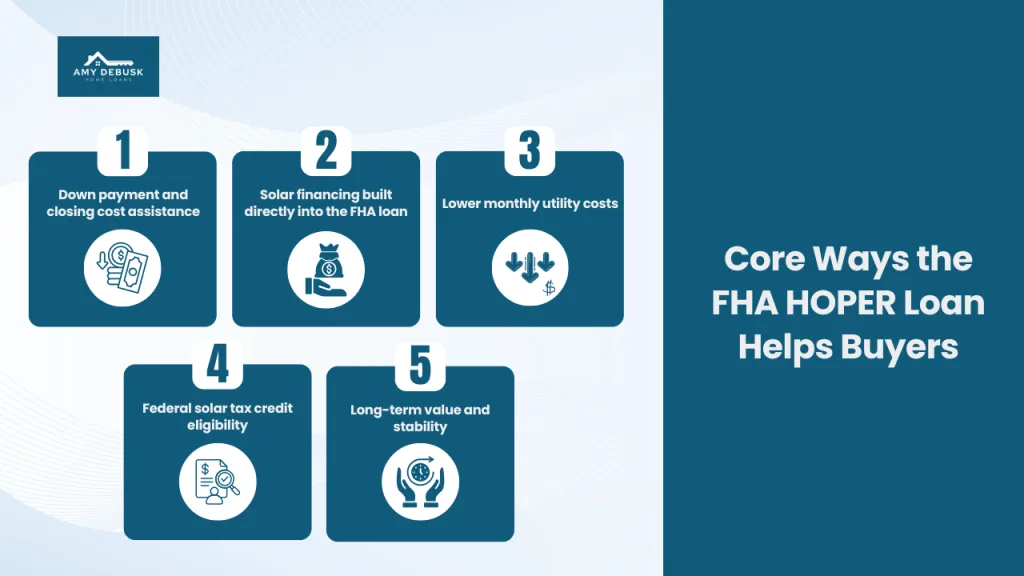
Here are the core ways this FHA program helps buyers and homeowners:
-
Down payment and closing cost assistance
Eligible borrowers may receive up to thirteen thousand dollars in assistance. These funds can be applied toward the down payment, closing costs, or even to reduce the interest rate. This significantly lowers the cash needed to purchase a home and can make homeownership possible sooner.
-
Solar financing is built directly into the FHA loan
The cost of a fully owned solar energy system is rolled into the FHA mortgage. Buyers do not need a separate solar loan, lease, or power purchase agreement. This means no large upfront solar payment and one predictable monthly housing expense.
-
Lower monthly utility costs
By owning a solar system, homeowners can reduce or eliminate electric bills. Over time, these energy savings can help offset the mortgage payment and improve overall monthly affordability.
-
Federal solar tax credit eligibility
Homeowners may qualify for the thirty percent federal solar tax credit. This incentive can return thousands of dollars after installation, offering additional financial relief and flexibility.
-
Long-term value and stability
Energy-efficient homes with owned solar systems often have increased resale value and greater appeal in competitive markets. Buyers benefit from both lower operating costs and long-term investment potential.
By combining financial assistance, renewable energy, and federal incentives, the FHA HOPER Loan creates a more affordable and forward-thinking path to homeownership in 2026 and beyond.
Learn more about the FHA HOPER Loan and see if you qualify at talkingwithamy.com
Why FHA Buyers Are Choosing Solar in 2026
FHA buyers in 2026 are becoming more cost-conscious than ever. While interest rates and home prices matter, rising electricity costs are playing a larger role in overall housing affordability. In many areas, monthly utility bills can add hundreds of dollars to housing expenses, especially in older or less energy-efficient homes.
Solar energy offers a way to stabilize those costs and protect households from future rate increases. When solar is paired with an FHA loan, it becomes far more accessible to everyday buyers who may not have the cash to invest upfront.
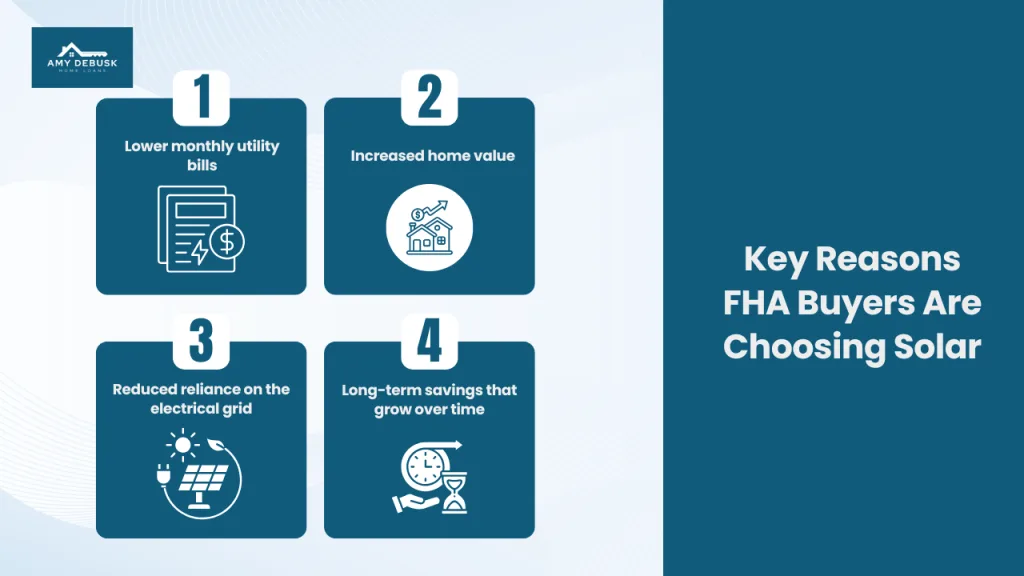
Key Reasons FHA Buyers Are Choosing Solar:
-
Lower monthly utility bills
Solar systems can significantly reduce or even eliminate electric bills. This improves monthly affordability and helps balance overall housing costs.
-
Increased home value
Homes with fully owned solar systems often appraise higher and are more attractive to future buyers compared to non-solar homes.
-
Reduced reliance on the electrical grid
Solar allows homeowners to generate their own energy, offering more independence from rising utility rates and grid instability.
-
Long-term savings that grow over time
As electricity prices continue to increase, the value of solar savings compounds year after year, creating lasting financial benefits.
For many families, solar is no longer viewed as a luxury upgrade. It has become a practical and strategic financial decision that supports affordable homeownership.
If you want to explore additional energy-focused loan options, read our blog on FHA and VA Energy Efficient Mortgages in Roseville and Auburn to see how buyers are improving efficiency beyond solar.
What Most Buyers Don't Realize About Solar and Homeownership
One of the biggest misconceptions is that adding solar makes buying a home more expensive.
In reality, when solar is financed into a mortgage, it can reduce your total monthly housing cost by lowering or eliminating your electric bill.
In high-cost states like California, where utility rates continue to rise, this can make a meaningful difference in long-term affordability.
FHA HOPER Loan Solar Savings for Older Homes
Older homes tend to consume more electricity due to outdated appliances, aging insulation, and less efficient heating and cooling systems. In high utility cost states like California, this can translate into extremely high monthly power bills.
When a fully owned solar system is added through the FHA HOPER Loan, the savings can be substantial. Below are realistic examples based on average electricity costs to help illustrate the potential impact.
Example Solar Savings Scenarios:
Moderate Energy Use
Approximately 1,200 kilowatt hours per month
In this example, a buyer purchases an older home with average electricity usage. Before solar, the monthly power bill added a noticeable expense to the household budget. After adding a fully owned solar system through the FHA HOPER Loan, energy costs drop significantly, creating immediate monthly relief.
- Average monthly electric bill before solar: Around $396
- Estimated monthly electric cost after solar: Around $50
- Estimated monthly savings: $346
- Estimated annual savings: $4,152
High Energy Use
Approximately 1,800 kilowatt hours per month
In this scenario, the home has higher electricity usage due to factors like older HVAC systems or a larger household. Utility bills are a major part of the monthly expenses. Solar dramatically reduces those costs, freeing up hundreds of dollars each month that can be redirected toward other financial goals.
- Average monthly electric bill before solar: Around $594
- Estimated monthly electric cost after solar: Around $75
- Estimated monthly savings: $519
- Estimated annual savings: $6,228
Very High Energy Use
Approximately 2,400 kilowatt hours per month
This example reflects an older home with very high energy demand, often seen in hot climates or larger properties. Before solar, electricity costs can feel overwhelming. After installing solar through the FHA HOPER Loan, the homeowner sees a dramatic reduction in monthly bills, creating long-term financial stability.
- Average monthly electric bill before solar: Around $792
- Estimated monthly electric cost after solar: Around $100
- Estimated monthly savings: $692
- Estimated annual savings: $8,304
These examples show how powerful solar savings can be for older homes, especially in high electricity cost areas. When solar is financed through the FHA HOPER Loan, the reduced utility bills can help balance monthly housing expenses and make long term homeownership more affordable and predictable.
If the home you're buying also needs updates, there are ways to roll those improvements into your loan instead of paying out of pocket.
Why Older Homes Benefit Even More From Solar
Many buyers assume solar is best suited for newer homes with modern systems and construction. In reality, older homes often experience the most dramatic financial benefits once solar is installed.
Older properties typically rely on less efficient appliances, aging insulation, and outdated heating and cooling systems. This leads to higher electricity usage and larger monthly utility bills, especially in warmer climates or larger homes.
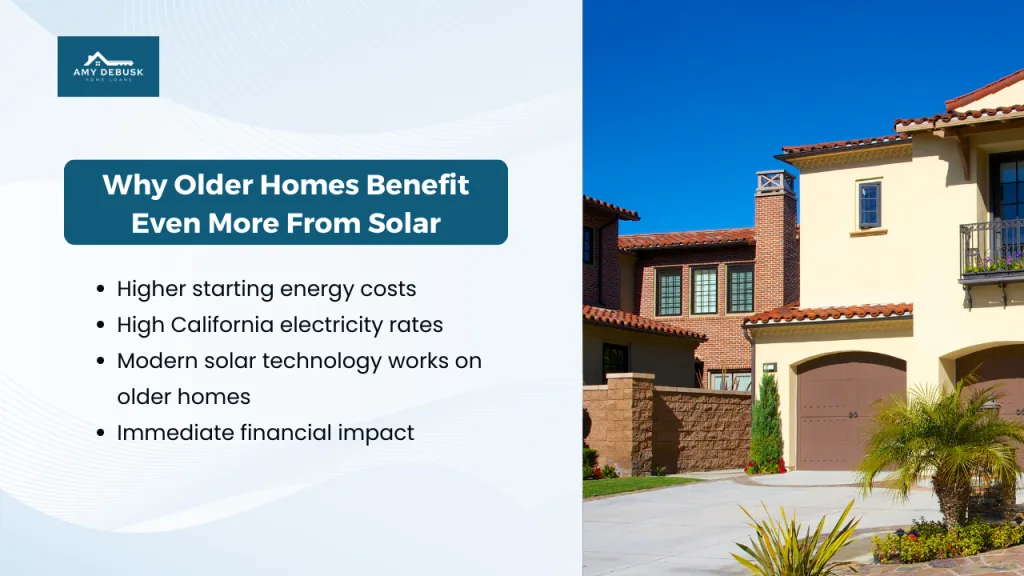
Why Solar Makes a Bigger Difference for Older Homes:
-
Higher starting energy costs
Older homes often begin with significantly higher electric bills compared to newer construction. This means solar offsets more expensive electricity right away, creating noticeable savings from the first month.
-
High California electricity rates
California continues to have some of the highest utility rates in the country. When solar replaces costly grid electricity, homeowners gain protection from future rate increases and unpredictable monthly bills.
-
Modern solar technology works on older homes
Today's solar panels are highly efficient and adaptable. They perform well on older rooftops and can be customized to match a home's energy usage, roof layout, and sun exposure.
-
Immediate financial impact
Because older homes often consume more electricity, the reduction in utility bills is felt immediately. These savings can help offset a mortgage payment and improve overall monthly affordability.
For many FHA buyers, pairing solar with an older home is not just environmentally responsible. It is a smart financial move that transforms high operating costs into long-term savings and stability.
If your home also needs repairs or upgrades, our Free FHA 203K Guide shows how FHA renovation financing can work alongside energy improvements.
How the FHA HOPER Loan Works Step by Step
Understanding the process makes the FHA HOPER Loan feel far more approachable. While it offers unique benefits like solar financing and financial assistance, the structure is designed to be straightforward and familiar for FHA buyers.
Here is how the process typically works from start to finish:
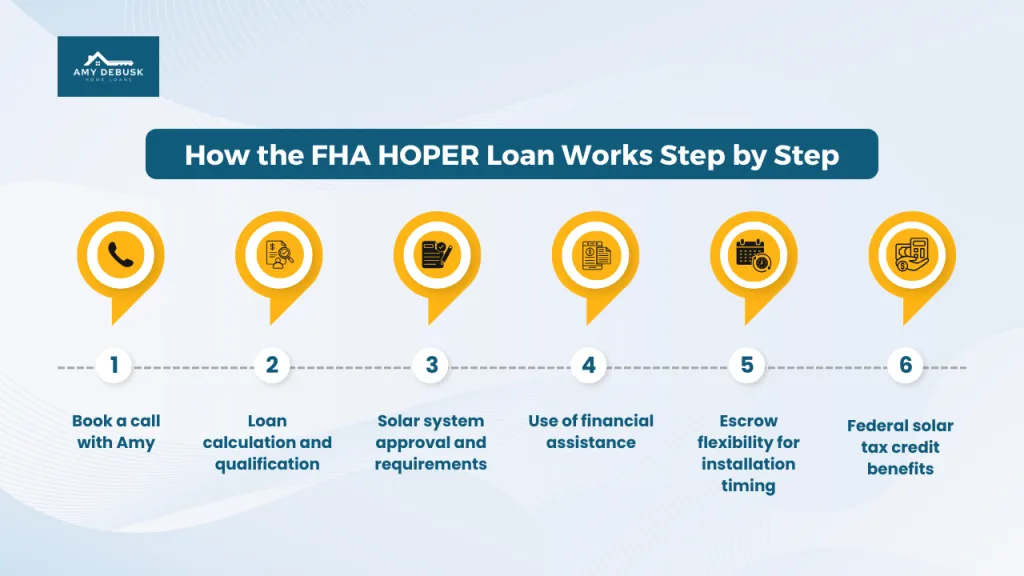
Step 1: Book a call with Amy
The first step is to book a call with Amy to review eligibility, goals, and overall affordability. During this conversation, buyers can ask questions, discuss solar options, and learn how the FHA HOPER Loan fits their homeownership plans. This call helps create a clear roadmap before moving forward.
Step 2: Loan calculation and qualification
Borrowers may finance up to 96.5 percent of the home value, with the cost of a fully owned solar system included in the total FHA loan amount. This allows buyers to roll solar into one mortgage instead of taking on separate financing.
Step 3: Solar system approval and requirements
The solar system must meet local building codes and FHA guidelines. Installation is completed by licensed professionals to ensure safety, compliance, and long-term performance.
Step 4: Use of financial assistance
Eligible borrowers may receive assistance funds that can be applied toward the down payment, closing costs, or interest rate reduction. This step helps reduce upfront cash requirements and improve affordability.
Step 5: Escrow flexibility for installation timing
If the solar system is not installed by the time of closing, funds are safely held in escrow. The loan can still close while installation is completed shortly afterward.
Step 6: Federal solar tax credit benefits
- Active Solar Energy System Property Tax Exclusion: This program ensures that the increase in your home's value due to the installation of a solar energy system is excluded from your property tax assessment. This exclusion is in effect until January 1, 2027.
- Self-Generation Incentive Program (SGIP): This program provides cash rebates for installing energy storage systems (batteries). The rebate amount varies by utility provider and is significantly higher for low-income households or those in high fire-risk areas.
- Disadvantaged Communities Single-Family Affordable Solar Homes (DAC-SASH) Program: For qualifying low-income homeowners in designated communities, this program offers significant upfront incentives that can cover most or all of the installation costs.
- Local Utility Company Incentives: Depending on your specific utility provider (e.g., Sacramento Municipal Utility District (SMUD) or Los Angeles Department of Water and Power (LADWP)), you may be eligible for additional rebates or beneficial net metering programs.
- The FHA HOPER (Homeownership Preservation Enhancement & Recovery) program isn't a typical loan; it's structured as compensation for participating in research, making the assistance taxable 1099 income, not a loan to be repaid or a grant. You receive funds for completing classes and energy-efficiency upgrades, which are then reported as income by the program, not a debt you owe back. Repayment isn't a factor, but you must fulfill program requirements (classes, upgrades) to earn the incentive, and lenders use this earned income for mortgage qualification, not as a loan obligation.
To better understand how the FHA HOPER program works and how the incentives are earned, homeowners can review detailed program information through the FHA HOPER loan website. For those who want help determining eligibility or using the income for mortgage qualification, working with an FHA HOPER loan lender can provide clear guidance on the next steps.
You can also learn how energy improvements are financed through other programs by reading our blog on FHA and VA Energy Efficient Mortgages in Roseville and Auburn.
Important Program Considerations
The FHA HOPER Loan is not a standard FHA program and may not be offered by all lenders.
Program availability, terms, and eligibility can vary depending on the lender and location.
Working with a lender familiar with this program is important to understand how it applies to your specific situation.
Every loan program has tradeoffs, and FHA is just one path. If you're also looking at state programs, this is where I explain how Dream For All and CalHFA compare in real situations.
Some buyers also qualify for more niche programs depending on their situation. For example, there are options specifically for physicians that work differently from standard loans.
 FHA HOPER Loan for Affordable Homeownership With Solar FAQs
Buyers often have questions before getting started. Here are answers to some of the most common ones we hear.
❓ Can the FHA HOPER Loan be used for refinancing?
Yes. Homeowners may refinance an existing mortgage and add a fully owned solar system using this program.
❓ Are leased solar panels allowed?
No. Only fully owned solar systems qualify. Leased solar panels and power purchase agreements are not permitted.
❓ Who qualifies for the FHA HOPER Loan?
Borrowers must meet standard FHA loan requirements, including credit score, income verification, and property eligibility guidelines.
❓ Where is the FHA HOPER Loan available?
The program is available in select states, including California, Texas, and Nevada, with additional states expected to participate.
❓ How can the assistance funds be used?
Assistance funds may be applied toward the down payment, closing costs, or interest rate reduction.
❓ How much can buyers receive in assistance?
Eligible borrowers may receive up to $13,000, depending on program guidelines and availability.
❓ Does solar have to be installed before closing?
No. If installation is not complete by closing, the solar funds can be held safely in escrow until the system is installed.
❓ Do buyers still qualify for the federal solar tax credit?
Yes, buyers still can qualify for a federal solar tax credit in 2025, but only for systems that are installed and "placed in service" by December 31, 2025. After that date, the federal residential tax credit ends and homeowners generally will not be able to claim it for systems installed in 2026 or later.
Yes. Homeowners may refinance an existing mortgage and add a fully owned solar system using this program.
No. Only fully owned solar systems qualify. Leased solar panels and power purchase agreements are not permitted.
Borrowers must meet standard FHA loan requirements, including credit score, income verification, and property eligibility guidelines.
The program is available in select states, including California, Texas, and Nevada, with additional states expected to participate.
Assistance funds may be applied toward the down payment, closing costs, or interest rate reduction.
Eligible borrowers may receive up to $13,000, depending on program guidelines and availability.
No. If installation is not complete by closing, the solar funds can be held safely in escrow until the system is installed.
Yes, buyers still can qualify for a federal solar tax credit in 2025, but only for systems that are installed and "placed in service" by December 31, 2025. After that date, the federal residential tax credit ends and homeowners generally will not be able to claim it for systems installed in 2026 or later.
Final Thoughts
As home prices and utility costs continue to rise, buyers in 2026 are looking for smarter ways to make homeownership sustainable. The FHA HOPER Loan stands out because it does more than help you buy a home. It helps you afford living in it long-term.
By combining FHA financing, solar energy, and financial assistance, this program addresses two of the biggest challenges homeowners face today. Upfront affordability and ongoing monthly expenses. For first-time buyers, growing families, and homeowners looking to refinance, this loan creates an opportunity to build equity while lowering energy costs at the same time.
If you are already exploring FHA loan options, adding solar through the FHA HOPER Loan can be a powerful way to future-proof your home and your budget. With federal incentives still available and energy prices showing no signs of slowing down, this program offers both immediate and long-term value.
Understanding how all of these options connect is what allows buyers to build the right strategy.
Watch Our FHA Loans YouTube Playlist
If you want a quick and simple way to learn more about FHA loans, our YouTube playlist is a great place to start. We explain FHA loan basics, common questions, and what to expect in easy-to-understand videos designed for real buyers.
These videos are perfect if you prefer learning visually or want a clearer understanding before applying for an FHA loan.
Contact Amy DeBusk Home Loans
At Amy DeBusk Home Loans, we specialize in helping buyers navigate FHA programs with confidence. Our team is here to explain your options clearly and guide you every step of the way.
📞 Call: 916 705 2557 or talkingwithamy.com
📧 Email: amy.debusk@apmortgage.com
🌐Visit: amydebuskhomeloans.com
Let us help you make homeownership affordable and energy smart in 2026.
All Mortgage Made Easy articles · Book a Complimentary Discovery Call