

Is Buying a Condo Cheaper Than Buying a Single-Family Home in California?
Buying a condo is not always cheaper than buying a single-family home in California. While condos often have a lower purchase price, the HOA dues can significantly impact the monthly payment and may make the condo just as expensive, or sometimes more expensive, than a single-family residence.
In my experience helping California homebuyers, the biggest mistake buyers make is comparing the sales price instead of the full monthly payment. A condo may look more affordable at first, but once you include HOA dues, taxes, insurance, and mortgage insurance if applicable, the real cost can change quickly.
That does not mean condos are a bad choice. In many California markets, like the Inland Empire area in towns like Chino Ca. A condo may be the most realistic and strategic way to become a homeowner, especially when single-family homes are outside the buyer's price range. Condos can also be a great fit for buyers who want a low-maintenance lifestyle, access to amenities, a prime location, or a home that better fits their current stage of life.
The best choice is not simply condo vs. single-family home. The better question is: which type of property gives you the best combination of affordability, lifestyle, financing approval, and long-term wealth-building potential?
The Consumer Financial Protection Bureau recommends evaluating the total cost of homeownership, including your mortgage payment, property taxes, homeowners insurance, HOA dues, and other ongoing expenses before deciding which property is the better fit.
Is Buying a Condo a Good Way to Build Wealth?
Buying a condo can absolutely be a good way to build long-term wealth, especially when it allows a buyer to step into homeownership instead of continuing to rent. However, it is important to understand that condos and single-family homes do not always appreciate at the same pace.
There is an old saying in real estate that seasoned agents often share: in a strong real estate market, condos are usually slower to rise in value, and in a declining market, condos can be among the first properties to soften in price. In my experience helping buyers in the Sacramento, California market, I have seen this pattern play out in certain neighborhoods and price ranges.
One reason for this is simple: the buyer pool for condos is usually smaller than the buyer pool for single-family homes. Many buyers want a backyard, more privacy, no shared walls, and more control over the property. A single-family residence often appeals to families, pet owners, investors, move-up buyers, and people who want land or outdoor space. Condos, on the other hand, usually appeal to a more specific lifestyle buyer.
That does not mean condos are a poor investment. It means buyers need to understand what they are buying.
Condos come with their own set of pros and cons. Shared walls, HOA rules, limited outdoor space, parking restrictions, pet rules, and the financial health of the HOA can all affect the ownership experience. There are also shared-property risks. For example, another owner's maintenance issue, water leak, fire, noise, or behavior can impact your comfort, safety, insurance, or property value.
At the same time, condos can offer major benefits. They may provide a lower-maintenance lifestyle, more affordable entry into a desirable market, access to amenities, and the opportunity to own in locations where single-family homes may be out of reach. For retirees, busy professionals, first-time buyers, veterans, and buyers who do not want yard work or exterior maintenance, a condo can be an excellent fit.
The most important thing to remember is this: homeownership is one of the most powerful gateways to long-term wealth. If buying a condo fits your lifestyle, your spending plan, and your long-term goals, it can be a wonderful investment.
In my opinion, owning a condo is still far ahead of renting on the scale of smart financial choices. Renting may provide flexibility, but it does not give you ownership, equity growth, principal paydown, or the same long-term wealth-building opportunity. A condo may not be the perfect fit for every buyer, but for the right buyer, it can be the first powerful step toward financial stability, homeownership, and generational wealth.
If you are considering buying a condo, this comprehensive guide will walk you through everything you need to know. For buyers who want a deeper breakdown of the entire process, our First Time Home Buyer Guide From Start to Keys walks through everything from pre-approval to closing.
Can You Buy a Condo With a VA, FHA, or Conventional Loan?
One inspiring example involved a veteran relocating back to California from Nevada. After struggling to find an affordable single-family home in the Inland Empire, they discovered a beautiful condo in Chino, California with resort-style amenities, including swimming pools, a gym, beautiful common areas, and places for residents to barbecue and gather.
The monthly HOA dues were $660, which may sound high at first. However, in this case, the HOA dues included access to incredible amenities and also included the homeowners insurance coverage provided through the HOA master policy. Sometimes an HOA fee may include portions of insurance, exterior maintenance, landscaping, common area upkeep, amenities, water, trash, or other community expenses. This is why buyers should not look at the HOA fee in isolation. They need to understand what the HOA dues actually cover and how those costs affect the full monthly payment.
For this buyer, the condo felt like resort-style living. It offered a beautiful place to live, a lower-maintenance lifestyle, and access to homeownership in a market where many single-family homes were outside their price range.
The best part was that the condo project was VA approved. Because the project met VA requirements, the buyer was able to use their VA loan benefits to purchase the property with favorable financing terms.
This is an important lesson for anyone buying a condo: the buyer must qualify, but the condo project must qualify too.
When purchasing a condo with a VA loan, the condo project generally needs to be approved by the VA. An experienced lender can look up the condo project to see whether it is already VA approved before the buyer gets too far into the process.
The same concept applies to FHA loans. If a buyer wants to use FHA financing to purchase a condo, the condo project generally needs to be FHA approved. However, if the entire project is not FHA approved, an experienced FHA lender may be able to help with what is called an FHA single-unit approval. This is sometimes referred to as an FHA spot approval. It allows a specific unit in a condo project to be reviewed for FHA financing, even if the full condo project is not already on the FHA-approved list.
For conventional loans, many condos can be financed as long as the condo project meets conventional lending requirements. This is often referred to as the condo being warrantable. If the condo project does not meet the guidelines required by Fannie Mae, Freddie Mac, or the lender, it may be considered non-warrantable. A non-warrantable condo can be much harder to finance and may require a different loan program, a larger down payment, a higher interest rate, or may not be financeable through traditional conventional options at all.
This is why condo financing can be more complicated than buying a single-family home. With a single-family residence, the lender is primarily reviewing the borrower, the property, and the appraisal. With a condo, the lender also has to review the HOA, the insurance, the budget, the project approval status, owner-occupancy rules, litigation, repairs, and other project-level details.
That does not mean condos are bad. It simply means buyers need the right guidance before they fall in love with a property.
The Chino condo was a beautiful example of a condo purchase that made sense. The buyer found a property that fit their lifestyle, the HOA dues provided meaningful value, the project was VA approved, and the financing aligned with their goals. In that situation, the condo was not just a place to live. It was a smart path into California homeownership.
Condo Insurance Explained
Condo insurance is different from homeowners insurance for a detached single-family home. When you buy a single-family home, your homeowners insurance policy usually covers the structure, the interior, your personal belongings, liability, and other protections.
In our Veteran's story who bought a condo in Chino Ca, part of the insurance coverage was included through the HOA master policy, which helped offset some of the monthly cost. However, buyers should always confirm what the HOA policy
With a condo, insurance is typically split between the HOA's master insurance policy and the individual condo owner's policy. This is why it is so important to review the HOA master insurance policy before purchasing.
The HOA master policy may cover certain shared parts of the building, but it does not always cover everything inside your unit. Some HOA policies may cover the exterior structure, roof, common areas, shared walls, or community liability. Other policies may provide more limited coverage, sometimes referred to as "bare walls" coverage, which may leave the condo owner responsible for more interior items.
As a condo owner, you may need your own condo insurance policy, often called an HO-6 policy. This policy may help cover your personal belongings, interior improvements, liability inside your unit, flooring, cabinetry, fixtures, and additional living expenses if the unit becomes temporarily unlivable due to a covered loss.
The California Department of Insurance offers a coverage comparison tool for homeowners, renters, and condominium owners. Buyers should review the HOA master policy and their individual condo insurance policy carefully because the actual policy determines what is covered, limited, or excluded.
In many cases, the buyer may also need additional coverage for personal property, because the HOA master policy typically does not cover belongings such as furniture, clothing, electronics, jewelry, or personal items.
The HOA Master Policy May Cover:
- Exterior structure
- Roof
- Common areas
- Shared amenities
- Community liability
- Certain building components
- Some portions of the interior, depending on the policy
Your Individual Condo Policy May Cover:
- Personal belongings
- Interior walls, depending on the HOA master policy
- Flooring
- Cabinets
- Fixtures
- Appliances
- Personal liability
- Loss of use or additional living expenses
- Improvements or upgrades made to the unit
The most important takeaway is this: every condo project is different. Buyers should not assume the HOA covers all insurance needs. Always review the HOA master policy, ask what is covered, confirm what is excluded, and speak with a qualified insurance professional before closing.
All loans subject to approval. Equal Housing Lender.
New Condo Insurance Requirements (Effective July 1, 2026)
When you're buying a condominium with conventional financing through Fannie Mae or Freddie Mac, the lender doesn't just review you as the borrower. The condominium project itself must also meet specific approval guidelines.
As part of recent updates, Fannie Mae and Freddie Mac now require condominium associations to carry stronger insurance protection. Effective July 1, 2026, the association's master insurance policy generally cannot have a per-unit deductible greater than $50,000. If the deductible is higher, each individual unit owner must carry a homeowners (HO-6) insurance policy that provides enough coverage to fully cover that deductible, along with the appropriate property and liability protections.
These updated requirements are designed to help protect homeowners, lenders, and the long-term financial stability of the condominium community. During the mortgage process, we'll review the condominium's insurance, budget, financials, and other project documents to determine whether the project meets Fannie Mae or Freddie Mac eligibility requirements.
The good news is that you don't have to navigate this process on your own. Our team works directly with the HOA, escrow, insurance agents, and management company to obtain the necessary documentation and determine whether the condominium is eligible for financing before closing.
For complete details, you can review the official Fannie Mae policy update here.
What Is a Condo?
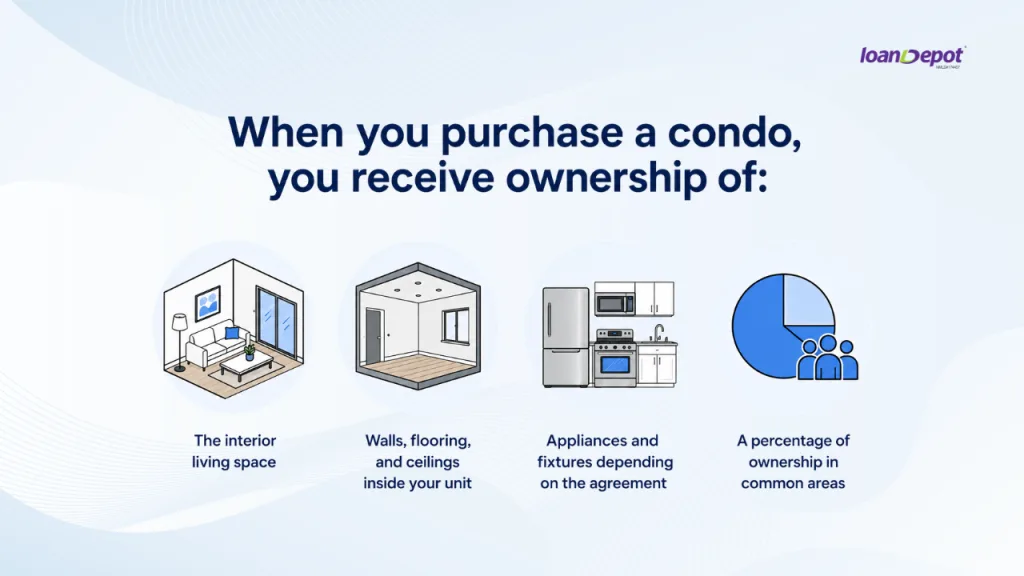
A condominium, commonly referred to as a condo, is a type of residential property where an individual owns a private living unit within a larger building or community. Condos can be found in high rise towers, low rise apartment buildings, townhome style developments, and planned residential communities. While condo owners have full ownership of the interior of their unit, they share ownership and responsibility for common areas and amenities with other residents in the community.
Unlike a detached single family home, where the homeowner owns both the structure and the land it sits on, condo ownership is generally limited to the unit itself. The exterior portions of the building, surrounding grounds, and shared facilities are collectively owned by all unit owners within the development.
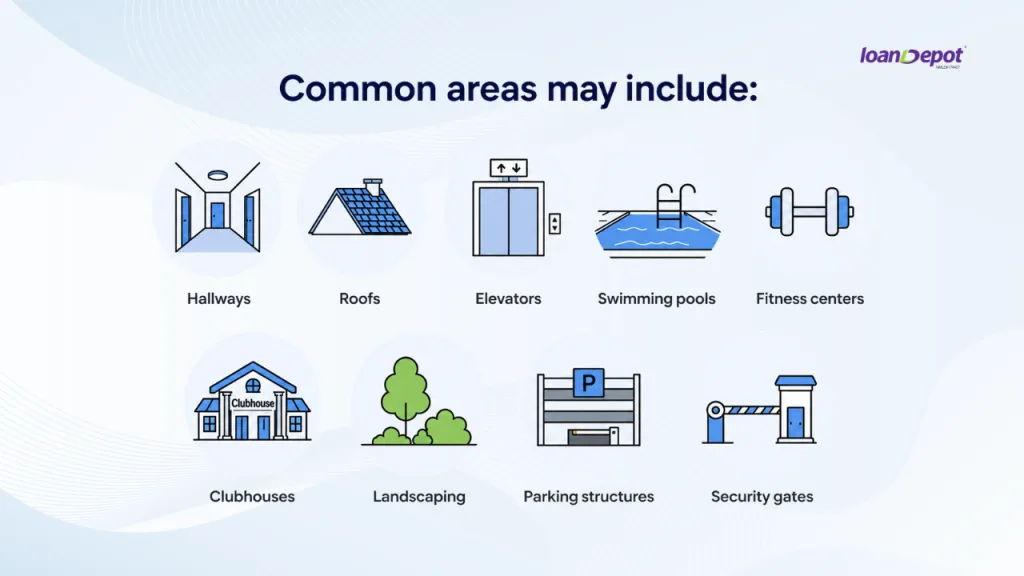
These shared spaces are maintained by a homeowners association (HOA), which collects monthly fees to cover maintenance, repairs, insurance, and community services.
Many homebuyers choose condos because they offer a lower maintenance lifestyle and often include amenities that would be costly to maintain individually. Condos can also be more affordable than single family homes in certain markets, making them a popular option for first time buyers, retirees, and those seeking a convenient, community-oriented living experience.
Learn more about the different types of homes first-time buyers can purchase before deciding which option best fits your goals.
How Condo Ownership Works
The HOA is responsible for maintaining community spaces and enforcing neighborhood rules. In exchange, homeowners pay monthly HOA dues.
This ownership structure makes condos very different from detached homes, where the owner is fully responsible for both interior and exterior maintenance.
Are Condos Easier to Qualify for Than Single-Family Homes?
Many buyers assume condos are easier to qualify for than single-family homes because the purchase price is often lower. That is not always true.
When you buy a single-family home, the lender is mainly reviewing the borrower's income, credit, assets, debt, and the property itself. When you buy a condo, the lender must review all of that, plus the condo project.
That means the borrower has to qualify, and the condo project has to qualify too.
All lenders require some form of condo project review, often called a condo certification or condo questionnaire. This review helps the lender determine whether the condo project meets financing guidelines. The lender may review items such as the HOA budget, insurance coverage, owner-occupancy levels, pending litigation, building condition, repairs, reserves, and whether the project meets the requirements for the loan program being used.
This is one of the biggest differences between buying a condo and buying a single-family residence.
HOA dues also matter. Monthly HOA dues are counted as part of the borrower's monthly housing expense when determining whether they qualify for the loan. So even if the condo has a lower sales price, higher HOA dues can reduce buying power or make the total monthly payment less affordable than expected.
A great example involved a veteran relocating back to California from Nevada. After searching for an affordable single-family home in the Inland Empire, they were struggling to find a property that fit their budget and lifestyle. Then they discovered a beautiful condo in Chino, California with resort-style amenities, including a swimming pool, gym, and stunning common areas.
In this case, the condo made perfect sense. The community offered the lifestyle they wanted, the price point worked better than many single-family homes in the area, and the condo project was VA approved. Because the project met VA requirements, the buyer was able to use their VA loan benefits and purchase the property with favorable financing terms.
This is where condo ownership can be a beautiful path to homeownership. For the right buyer, in the right project, with the right financing, a condo can provide access to homeownership in a market where a single-family home may be outside the buyer's price range.
But not every condo project qualifies for financing.

I recently worked with a first-time buyer who came to me already in contract on a condo in Citrus Heights, California. The buyer wanted to purchase the condo using conventional financing because the payment was much lower than it would have been with FHA financing. Based on the buyer's financial situation, conventional financing was in her best interest.
However, the condo project was considered non-warrantable. Fannie Mae had cited the project for building code violations, and the HOA did not have enough money available to complete the required repairs. Because of those issues, Fannie Mae would not lend on that condo project.
This created a major problem. Even though the buyer may have qualified personally, the condo project did not meet the requirements for conventional financing. Because of the extensive repairs and the HOA's financial challenges, it was ultimately not in the buyer's best interest to move forward with the purchase. She made the decision to back out of the contract.
This is why condo buyers need to get educated before falling in love with a property.
A condo can be an incredible investment, but the HOA matters. The budget matters. The insurance matters. The reserves matter. The building condition matters. The project approval matters. And the loan program matters.
Before buying a condo, buyers should ask these important questions:
- Are the HOA dues affordable when added to the full monthly mortgage payment?
- What do the HOA dues actually cover?
- Is the condo project approved for the loan program I want to use?
- Are there any pending repairs, building code violations, lawsuits, or special assessments?
- Does the HOA have enough reserves to maintain the property long term?
- Will the condo project qualify for conventional, FHA, or VA financing?
The bottom line is this: condos are not automatically easier to qualify for than single-family homes. In some cases, they can be more complex. But when the buyer, the budget, the lifestyle, the HOA, and the financing all align, a condo can be a wonderful way to become a homeowner and begin building long-term wealth.
If you would like to see what a condo home loan pre-approval looks like for you, book a free discovery call today!
Condo vs. Single Family Home
Choosing between a condo and a single family home is one of the biggest decisions buyers make. Both offer unique advantages, and the best fit depends on your lifestyle, budget, long term goals, and how much maintenance you want to handle.
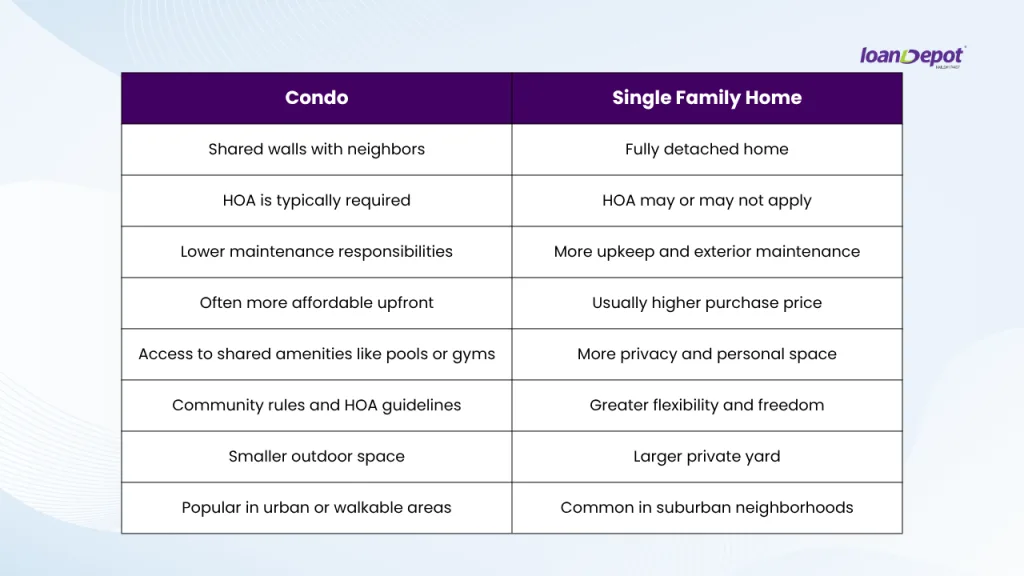
Why Buyers Choose Condos
- Lower maintenance lifestyle
- Convenient locations near shopping, dining, and entertainment
- Amenities like pools, fitness centers, or gated access
- Lower upfront costs in many markets
Why Buyers Choose Single Family Homes
- More privacy and living space
- Room for pets, outdoor entertaining, or future additions
- Fewer restrictions on renovations and customization
- More separation from neighbors
The better option comes down to how you want to live day to day, not just the price tag.
First-time buyers may also benefit from reviewing our Ultimate 2026 CalHFA Guide for First-Time Homebuyers.
Types of Condos
Condos come in several different styles, and each offers a unique living experience. Understanding how they differ can help you choose the right fit for your lifestyle, budget, and long term goals.
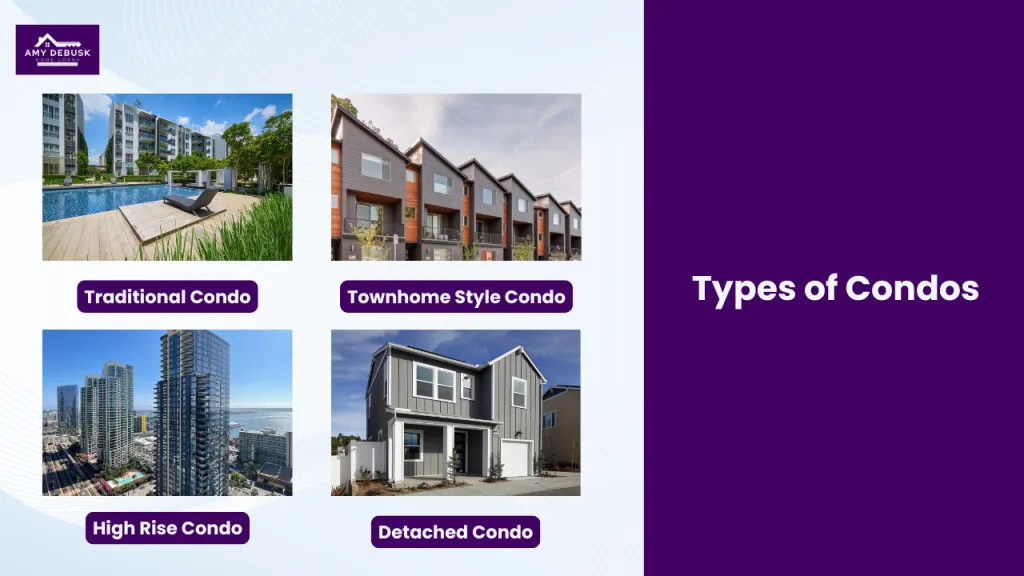
Traditional Condo
Typically found in condo communities or mid sized residential buildings, traditional condos share walls, hallways, and common spaces with neighboring units. Residents usually have access to amenities like pools, fitness centers, clubhouses, or secured entrances. Maintenance for exterior areas and shared spaces is handled through the HOA, making this a popular low maintenance option for busy homeowners.
Townhome Style Condo
Townhome style condos are designed to feel more like a traditional house. These units often feature multiple floors, attached garages, and private entrances. While owners may have more personal space and separation from neighbors, the property is still legally considered a condo and managed by an HOA. This option appeals to buyers who want a balance between condo convenience and single family home living.
High Rise Condo
High rise condos are located in taller residential buildings, most commonly in downtown or urban areas. These communities often offer upscale amenities such as rooftop lounges, concierge services, secure parking, fitness centers, and enhanced security features. High rise living is ideal for buyers looking for convenience, walkability, and a more city centered lifestyle.
Detached Condo
Detached condos look very similar to single family homes because they do not share walls with neighboring properties. However, they are still part of a condo association, meaning exterior maintenance, landscaping, or community amenities may be managed through the HOA. Buyers often choose detached condos when they want more privacy while still enjoying reduced maintenance responsibilities.
Choosing the Right Condo Style
The right condo type depends on what matters most to you. Some buyers prioritize convenience and amenities, while others want more privacy, space, or a home that feels closer to a traditional house. Understanding these differences can make your home search more focused and less overwhelming.
Understanding HOA Dues When Buying a Condo
HOA dues are one of the most important things to understand before buying a condo. These monthly dues are paid to the homeowners association and are used to help maintain, insure, and operate the community.
When comparing a condo to a single-family home, buyers should never look at the purchase price alone. HOA dues are included in your monthly housing payment for loan qualifying purposes, which means they can affect how much home you qualify for. A condo with a lower sales price but a high HOA payment may not always be more affordable than a single-family home.
At the same time, a higher HOA payment is not automatically a bad thing. What matters is what the HOA dues cover and whether the community is being managed well.
What Do HOA Dues Usually Cover?
Every condo community is different, but HOA dues may cover things such as:
- Exterior maintenance
- Landscaping
- Common area maintenance
- Trash collection
- Water and sewer
- Building insurance or portions of the HOA master insurance policy
- Pools, gyms, clubhouses, and shared amenities
- Security services
- Elevator maintenance
- Roof maintenance
- Gated access
- Reserve funds for future repairs
In some communities, the HOA dues may include valuable expenses that the homeowner would otherwise pay separately. For example, some HOA dues may include portions of insurance, water, trash, exterior maintenance, or amenities. This is why buyers should always ask what the HOA dues include before deciding whether the payment is reasonable.
How Much Are HOA Dues in California?
HOA dues in California can vary widely depending on the location, property type, amenities, insurance costs, and condition of the community. Some condo communities may have HOA dues under $300 per month, while luxury communities, high-rise buildings, or communities with extensive amenities may have HOA dues of $1,000 per month or more.
The amount matters, but the financial health of the HOA matters just as much. A low HOA payment may look attractive, but if the association is underfunded or not maintaining the property properly, it could lead to larger expenses later. A higher HOA payment may make sense if the community is well maintained, properly insured, and financially prepared for future repairs.
What Is a Special Assessment?
A special assessment is an extra fee charged by the HOA when the association does not have enough money available to cover a major expense or unexpected repair.
Special assessments may be used for things such as:
- Roof replacement
- Plumbing repairs
- Structural repairs
- Balcony repairs
- Elevator replacement
- Parking lot resurfacing
- Insurance increases
- Major common area improvements
- Building code repairs
Special assessments can be expensive, so buyers should ask whether there are any current or upcoming assessments before purchasing a condo. It is also important to review the HOA budget, reserves, meeting minutes, insurance coverage, and any known repair issues.
The bottom line is this: HOA dues are not just another monthly bill. They are part of the overall financial picture of condo ownership. Before buying a condo, make sure you understand what the HOA dues cover, how they affect your loan approval, whether the HOA is financially healthy, and whether the community fits your lifestyle and long-term goals.
All loans subject to approval. Equal Housing Lender.
What Lenders May Review in a Condo Project
When financing a condo, lenders may review:
- HOA financial reserves
- HOA budget
- Percentage of owner-occupied units
- Percentage of investor-owned units
- Pending lawsuits involving the HOA
- Insurance coverage for the building
- HOA delinquency rates
- Building condition
- Common area condition
- Special assessments
- Required repairs
- FHA, VA, Fannie Mae, or Freddie Mac project eligibility
If a condo community does not meet lending requirements, financing options may become limited, even if the buyer qualifies personally.
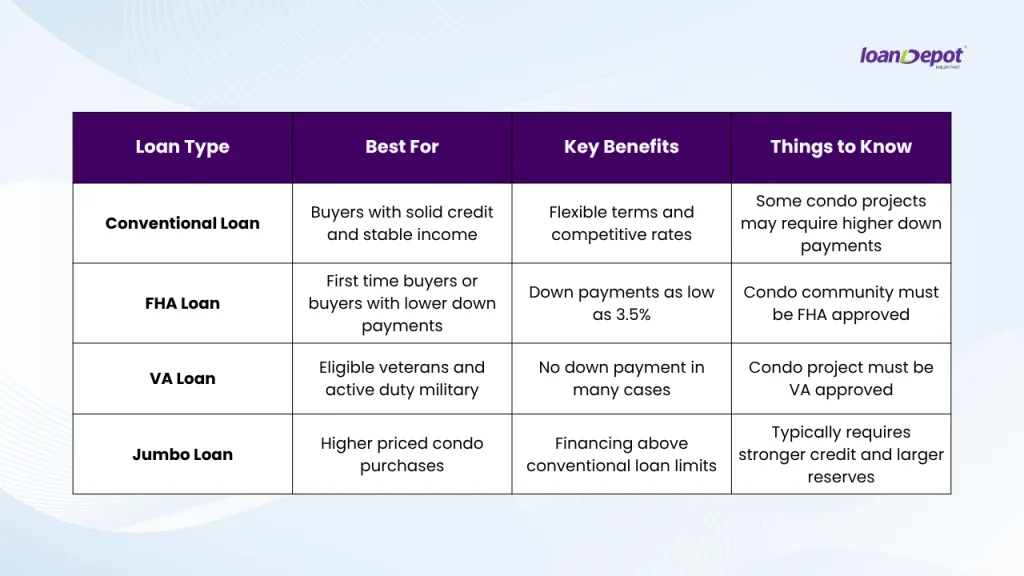
Why FHA, VA, and Conventional Condo Approval Matters
Some condo communities are already approved for FHA or VA financing, which can make the loan process smoother. For example, the veteran buyer in Chino was able to purchase their condo using a VA loan because the condo project was already VA approved.
For VA financing, the condo project generally needs to be VA approved. Your lender can help look up whether the project is currently approved.
For eligible veterans using a VA loan, the condo project generally needs to be VA approved. Your lender can help verify VA condo approval status through the official VA resources before you move too far into the purchase process: VA-approved condominium information.
For FHA financing, the condo project generally needs to be FHA approved. If the full condo project is not approved, an experienced FHA lender may be able to help with an FHA single-unit approval, sometimes called an FHA spot approval, for one specific condo unit.
For buyers considering FHA financing, you can search HUD's official database to see whether a condo project is currently listed as an FHA-approved condominium project: FHA-approved condo project lookup.
For Conventional financing, the condo project usually needs to meet Fannie Mae, Freddie Mac, and lender requirements. If it does not, it may be considered non-warrantable, which can limit financing options.
The bottom line is simple: when buying a condo, get fully pre-approved before shopping and have your lender review the condo project as early as possible. This can help you avoid falling in love with a property that may not qualify for the loan program you want to use.
Benefits of Buying a Condo With a VA Loan
For eligible veterans, active-duty service members, and qualifying surviving spouses, VA financing can be a powerful way to purchase a condo, as long as the condo project meets VA approval requirements.
Potential VA loan benefits may include:
- 0% down payment
- No monthly mortgage insurance
- Competitive interest rates
- Flexible credit guidelines
- Seller-paid closing costs
- Lower upfront cash needed to purchase
VA financing can be especially valuable when the buyer finds a condo project that is already VA approved. In the Chino transaction, the buyer was able to use their VA loan benefits to purchase a beautiful condo with resort-style amenities. The transaction also included seller credits that helped cover closing costs and contributed toward reducing the buyer's interest rate through a rate buydown.
This is why it is so important to work with a lender who understands VA condo financing. The lender can help verify whether the condo project is VA approved and help structure the financing in a way that supports the
Want to see how VA financing could work for you? Check out our VA Home Loan GPT.
Financing a Condo: Why the Condo Project Must Qualify Too
Financing a condo is different from financing a single-family home because the lender does not only review the buyer. The lender also reviews the condo project.
This process is often called a condo project review or condo certification. It helps the lender determine whether the condo community meets the requirements for the loan program being used.
When buying a single-family home, the lender typically reviews the buyer's income, credit, assets, debt, appraisal, and property condition. When buying a condo, the lender may also review the HOA, insurance, budget, reserves, owner-occupancy levels, pending litigation, delinquent HOA dues, building condition, and whether the project is approved for the loan program.
HUD Condos and Foreclosure Opportunities
Some condo buyers pursue HUD foreclosure properties because they may offer discounted pricing and built-in equity opportunities. A HUD home is a property that was previously financed with an FHA loan, went through foreclosure, and is now owned by the U.S. Department of Housing and Urban Development.
One recent example involved a single mom who purchased a lovely condo in Roseville, California. She was able to buy the condo for approximately $265,000, while similar units in the same community were selling for around $350,000. That means she purchased the property for more than $90,000 under nearby comparable sales.
This was a powerful opportunity because Roseville is a market where many homes are priced much higher, and this condo allowed her to become a homeowner in a desirable area using FHA financing with only 3.5% down. She was also able to receive a $7,000 seller credit, which helped reduce her out-of-pocket costs.
However, this process required patience. Because the property was a HUD foreclosure, the transaction came with additional steps, extra paperwork, and a much longer timeline than a typical purchase. In this case, it took approximately four months to fund the loan.
HUD foreclosure transactions can move differently than traditional home purchases. They may involve longer closing timelines, strict procedures, delayed responses, property condition concerns, HOA documentation issues, outstanding balances, utility concerns, or other items that must be cleared before closing.
For the right buyer, a HUD condo can be an incredible opportunity. But it is important to go into the process with realistic expectations. These transactions may require patience, persistence, and an experienced mortgage team that understands how to work through the details.
The Roseville buyer's story is a beautiful example of why condo ownership can be such a meaningful path to homeownership. She was able to purchase in a market that may have otherwise been difficult to access, use FHA financing with a low down payment, receive seller credit assistance, and begin building equity instead of continuing to rent.
Not sure how much help may be available for your down payment? Use our Down Payment Assistance GPT to learn about grants, assistance programs, eligibility guidelines, and homebuyer resources
All loans subject to approval. Equal Housing Lender.
Local California Condo Market Insights
California's condo market continues to attract buyers looking for more affordable alternatives to single family homes, especially in high demand regions where home prices remain elevated. Market conditions can vary significantly by area, but condos often provide an accessible path to homeownership with lower purchase prices, reduced maintenance, and desirable community amenities.
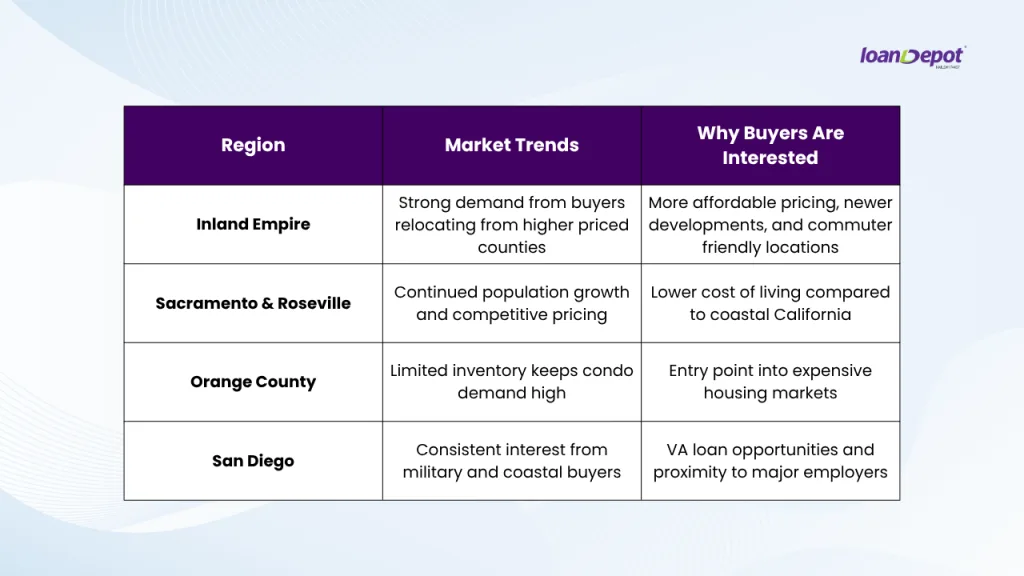
Inland Empire
Cities like Chino, Corona, Ontario, and Rancho Cucamonga continue attracting buyers who are being priced out of Orange County and Los Angeles. Many condo communities in these areas offer newer construction, modern amenities, attached garages, and community features at a lower price point than nearby coastal markets. The region remains especially attractive for first time buyers and commuters looking for more value.
Sacramento & Roseville
The Sacramento region continues seeing strong demand from buyers relocating from more expensive parts of California. Buyers are often drawn to the area because of lower housing costs, growing job opportunities, and newer suburban developments. Condo buyers may also find occasional HUD owned properties and foreclosure opportunities that can offer additional savings for qualified buyers willing to navigate a more competitive process.
Orange County
Orange County's condo market remains highly competitive due to limited housing inventory and the high cost of detached homes. For many buyers, condos provide one of the few affordable opportunities to own property in desirable areas close to beaches, employment centers, shopping, and entertainment. Communities with upgraded amenities and lower HOA fees tend to move quickly in this market.
San Diego
San Diego continues seeing steady condo demand, especially among military buyers, healthcare professionals, and coastal workers. Many eligible veterans and active duty service members use VA financing to purchase condos near military bases and major employment hubs. Walkability, lifestyle, and proximity to the coast remain major drivers of condo demand throughout the area.
Understanding local market conditions can help buyers identify opportunities, set realistic expectations, and choose a condo community that aligns with both their budget and lifestyle goals.
Final Thoughts
Buying a condo in California can be a wonderful opportunity for buyers who want to enter the housing market, reduce exterior maintenance responsibilities, enjoy community amenities, or use valuable financing options such as VA, FHA, or conventional loans.
A condo is not the right fit for every buyer, and it is not always the cheaper option once HOA dues, insurance, taxes, and financing requirements are considered. But when the full monthly payment works, the HOA is well managed, the condo project qualifies for financing, and the lifestyle fits your goals, condo ownership can be a smart and meaningful path into homeownership.
Whether you are looking for affordability, convenience, location, low-maintenance living, or long-term wealth-building potential, condos deserve serious consideration. With the right guidance, careful research, and a strong financing strategy, buying a condo can become a powerful stepping stone toward financial security, stability, and homeownership success.
If you are thinking about buying a condo in California, I would be happy to help you compare your options, review the financing, and understand whether a condo or single-family home is the best fit for your next step.
❓FAQs About Buying a Condo in California
Yes, buying a condo can be a good investment, especially when it helps you become a homeowner instead of continuing to rent. A condo can help you build equity, pay down principal, and benefit from potential appreciation over time.
However, condos do not always appreciate at the same pace as single-family homes. In some markets, condos may be slower to rise in value during a strong real estate market and may soften faster during a declining market. This does not mean a condo is a bad investment. It means buyers should understand the full picture, including the HOA, monthly dues, resale demand, location, project condition, and long-term lifestyle fit.
Not always. A condo may have a lower purchase price, but the HOA dues can significantly affect the total monthly payment. In some cases, a condo can be just as expensive, or even more expensive monthly, than a single-family home once HOA dues, taxes, insurance, and mortgage insurance are included.
The smartest way to compare a condo and a single-family home is to look at the full monthly payment, not just the sales price.
Not necessarily. Condos can sometimes be harder to qualify for because both the buyer and the condo project must qualify.
When buying a single-family home, the lender mainly reviews the borrower, the property, and the appraisal. When buying a condo, the lender also reviews the condo project, HOA, insurance, budget, project approval status, litigation, repairs, and other project details. This is why working with an experienced condo lender is so important.
HOA dues are counted as part of the borrower's monthly housing expense when determining loan qualification. This means HOA dues are included in the debt-to-income ratio.
For example, if a condo has a lower purchase price but a high monthly HOA payment, that HOA payment can reduce the buyer's qualifying power. This is why buyers should know the HOA amount early in the process before assuming a condo is more affordable.
Yes, condos can be purchased with VA, FHA, or conventional financing, but the condo project must meet the requirements for the loan program being used.
For a VA loan, the condo project generally needs to be VA approved. For an FHA loan, the condo project generally needs to be FHA approved, although an experienced FHA lender may be able to help with a single-unit approval for one specific condo unit. For a conventional loan, the condo project typically needs to meet Fannie Mae, Freddie Mac, and lender requirements.
A non-warrantable condo is a condo project that does not meet certain lending guidelines required for traditional conventional financing. This can happen because of building condition issues, HOA financial problems, pending litigation, inadequate insurance, too many investor-owned units, commercial space concerns, or major repairs that have not been completed.
This matters because even if the buyer qualifies personally, the lender may not be able to approve the loan if the condo project does not qualify.
A poorly managed HOA can create serious problems for condo owners and future buyers. Poor management can lead to deferred maintenance, higher HOA dues, special assessments, insurance problems, building condition issues, lower resale value, and financing challenges.
Before buying a condo, buyers should review the HOA budget, reserves, meeting minutes, insurance, rules, pending repairs, and any known issues affecting the project.
Buying a condo may be right for you if you want to own a home, prefer lower exterior maintenance, like community amenities, want a desirable location, or need a more affordable entry point into homeownership.
Buying a single-family home may be a better fit if you want more privacy, a yard, fewer shared rules, more control over the property, or more space.
The best choice is not just about condo vs. single-family home. It is about which property gives you the best combination of affordability, lifestyle, financing approval, and long-term wealth-building potential.
All loans subject to approval. Equal Housing Lender.
All Mortgage Made Easy articles · Book a Complimentary Discovery Call