
Chapter 3 of 12
What’s Keeping Homes Off the Market?
Explore mortgage lock-in, aging in place, institutional ownership, and the limits of proposed mobility reforms.
Jump to a page on the report 1-59 + 37A-37C
The online edition groups several PDF pages into each chapter. Select a page to open its place in the web edition. Pages 1 and 2 correspond to the cover and contents on the research home page. The revised PDF adds Chapter 7 pages 37A-37C while retaining the original page numbers.
When Homeowners Stay Put, Fewer Homes Come Up for Sale
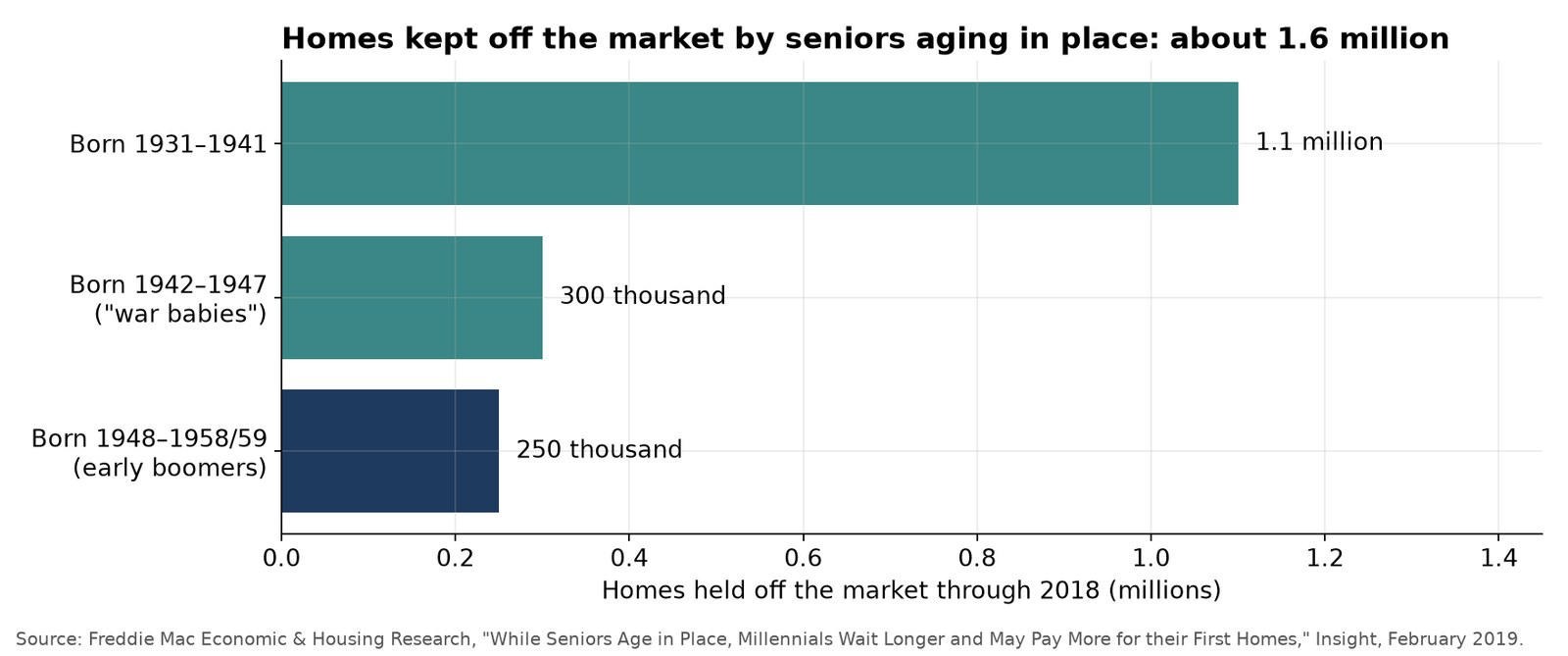
Older owners often remain in their homes longer than comparable earlier cohorts. Freddie Mac’s February 2019 study estimated that about 1.6 million more homes remained owner-occupied in 2018 than if three older cohorts had exited ownership like earlier generations. The counterfactual attributed roughly 1.1 million to people born in 1931 through 1941, 300,000 to the 1942-through-1947 cohort, and 250,000 to those born in 1948 through 1959. This is a historical model estimate, not a current count of vacant homes or properties withheld from sale. [35]
 Select the figure for a larger view
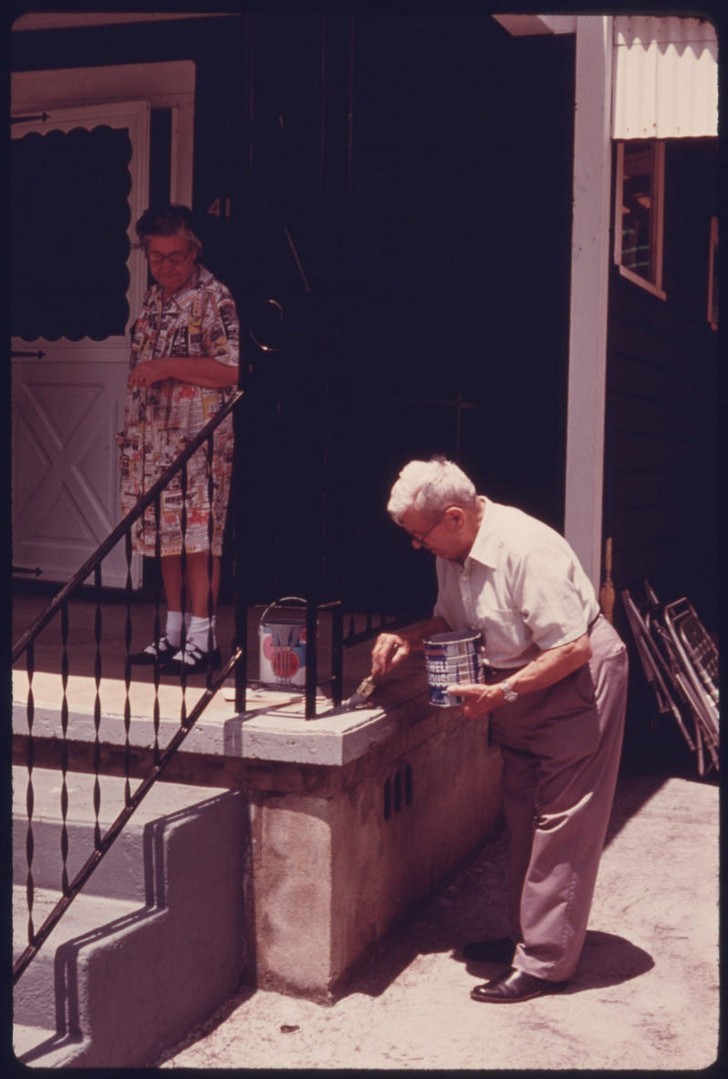
Figure 16. An older couple paints the porch of their house in Boomer, West Virginia, June 1975.
 Select the figure for a larger view
Figure 17. Freddie Mac estimated approximately 1.6 million additional homes retained by older owners through 2018 relative to a counterfactual based on earlier generations. Historical model estimate for 2018, not a current count of vacant homes. [35]
Remaining at home can reflect preference, community ties, a lack of suitable alternatives, taxes, care arrangements, or the cost of moving. A person who stays continues to consume housing. Encouraging an older owner to move is therefore not the same as creating another unit. It changes the distribution of available homes and can release an existing property for another household.
 Select the figure for a larger view
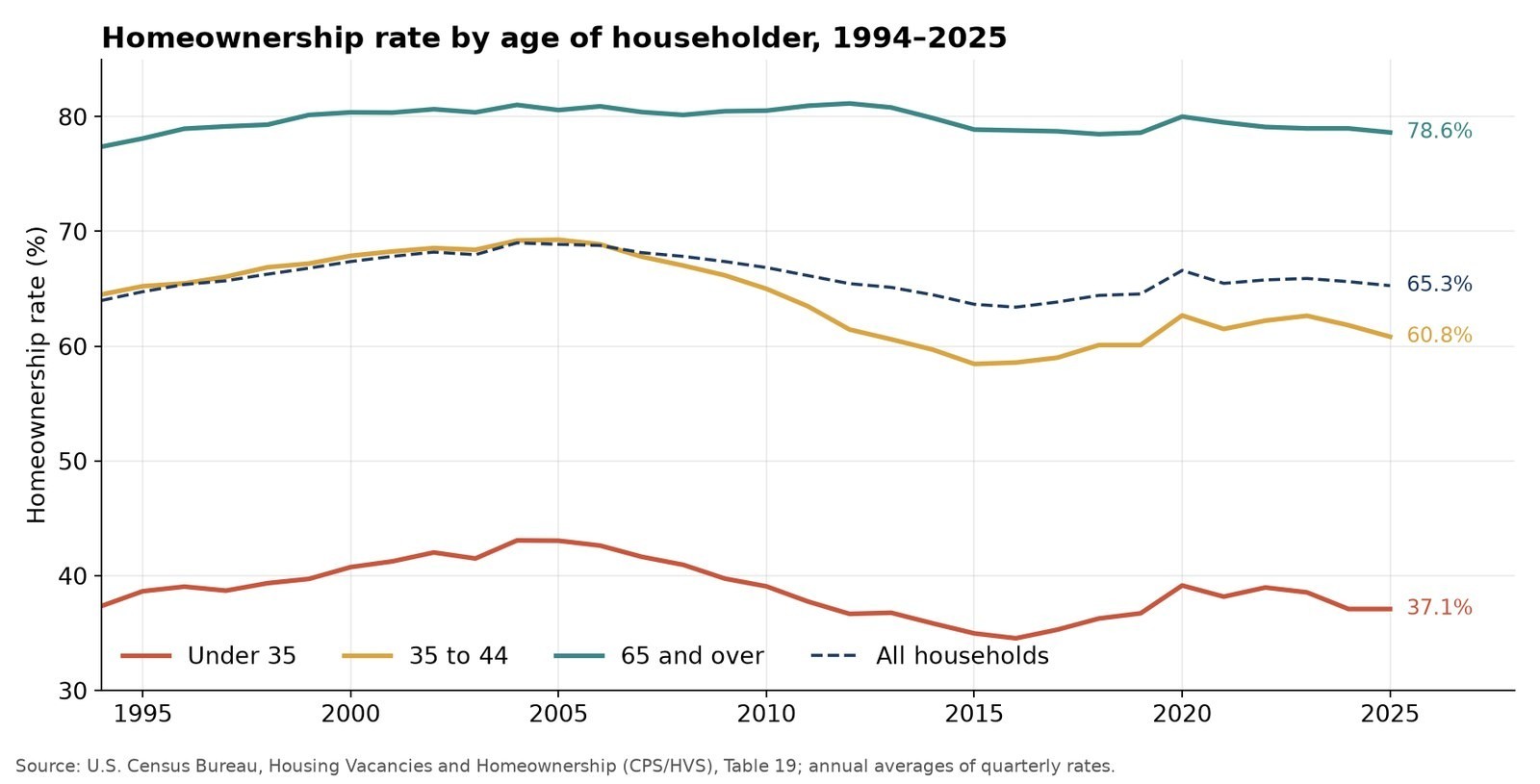
Figure 18. Homeownership by age of householder, 1994-2025. The source exhibit reports 2025 averages of 37.1% for under-35 householders and 78.6% for householders aged 65 and older. The 2025 endpoints are simple averages of quarterly rates. Q4 covers November-December only; the annual under-35 estimate is 37.0%, rather than the plotted 37.1%.
[64]
How California Property Taxes Shape Moving and Inheritance
Since April 1, 2021, Proposition 19 has allowed eligible owners age 55 or older, people with severe permanent disabilities, and qualifying wildfire or disaster victims to transfer a principal residence’s taxable value to a replacement principal residence anywhere in California, subject to timing and value rules. Age- and disability-based transfers are limited to three per person. Qualifying disaster transfers do not count toward that limit. Claims go to the replacement property’s county assessor. [36]
 Select the figure for a larger view
 Select the figure for a larger view
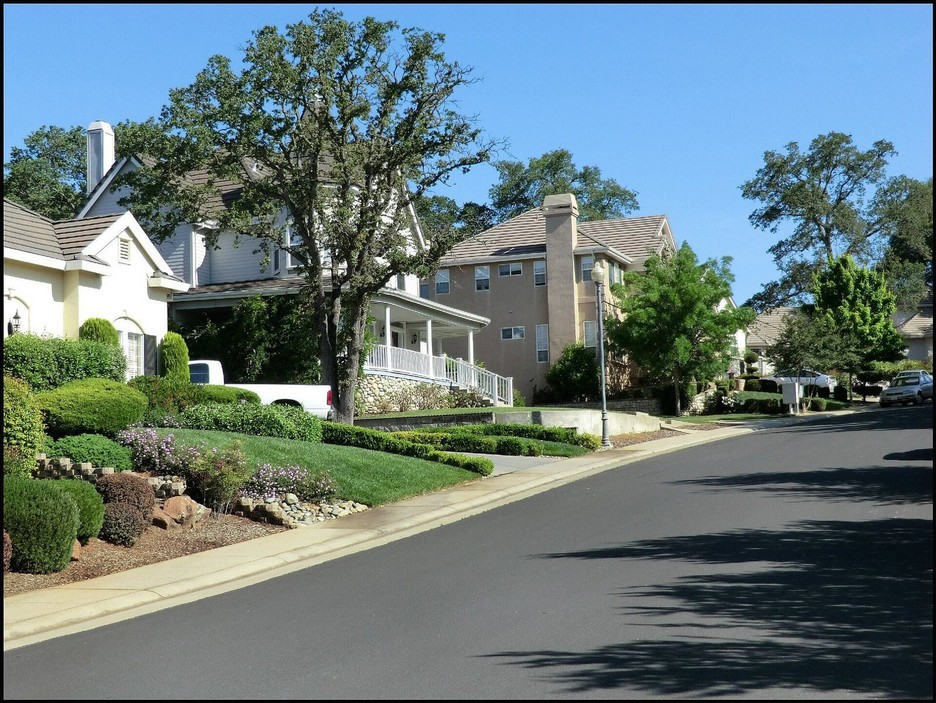
Figures 19 and 20. Left: Residences at Pilgrim Place, a senior community in Claremont, California, April 2023. Right: An established neighborhood in the Briggs Ranch area of Folsom, Sacramento County, May 2012.
The inheritance rules are different. For qualifying parent-child transfers from February 16, 2021, retaining the family home’s prior taxable value generally requires the child to use it as a principal residence and meet the filing requirements. The exclusion threshold for qualifying transfers from February 16, 2025 through February 15, 2027 is the prior taxable value plus $1,044,586. A market value above that threshold can produce a partial reassessment. These rules can affect whether a family keeps, occupies, rents, or sells an inherited home, but the evidence reviewed does not measure their net effect on listings. [37]
What It Costs to Leave a Low Mortgage Rate Behind
 Select the figure for a larger view
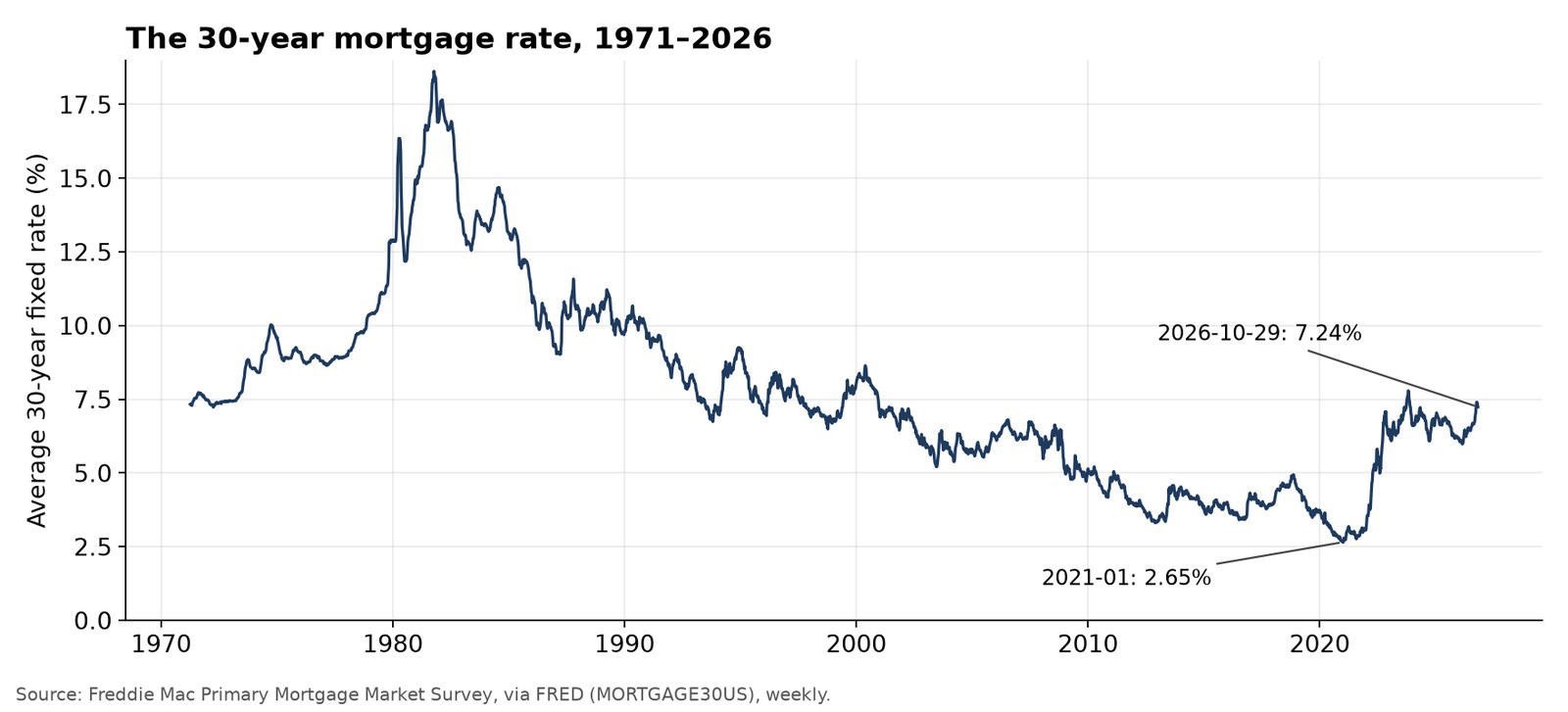
Figure 21. Freddie Mac 30-year fixed mortgage survey rate, 1971-October 29, 2026. The source exhibit marks 2.65% in January 2021 and 7.24% on October 29, 2026. Weekly Freddie Mac survey, not an individual loan quote. The endpoint is October 29, 2026. [38]
An owner with a low fixed-rate mortgage may face a large payment increase after moving, even when the replacement property is similar. That financial incentive to stay reduces the flow of resale listings. It interacts with underbuilding by limiting access to homes that already exist.
The revised August 2024 FHFA study estimates that each percentage-point gap between prevailing and existing mortgage rates reduced the probability of sale by 18.1%. It attributes approximately 1.72 million prevented sales from the second quarter of 2022 through the second quarter of 2024 to lock-in and estimates a 7% house-price effect from the resulting supply restriction. Those are historical model estimates, not a count of missing housing units or a current forecast. [2]
Freddie Mac’s weekly 30-year fixed rate was 2.65% in January 2021 and 7.24% on October 29, 2026. For a $300,000 loan over 30 years, principal and interest are about $1,265 at 3% and $2,047 at 7.25%. The roughly $782 monthly difference helps explain why an owner may rationally stay even when a home no longer fits. These payments exclude taxes, insurance, and other ownership costs.
[38]
Life events still cause households to move, and the importance of lock-in changes with rates, prices, equity, and time. Policies that increase mobility can help the resale channel. They can also release purchasing demand from the same owners, so additional listings do not translate one-for-one into a net improvement for first-time buyers.
 Select the figure for a larger view
Figure 22. Townhouses under construction in San Jose, June 2010.
Could You Take Your Low Rate to a New Home?
Mortgage-rate portability could reduce the financial penalty for moving, but it cannot be treated as an immediate, cost-free change to existing mortgages. A workable proposal must identify who controls the loan, how its collateral changes, how investors are treated, and who finances the benefit. The federal proposal most directly addressing this idea is a feasibility-study bill, not an enacted entitlement to retain a low rate.
What the Proposed Federal Bills Would Do
Representative Tom Barrett introduced H.R. 7754, the Take Your Rate Act of 2026, on March 3, 2026. It would direct HUD and FHFA to study portability for federally backed residential mortgages, including loans purchased or securitized by Fannie Mae and Freddie Mac. Required subjects include operational feasibility, housing-market effects, federal costs, financial soundness, necessary legal changes, and whether a limited demonstration would be worthwhile. The report would be due 180 days after enactment, not introduction. The bill expressly requests alternatives if portability proves infeasible. As of November 5, 2026, the official status record lists referral to House Financial Services as its latest action. It has not become law and does not itself establish a portability program. [3, 39]
A related but different proposal is Representative Pat Ryan’s H.R. 892, the Mortgage Rate Reduction Act, introduced January 31, 2025. It would facilitate assumptions through specified FHA and VA second-lien statutory changes, express support for second mortgages in FHA, USDA, and VA programs, and require publication of addresses and origination dates for specified federally supported loans. Its latest recorded action is referral to the Veterans’ Affairs Subcommittee on Economic Opportunity on March 5, 2025. It also remains proposed legislation. Its central mechanism helps a buyer take over financing on the same property; it does not let a seller carry that financing to another house. [40, 41]
Where Your Mortgage Goes After Closing
 Select the figure for a larger view
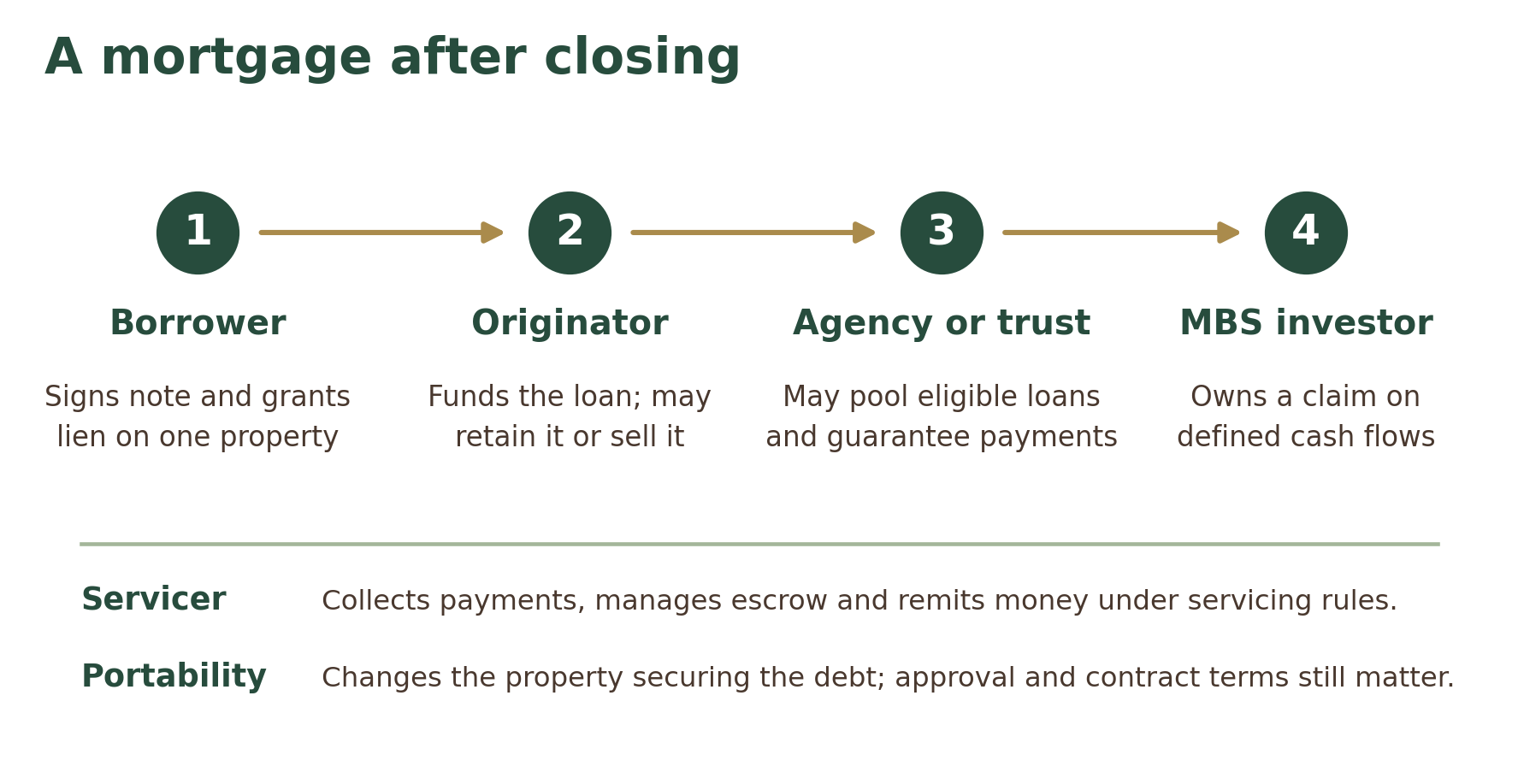
Figure 23. The agency mortgage pathway after closing. Loans may instead remain in portfolio or enter private-label securities. Servicing rights, ownership and guarantees are distinct.
At closing, the borrower signs a promissory note, which establishes the debt and repayment terms, and a mortgage or deed of trust, which secures that obligation against identified real estate. The interest rate belongs to this contractual loan arrangement. It is not a separate credit that the borrower can automatically attach to any future purchase. Releasing the original house and securing the debt against a replacement house requires legal documentation and a valid replacement lien. [42]
The originating lender supplies the loan funds but may later sell the loan. The servicer collects payments, manages escrow, and administers the account; the company appearing on the monthly statement need not own the debt. A lender can retain loans in its own portfolio, but a securitized loan operates within additional contractual arrangements. Keeping the same servicer therefore does not establish that the servicer can approve a collateral exchange. [43, 44]
In the agency securities market, mortgages support mortgage-backed securities, or MBS. For example, Fannie Mae holds pooled loans as trustee for trusts whose investors own beneficial interests. Borrower payments support distributions to those investors, while servicing and guaranty arrangements allocate administration, fees, and payment responsibilities. A security may have many investors, but each does not separately administer the homeowner’s loan. The governing contracts define the authority of the servicer, trustee, and guarantor. [45, 44]
The institutions should not be conflated. Fannie Mae and Freddie Mac purchase or securitize qualifying mortgages. Ginnie Mae guarantees timely principal and interest on eligible securities issued by approved private institutions and backed by federally insured or guaranteed loans. The loan-level insurance or guaranty and the security-level guaranty perform different functions.
Neither arrangement makes the old interest rate an unrestricted government benefit that follows the borrower. [3, 46]
Why Changing Existing Mortgages Is Complicated
First, the current house is the collateral. A replacement could have different value, title defects, insurance costs, disaster exposure, or occupancy characteristics. Any responsible program would need replacement-property eligibility and valuation standards, lien-priority protection, updated insurance arrangements, and rules for subordinate financing. Maintaining the same borrower and note rate does not establish equivalent credit protection.
Second, an ordinary sale commonly ends the existing financing. Fannie Mae’s December 2025 prospectus explains that applicable due-on-sale provisions are generally enforced, or the loan is purchased from the pool, subject to legal and contractual exceptions. Those events return principal to security holders. Portability would instead seek to keep the low-rate obligation alive while replacing its collateral. Existing exceptions for protected ownership transfers or permitted assumptions do not create a general right to move the loan to an unrelated property. [45, 47]
Third, the servicer has limited authority. Fannie Mae’s servicing guide restricts changes to MBS loan terms, repurchases, and releases of collateral. It also states that servicing agreements cannot expand authority beyond the trust documents. The prospectus separately says that another mortgage loan cannot simply be substituted for a withdrawn loan. Paying off one mortgage and inserting a new low-rate mortgage into its old pool is therefore not an ordinary administrative transaction. These are concrete contractual obstacles, rather than a claim that every bondholder must individually approve every change. [44, 47]
The restrictions are substantial, but not absolute. Fannie Mae’s trust agreement permits certain modifications that are not significant for tax purposes, subject to the servicing contract. Treasury’s REMIC regulation expressly allows qualifying collateral substitutions when the obligation remains principally secured by real property under the prescribed tests. Thus, neither “securitized mortgages can never change” nor “REMIC law prohibits every property substitution” is accurate. Any program must establish the applicable authority and conditions for the particular loans and securities involved. Tax permissibility alone does not grant borrowers portability or override servicing restrictions. [45, 48]
Who Would Pay to Make a Mortgage Portable?
MBS investors price both interest payments and the timing of principal repayment. Borrowers may repay early through refinancing, sales, or other events. When rates rise, refinancing generally slows and low-rate loans can remain outstanding longer. Investors already bear this prepayment and interest-rate uncertainty; they are not promised that every mortgage will repay on a particular sale date. Nevertheless, changing the contractual treatment of sales can change expected cash flows and security values. [47, 49]
The economic concern is that portability could remove a source of repayment precisely when investors would prefer their principal returned for reinvestment at higher yields. Borrowers would tend to preserve attractive below-market financing while retaining whatever refinancing rights the product allows. That option has value. For existing loans, allocating its cost requires more than observing that the borrower continues making the original monthly payment. A payment guaranty does not eliminate the opportunity cost of receiving below-market interest for longer. This is an economic implication of the cash-flow structure, not a finding that portability must destabilize the entire MBS market. [49]
An illustrative calculation shows the funding issue. A $300,000 balance amortizing over 25 remaining years at 3% requires approximately $1,423 monthly principal and interest. Discounting those scheduled payments at an assumed 6.5% annual rate, compounded monthly, produces a value of approximately $210,696. These assumptions exclude prepayment, default, servicing, and guaranty fees; this is not an MBS market quote. Nor is the roughly $89,304 difference an estimate of the incremental loss caused by portability: an existing low-rate loan may already trade below principal. It illustrates why paying off investors at $300,000 and funding a replacement 3% obligation creates an economic gap someone must absorb.
A Workable Pilot Needs Funding and Clear Rules
Prospective portability could be written into new loan contracts and disclosed to investors before purchase. Lenders and investors could price the option, restrict replacement collateral, preserve the remaining term and balance, and charge separately for additional borrowing. A portfolio lender may have fewer securitization constraints, although funding costs and credit risk remain. These are possible product designs, not benefits already established by H.R. 7754.
An authorized exchange or subsidized replacement loan could discharge the existing mortgage and provide new financing with a comparable borrower payment. That approach must identify authority for any pool removal and a source of funding for the low-rate replacement. Borrower fees, lender concessions, guarantor resources, or appropriated public funds would have different distributional consequences. Any public subsidy should be estimated transparently rather than described as simply allowing owners to keep something the lender can provide at no cost.
Assumability remains a separate option: the buyer takes responsibility for the existing loan on the same house. Approval and release-of-liability rules still apply. The equity gap also remains. A $450,000 sale with a $275,000 assumable balance requires another $175,000 before closing costs, from cash or permissible additional financing. H.R. 892 addresses this financing problem rather than property portability. [40, 50]
Finally, better mobility is not equivalent to new housing supply. Research supports mortgage lock-in as an impediment to sales, but a moving homeowner often becomes a buyer elsewhere. Portability could improve matching and release particular homes without adding dwellings or guaranteeing lower prices. Its benefits also initially favor owners who already secured low rates.
[2] The defensible conclusion is that universal, immediate portability cannot simply be imposed through routine servicing under today’s contracts. Carefully designed products or funded pilots deserve evaluation, but they complement rather than replace construction and measures expanding first-time-buyer access.
Where Large Investors Fit Into the Housing Picture
 Select the figure for a larger view
Figure 24. Suburbs outside Phoenix seen from an arriving flight, March 2015.
 Select the figure for a larger view
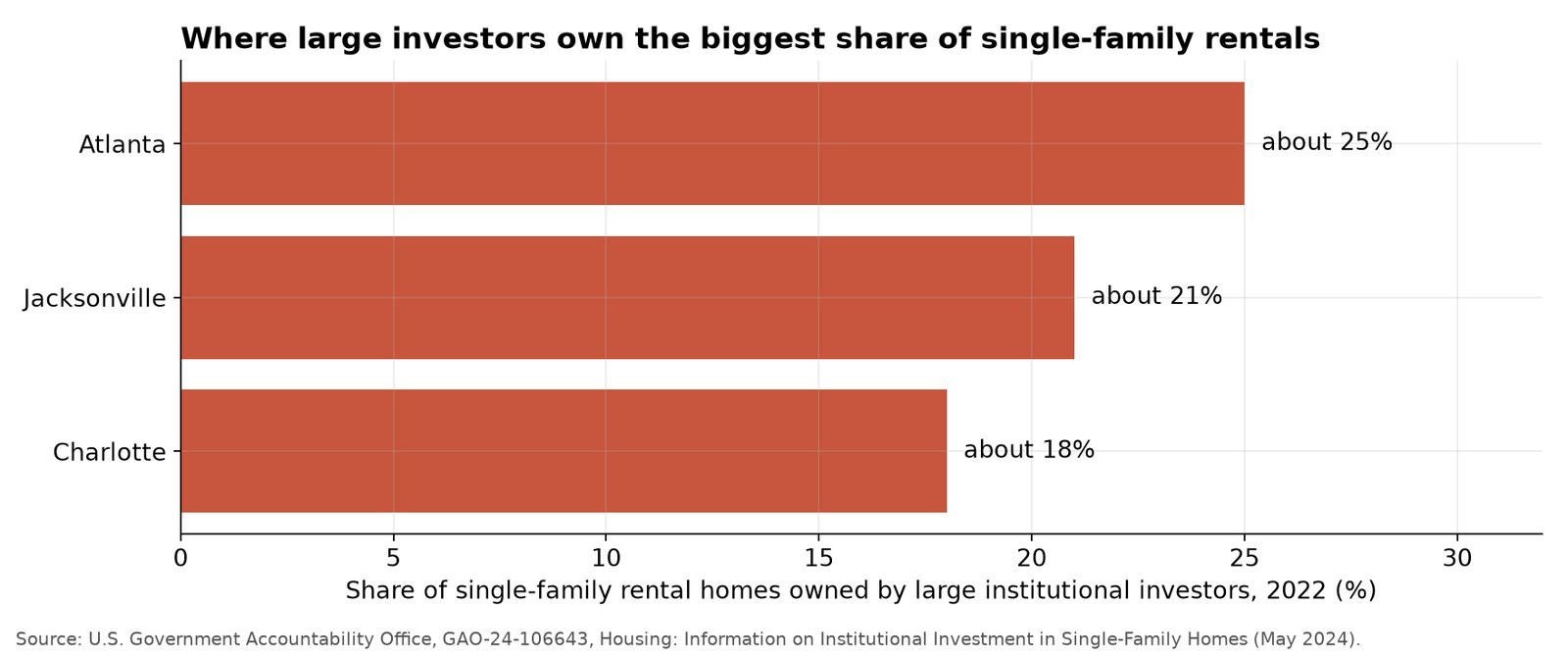
Figure 25. Institutional investors held about 25% of single-family rentals in Atlanta, 21% in Jacksonville, and 18% in Charlotte in the 2022 estimates summarized by GAO. Shares of single-family rentals, not all homes. The 2022 exhibit and the 2026 GAO study use different samples and definitions. [88, 1]
Large investors did not buy most American homes. Their concentration in particular neighborhoods and price ranges nevertheless makes the local resale channel important. A property held as a long-term rental remains housing, but it is unavailable for owner-occupant purchase until sold.
New GAO research published in March 2026 examined institutional investor activity in six selected metropolitan areas. Within that sample, institutional investors held about 4% to 22% of single-family rental homes and less than 1% to 3% of all single-family homes. Annual dispositions never exceeded 8% of their holdings during the study period. These findings support a narrower claim than national market domination: holdings can remain outside the purchase market for substantial periods where investors are concentrated. The six areas are not a nationally representative sample. [1]
Gross acquisition counts cannot measure the effect on ownership access. Purchases, sales, new construction, property condition, rent levels, and neighborhood characteristics all matter. Build-to-rent developments can add supply even when they add no ownership opportunities. Purchases of existing entry-level homes can change the tenure of the stock without adding a unit. These activities should be evaluated separately.
The available evidence does not establish the causal reduction in starter-home turnover in Sacramento or Placer County. A national or selected-market finding cannot supply that local estimate. The policy implication is to monitor ownership and disposition patterns alongside construction, rather than substitute an investor narrative for the broader supply analysis.
Could Investor-Owned Homes Create More Paths to Ownership?
Federal proposals to reduce institutional ownership offer another way to reopen the resale market to households. Their potential contribution is greater access to existing homes, especially where large owners hold entry-level properties. Selling an occupied rental changes its ownership and possibly its tenure; it does not, by itself, add a dwelling. A sound policy therefore needs to expand purchase opportunities while protecting residents who cannot buy. The legislative distinction is also essential: as of November 5, 2026, mandatory portfolio divestiture remains proposed, while a different federal acquisition restriction has become law but is not yet effective. [4, 51, 5, 52]
A Proposal to Phase Out Large Investor Portfolios
Representative Anna Paulina Luna introduced H.R. 7221, the Stopping Wall Street From Competing With Main Street Homebuyers Act, on January 22, 2026. Its latest official action remains referral to the House Financial Services Committee. The introduced text would prohibit covered funds from purchasing single-family homes beginning 90 days after enactment, require annual divestiture of at least 10% of the single-family homes held at enactment, and prohibit continued holdings, including through a parent or subsidiary, after ten years. The annual percentage refers to the original holdings, rather than a declining balance that never reaches zero. [4, 51]
Coverage is narrower than “all corporations.” The bill applies to registered investment companies, real estate investment trusts, and private funds with more than $500 million in assets under management, or that, during the year before enactment, owned at least 100 U.S. single-family homes or purchased more than five within a 30-day period. Its housing definition includes a residential structure or mobile home containing one family housing unit. The short introduced bill contains no express build-to-rent exemption, tenant purchase priority, affordable resale price requirement, or relocation assistance. Those protections should not be attributed to it. Its sale mandate would operate through amendments to the Investment Company Act, not through the per-home excise taxes proposed in other bills. [4, 51]
Using Tax Rules to Encourage Sales
The End Hedge Fund Control of American Homes Act, S. 3402 and H.R. 6608, was introduced on December 5, 2023. Both measures remained at committee referral and expired with the 118th Congress without becoming law. They should be identified as historical proposals, not current requirements. Their mechanism used acquisition and excess-holdings taxes to induce sales. [53, 54, 55]
In the 119th Congress, the related HOPE for Homeownership measures, H.R. 1745 and S. 788, were introduced on February 27, 2025. They remain referred to House Ways and Means and Senate Finance, respectively. Their introduced texts would tax covered hedge-fund acquisitions at the greater of 15% of purchase price or $10,000, and impose an annual $5,000 tax per residence above the applicable declining holding limit. For hedge-fund taxpayers, the limit falls from 90% of baseline holdings in the first full taxable year after the statutory baseline date to zero in taxable years beginning more than nine years after that date; other applicable taxpayers retain a 50-home allowance in the schedule. This is a tax-backed phase-down, not H.R. 7221’s direct prohibition. [56, 57, 58, 59]
HOPE generally covers partnerships, corporations, and REITs that manage pooled investor funds and act as fiduciaries. Its hedge-fund category starts at $50 million in net value or assets under management, and its housing definition covers one-to-four-unit properties. It excludes qualifying charitable organizations and businesses primarily constructing or rehabilitating homes for ordinary-course sale, with additional property exceptions. Selling to a business entity or someone who already owns another single-family residence would not count as a qualifying reduction. That rule favors buyers without another home, but it does not guarantee that an incumbent tenant receives the property. [56, 57, 58, 59]
A newer proposal, Representative Adam Smith’s Protecting American Homes from Hedge Funds Act, H.R. 9657, was introduced July 13, 2026 and remains referred to Ways and Means and Financial Services. It proposes a 50% acquisition tax and a $50,000 annual tax per excess residence, subject to its allowances and ten-year phase-down schedule. It covers fiduciary managers of pooled investor funds, while excluding organizations primarily constructing or rehabilitating homes and certain properties, including residences constructed, acquired, or operated with federal appropriations. These exemptions differ from HOPE. Its buyer-certification rules support the exclusion of sales to businesses and existing homeowners. It also directs tax receipts toward state housing-finance-agency assistance for down payments, closing costs, and rate buydowns for households at or below 120% of area median income, prioritizing purchases from covered taxpayers. Spending would depend on appropriations. These provisions strengthen the ownership-access link, but enactment and actual sales remain uncertain. [60, 61]
What the Enacted Law Does, and Doesn’t, Require
H.R. 6644 became the 21st Century ROAD to Housing Act, Public Law 119-101, on July 11, 2026. Section 1001 generally restricts acquisitions by for-profit entities with direct or indirect investment control of at least 350 single-family homes, with aggregation and exceptions. Its purchase prohibition and enforcement provisions take effect January 7, 2027. Treasury’s October 23, 2026 implementing notice is a proposed rule, not a final regulation. [5, 52, 62]
Crucially, the enacted statute expressly disclaims any requirement to sell homes purchased before enactment. It also permits specified purchases, including build-to-rent and qualifying rehabilitation programs, certain homeownership programs, and qualifying transfers between institutional investors. Its definition generally includes structures with one or two dwelling units but excludes manufactured homes. Thus it neither implements a nationwide 10% annual portfolio reduction nor guarantees that institutional sales will reach owner-occupants. One homeownership-program exception requires a right of first refusal and a 30-day first-look period; this is not a universal right for every tenant. The law also establishes renter outreach and ownership reporting. [5, 52]
What These Proposals Could Mean for Sacramento
Sacramento deserves specific analysis because institutional ownership is demonstrably present, but its scale must be measured correctly. Invitation Homes’ filing for the quarter ended September 30, 2026 reports 3,805 wholly owned homes in its Northern California market, which includes Sacramento-Roseville-Folsom alongside several other metropolitan areas. That number is neither a Sacramento count nor the total holdings of all institutional owners. The six markets in GAO’s 2026 ownership study exclude Sacramento, and its results are expressly nongeneralizable. Neither source supports assigning Sacramento another city’s investor share or predicting a local price reduction. [63, 1]
The plausible benefit is straightforward: sales of existing investor-held starter homes to households could expand listings, while accompanying acquisition restrictions could reduce competition from covered purchasers. Benefits would depend on which properties are released, their condition and price, the buyers’ financing, and whether sales substitute for transactions that would have occurred anyway. A national divestiture percentage would not ensure an equal percentage of sales in Sacramento, or concentration in the neighborhoods with the greatest unmet demand.
The rental consequences require equal attention. Conversion to owner occupancy reduces the rental stock. If renters become homeowners, rental demand falls too; otherwise, replacement rentals may be needed. Residents unable to qualify for a mortgage could face disruption or displacement even when a sale benefits another household. Tenant notice, enforceable lease protections, purchase counseling, workable purchase priority, and relocation support should accompany any local implementation strategy. These are policy recommendations, not promises contained in every federal bill.
Implementation would also require identifying affiliated owners, tracking baseline portfolios and qualifying buyers, resolving exemptions, and covering inspection, repair, transaction, and enforcement costs. Sacramento should evaluate additional owner-occupied purchases, tenant outcomes, rents, and new construction together. Portfolio divestiture could be a useful complement to construction and mortgage-access reforms, but its success should be judged by additional sustainable homeownership and housing stability, rather than by the number of institutional properties sold alone.
An Empty Home Isn’t Always a Home You Can Buy
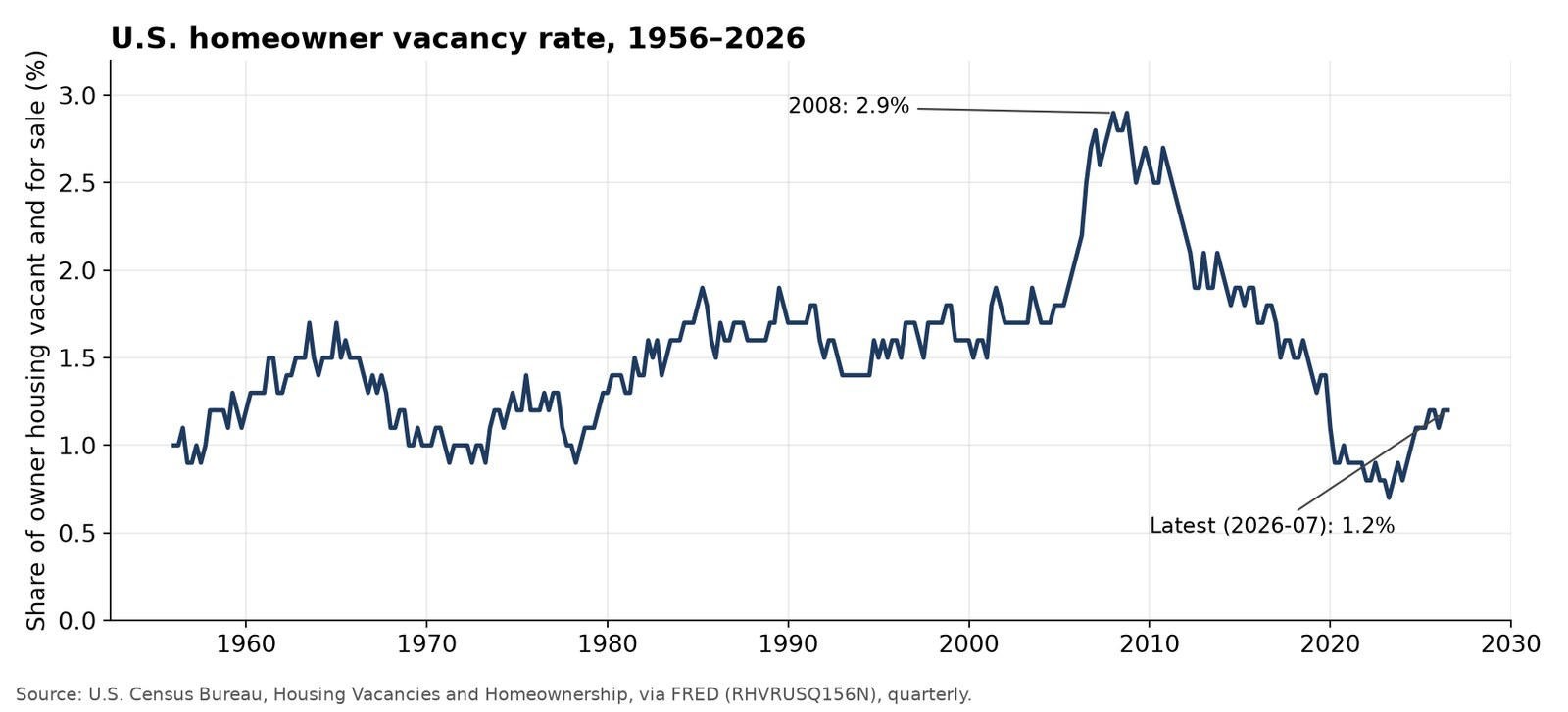
The homeowner vacancy rate is vacant for-sale housing divided by the sum of owner-occupied and vacant-for-sale units. It is not the share of occupied homes that are empty. The Census series reached 2.9% in early 2008 and 0.7% in the second quarter of 2023; it stood at 1.2% in the third quarter of 2026. A low rate indicates limited slack in the ownership stock, but it does not count every listing or establish whether a home is affordable. [64]
 Select the figure for a larger view
Figure 26. U.S. homeowner vacancy rate, 1956-2026. The source exhibit shows 2.9% in early 2008, 0.7% in 2023Q2, and 1.2% in 2026Q3. The denominator is owner-occupied plus vacant-for-sale housing units, not occupied homes alone. [64]
Prefer the original layout? Open this section in the PDF →