
Chapter 5 of 12
Can You Afford the Payment and Still Enjoy Your Life?
Connect mortgage costs to the expenses, reserves, and choices that shape everyday life.
Jump to a page on the report 1-59 + 37A-37C
The online edition groups several PDF pages into each chapter. Select a page to open its place in the web edition. Pages 1 and 2 correspond to the cover and contents on the research home page. The revised PDF adds Chapter 7 pages 37A-37C while retaining the original page numbers.
What a Rate Change Means for Your Monthly Payment
Mortgage qualification depends on more than principal and interest. Property taxes, insurance, mortgage insurance, association dues, and other debt all affect the payment ratios. Employment documentation, reserves, credit, property eligibility, and subordinate financing can also change the outcome.
 Select the figure for a larger view
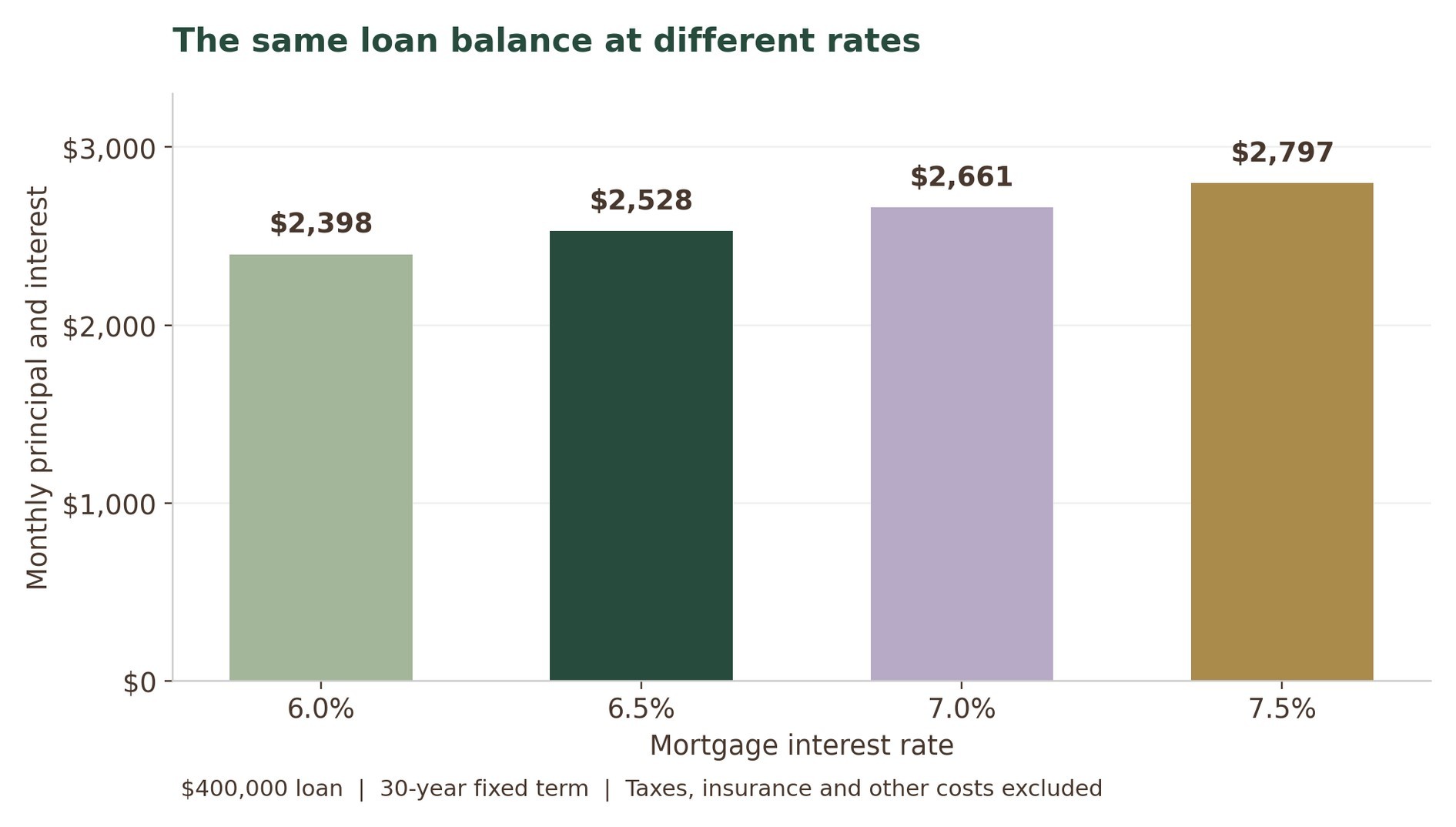
Figure 28. Monthly principal and interest on the same $400,000 mortgage at different fixed rates. Author calculations using a 30-year amortization schedule.
The Monthly Loan Payment on a $400,000 Mortgage
| Rate | Monthly payment | Change from 6.5% |
|---|---|---|
| 6.00% | $2,398 | $-130 |
| 6.50% | $2,528 | $+0 |
| 7.00% | $2,661 | $+133 |
| 7.50% | $2,797 | $+269 |
30-year fully amortizing fixed loan. Excludes taxes, insurance, mortgage insurance, HOA dues, fees and early payoff.
A half-percentage-point change from 6.5% to 7.0% raises monthly principal and interest on a $400,000 loan by approximately $133. That calculation measures sensitivity. It does not identify which policy, economic release, or market force caused a rate change.
An underwriting ratio is an eligibility screen, not a household comfort guarantee. Childcare, transportation, medical expenses, variable earnings, and support for relatives can make an approved payment difficult to sustain. A household budget should retain room for those obligations and for property repairs.
What You Can Qualify For and What You Can Comfortably Afford
At a fixed income and ratio limit, a larger down payment or deferred subsidy can reduce the first mortgage and make a purchase feasible. It does not necessarily pay the buyer’s required contribution, closing costs, or reserves. A temporary buydown can reduce early payments without improving the permanent obligation or the qualifying payment under the applicable rules.
A permanent buydown and principal reduction use public funds differently. Principal reduction lowers debt directly. A permanent buydown lowers the payment through the loan rate but may deliver less value if the borrower refinances or sells quickly. The appropriate comparison includes the subsidy cost, expected loan life, qualification result, and remaining household equity.
The county examples below illustrate a further problem: a program can permit a sale price that its target household cannot finance. A price ceiling protects a funding program from financing excessively expensive homes. It is not a promise that a household at the income limit can afford every property under that ceiling.
Know the Costs Before You Get the Keys
Useful homebuyer education explains amortization, leverage, total monthly costs, emergency reserves, insurance exposure, inspection findings, and exit costs. It also explains how to read a Loan Estimate, compare rate-and-point combinations, and recognize that program eligibility is conditional.
The educational objective is an informed, sustainable decision. A household may reasonably choose to rent while building savings, preserving mobility, or avoiding concentrated risk. Another may value the stability and control that ownership offers despite a modest expected financial advantage. Education serves both households when it makes assumptions and tradeoffs understandable.
Prefer the original layout? Open this section in the PDF →